
Spotted in St Mary’s Episcopal Church, Port Glasgow. From the Epiphany Chapel.
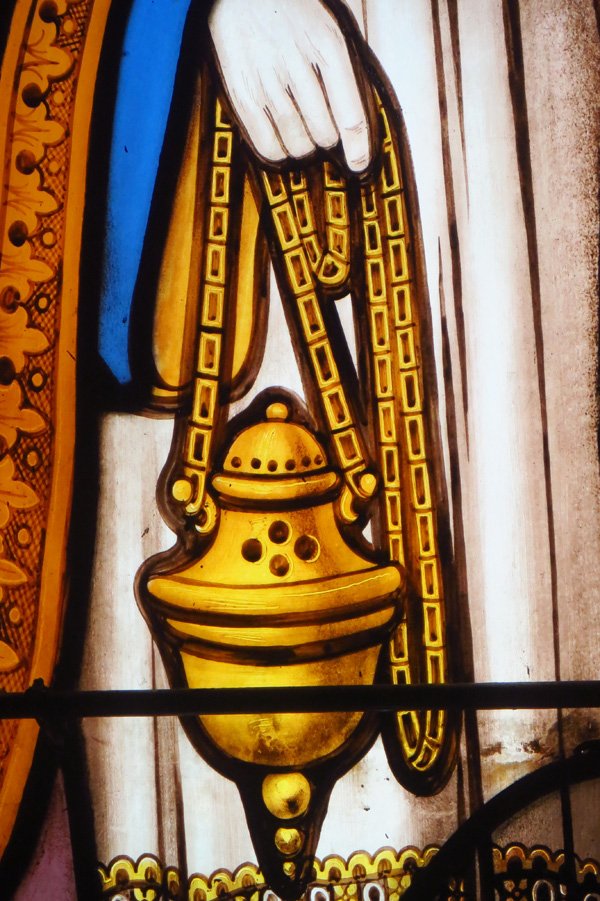
Spotted in St Mary’s Episcopal Church, Port Glasgow. From the Epiphany Chapel.

Kelvin, I follow your blog and I often find your conversations on facebook a lot of fun. But often, too, I don’t really understand what you are saying – such as your last paragraph there; ‘Like love. Like compassion. Like truth. Like hope. Like justice. Like joy. Like peace. Like the Way. Like the very essence of life itself.’ It sounds wonderful but what does it actually mean? Are you saying that the word, ‘God’ is a synonym for other worthwhile words which already have meanings I do understand?

What a good question.
No, I’m not saying that, or at least not quite. I would say that we can’t describe what God is like in language, but one of the closest ways we can come near to talking about God is to talk by analogy – to talk about what God is like.
The bible is full of times when people use analogy and metaphor to describe the reality of God which we can never completely comprehend.
In this sermon I’m saying that whilst God may be like a king, God is also like a lot of things that one doesn’t immediately associate with kingship and monarchy. That string of words that you picked out in the sermon are all ways that the bible uses to speak of God. I was using them to do the same.
Does any metaphor contain or enclose or sum up what we can say or know of God. The answer is always no.

I loved your sermon. And have subscribed to your blog.
No, I have not met the Queen, but I have met the King! And continue to get to know Him more and more every day. His love, peace joy, truth, etc.
Our priest in North Carolina, said on Sunday, that
it was hard to tell the difference between sheep and goats.
Since you live in Scotland, you see a lot of sheep and goats….why did Jesus picked those animals?
Thanks for your comments, Joy.
Actually, I don’t see that many sheep and goats in Great Western Road in the middle of Glasgow. I do see sheep when I drive in the countryside but very rarely goats.
I think that it is the case that in the Middle East, sheep and goats are pastured together and do sometimes need sorting out. Here in Scotland, sheep and goats (especially wild goats) look very different. However I think in the Middle East, that’s less true.
Kelvin, I’ve only just found your reply! Thanks so much for bothering. I really mean it. I thought you must have just ignored it. Yes, I see what you are saying but… I would say that all those meaningful words in the Bible about what God is like only make sense in the context of understanding who God is. ( i.e. that He came into being as the personification of the worldview of the marginalised Hebrew people, later taken up by Jesus, just as all of the other communities of the ancient Near East had gods representing their worldviews. I study with this bloke here http://www.bibleincartoons.co.uk. ) What I am trying – !! – to say is that God obviously cannot be everyone’s ‘truth’, ‘joy’, ‘justice’ etc because in society there are contradictory ideas about what these things are.
Are there contradictory ideas about truth, joy and justice?
I’m not so sure. Surely we can still speak of these things as though they had some commonly understood meanings.
oh absolutely there are, Kelvin. Just one of many examples: these immigrants in the Mediterranean Sea. Their truth and joy and justice is to be allowed to come and live here. Many folk here get their truth, joy and justice in seeking to put in controls. Whose truth, joy and justice is right? As I see it, the god of the marginalised Hebrews would side with the immigrants but I’m not sure about the Church…
I was speaking about God, not ethics. That’s not to say that there isn’t a lot that is interesting to say about the two, but they are quite different I think.
The fact that people disagree about how to show love. does not, to me at least, negate the assertion that God is love.
Oh absolutely there are contradictory ideas, Kelvin. Just one of many examples; these immigrants in the Mediterranean Sea. Their truth and joy and justice is to be allowed a place to live and thrive. For many folk here, their truth and joy and justice depends on keeping out as many immigrants as possible because they affect housing, medical care, schools etc. As I see it, the Biblical god of the marginalised Hebrews is on the side of the immigrants…
sorry I didn’t see your reply! My difficulty is that you use words as if they have a universal meaning. E.g. love is not a neutral word. there are many different types of love such as conservative paternalistic love or socialist love or non-marginalising love. They are all love. How can God be them all?
Just as a matter of interest, could you advise me which of two meetings I should go to, which clash in my diary. Should I go to the Property Committee or should I go to the Knitting Group? Please give reasons for your answer.
Last Saturday evening I found myself in Bridge of Weir. The choir from St Mary’s Cathedral (well, as many of the choir as could fit) went down to Bridge of Weir Episcopal Church to sing Evensong as part of their centenary celebrations. I went principally because someone was needed to sing the versicles for them…
Here is this morning's sermon in video form. I'll publish the words when I'm next at the computer upon which I wrote them.
I’m sorry to hear that the Scottish Episcopal Church’s Provincial Conference which had been planned for October this year has been cancelled. It must be very disappointing and frustrating for the organisers to get to this stage and then have to cancel. I like organising things like that and would have quite enjoyed working on…
Leave a Reply