
• Every Eucharist is a Virtual Eucharist

    Heaven

    Every Eucharist is a virtual Eucharist. Of course it is.

    We know this.

    We experience this.

    We forget this.

    Christianity – at least the bits of Christianity that are worth taking seriously – takes time and space so seriously that it knows that the particular cannot ever express the ultimate. Indeed, time and space are playthings in the hands of the religiously inspired.

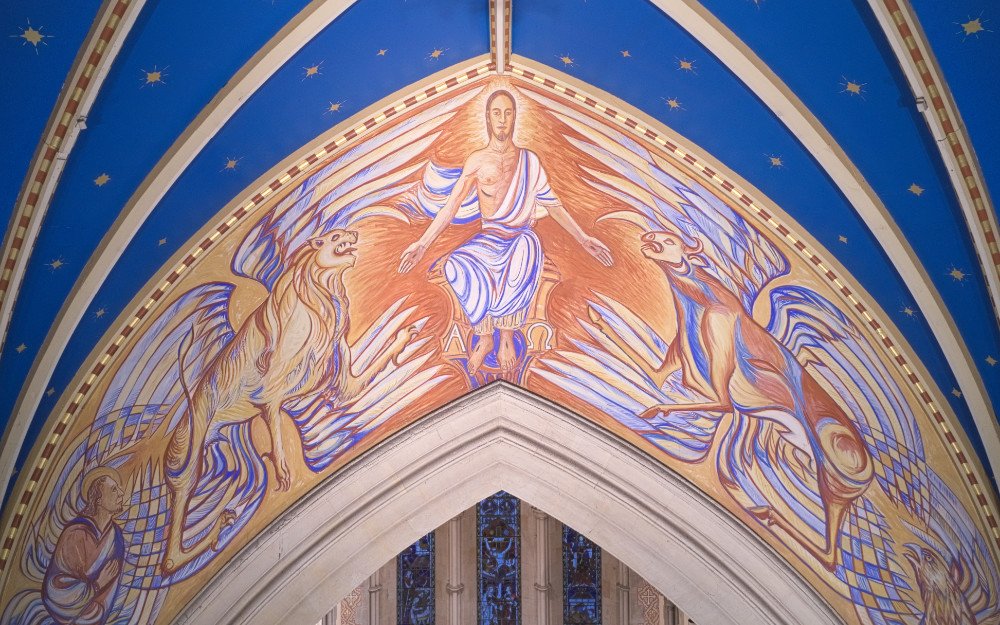
    Over the last few months it hasn’t been possible for my congregation to celebrate the Eucharist together in one space. But when we used to do that, we were never entirely in one space anyway. The very building itself is designed to transport people from the knowledge that they are a few yards from a busy thoroughfare in the Second City of Empire. Taking a few steps inside we find that we are in another place altogether. And in another empire, where the Emperor is servant of all and love is the essense of the law. The conceit that going into church takes you into a divine, heavenly realm is not an idea exclusive to the East. Coming into St Mary’s you are supposed to feel that you are stepping into heaven. It has been built to make you feel that. It has been decorated to make you feel that.  It does make people feel that.

    Whenever I take people into church I almost always hear them express a sense of wonder. We have the wow factor. It has been created by human skill to make you feel that the reality that you experience as you stand in the street is not the only reality that you can experience. It is a space that conveys that love, joy and peace might be possible and it does that without words. It is done with beauty and it takes people a few steps up the stairway to heaven.

    And it is the church playing with reality.

    That experience of going into a holy space and feeling part of something bigger is something common to religions that are divided on all kinds of doctrinal matters. It points to things that are best expressed through virtual reality and religious people are so used to virtual reality that they sometimes forget that it is all around them.

    When people come to the Eucharist in St Mary’s they are at once in Glasgow and simultaneously elsewhere. And elsewhere isn’t even singular either. At the Eucharist in Glasgow we are at one and the same time in an Upper Room in Jerusalem rather a long time ago and at the Wedding Feast of the Lamb at the ultimate consumation of all that is. The Last Supper and the Breakfast at the End of the Universe happen at the same table. At the same time.

    And as we gather at our table, we gather at every table and eat in communion with those who share in the same meal. Our fellowship with them isn’t prevented by circumstance. Our Eucharistic fellowship has never been prevented by circumstance or lack of physical proximity.

    We couldn’t keep the Triduum in Holy Week without virtual reality.

    Without virtual reality it would just be a way of making feet smell less.

    Without virtual reality it would just be a bonfire that would die.

    Christ is the celebrant at every Eucharist no matter which particular celebrant is standing there. Virtual reality becomes interwoven with the reality of the lives that we bring to the table and we are formed and changed and made new. It is how God’s love is expressed.

    This is virtual reality. Every Eucharist is a Virtual Eucharist. Cyberspace is one of the most powerful metaphors for prayer that human beings may ever develop.

    Our bodies are bound by physics.

    God’s love in this world isn’t.

    This is why religious buildings are important. It is also why they are not important.

    Every Eucharist is a Virtual Eucharist.

    Every Eucharist always was a Virtual Eucharist.

    Of course it was.

10 responses to “Sermon for Christ the King 2014”

  1. Julie Mansfield Avatar
    Julie Mansfield

    Kelvin, I follow your blog and I often find your conversations on facebook a lot of fun. But often, too, I don’t really understand what you are saying – such as your last paragraph there; ‘Like love. Like compassion. Like truth. Like hope. Like justice. Like joy. Like peace. Like the Way. Like the very essence of life itself.’ It sounds wonderful but what does it actually mean? Are you saying that the word, ‘God’ is a synonym for other worthwhile words which already have meanings I do understand?

    1. Kelvin Avatar

      What a good question.

      No, I’m not saying that, or at least not quite. I would say that we can’t describe what God is like in language, but one of the closest ways we can come near to talking about God is to talk by analogy – to talk about what God is like.

      The bible is full of times when people use analogy and metaphor to describe the reality of God which we can never completely comprehend.

      In this sermon I’m saying that whilst God may be like a king, God is also like a lot of things that one doesn’t immediately associate with kingship and monarchy. That string of words that you picked out in the sermon are all ways that the bible uses to speak of God. I was using them to do the same.

      Does any metaphor contain or enclose or sum up what we can say or know of God. The answer is always no.

  2. Joy Jones Avatar
    Joy Jones

    I loved your sermon. And have subscribed to your blog.

    No, I have not met the Queen, but I have met the King! And continue to get to know Him more and more every day. His love, peace joy, truth, etc.

    Our priest in North Carolina, said on Sunday, that
    it was hard to tell the difference between sheep and goats.
    Since you live in Scotland, you see a lot of sheep and goats….why did Jesus picked those animals?

    1. Kelvin Avatar

      Thanks for your comments, Joy.

      Actually, I don’t see that many sheep and goats in Great Western Road in the middle of Glasgow. I do see sheep when I drive in the countryside but very rarely goats.

      I think that it is the case that in the Middle East, sheep and goats are pastured together and do sometimes need sorting out. Here in Scotland, sheep and goats (especially wild goats) look very different. However I think in the Middle East, that’s less true.

  3. Julie Mansfield Avatar
    Julie Mansfield

    Kelvin, I’ve only just found your reply! Thanks so much for bothering. I really mean it. I thought you must have just ignored it. Yes, I see what you are saying but… I would say that all those meaningful words in the Bible about what God is like only make sense in the context of understanding who God is. ( i.e. that He came into being as the personification of the worldview of the marginalised Hebrew people, later taken up by Jesus, just as all of the other communities of the ancient Near East had gods representing their worldviews. I study with this bloke here http://www.bibleincartoons.co.uk. ) What I am trying – !! – to say is that God obviously cannot be everyone’s ‘truth’, ‘joy’, ‘justice’ etc because in society there are contradictory ideas about what these things are.

    1. Kelvin Avatar

      Are there contradictory ideas about truth, joy and justice?

      I’m not so sure. Surely we can still speak of these things as though they had some commonly understood meanings.

      1. Julie Mansfield Avatar
        Julie Mansfield

        oh absolutely there are, Kelvin. Just one of many examples: these immigrants in the Mediterranean Sea. Their truth and joy and justice is to be allowed to come and live here. Many folk here get their truth, joy and justice in seeking to put in controls. Whose truth, joy and justice is right? As I see it, the god of the marginalised Hebrews would side with the immigrants but I’m not sure about the Church…

        1. Kelvin Avatar

          I was speaking about God, not ethics. That’s not to say that there isn’t a lot that is interesting to say about the two, but they are quite different I think.

          The fact that people disagree about how to show love. does not, to me at least, negate the assertion that God is love.

      2. Julie Mansfield Avatar
        Julie Mansfield

        Oh absolutely there are contradictory ideas, Kelvin. Just one of many examples; these immigrants in the Mediterranean Sea. Their truth and joy and justice is to be allowed a place to live and thrive. For many folk here, their truth and joy and justice depends on keeping out as many immigrants as possible because they affect housing, medical care, schools etc. As I see it, the Biblical god of the marginalised Hebrews is on the side of the immigrants…

        1. Julie Mansfield Avatar
          Julie Mansfield

          sorry I didn’t see your reply! My difficulty is that you use words as if they have a universal meaning. E.g. love is not a neutral word. there are many different types of love such as conservative paternalistic love or socialist love or non-marginalising love. They are all love. How can God be them all?

Leave a Reply

Your email address will not be published. Required fields are marked *

Previous Posts

  • Generous Episcopacy: The Rt Rev Michael Hare Duke RIP

    I gather from a twitter correspondent that the Rt Rev Michael Hare Duke has died. Bishop Michael was the bishop with whom I first tested my vocation. Having been a bishop since 1969, he saw and influenced the entire modern story of the Scottish Episcopal Church. Where to begin with memories? The time I sat…

  • The Peace and Unity and Order of the Church

    One of the things that I’ve occasionally raised in blog posts is the question of whose responsibility it is to promote the unity of the church. I think this was focused for me particularly at the consecration of the Bishop of St Andrews, Dunkeld and Dunblane just over 9 years ago when the preacher preached…

  • New Statement from College of Bishops

    There’s a new statement from the College of Bishops today about same-sex marriage. It can, and should, be read in full – see here: College of Bishops Guidance re Marriage 2014 I’m appalled by its contents and in particular appalled at the way the Bishops of the Scottish Episcopal Church are treating gay clergy and…