
• Back from hols and quick theatre reviews

    beckettsmall
    I’m back to work at St Mary’s today after a post-Christmas (well, post-Epiphany) week off. I’m writing this at the point just before I go into work, say morning prayer and open up the emails that have come in to me whilst I was away.

    It has been a busy week. I managed to fit in a trip to Yorkshire to see family and a wee theatre trip to London.

    Here are a few quick theatre reviews of what I saw.

    • Matthew Bourne’s Swan Lake at Saddlers Wells – by some distance the most exciting thing I saw. I’ve come rather late to this one but loved it. (Except the ending which reminded me of Brokeback Mountain – how often gay couples only end up together when they are dead).
      Rating: ★★★★★
    • Ghosts at the Trafalgar Studios – A very good production of this Ibsen play though I was surprised when I got in that I’d already seen a strikingly similar production of the same play at the Citz a while ago. Outstanding question – why did the maid and her father sound as though they came from Govan when they were supposed to be rural Swedes?  Apart from that, all made sense and this was quite gripping.
      Rating: ★★★★☆
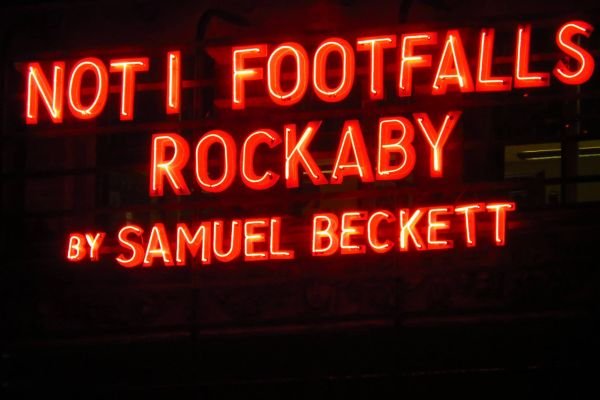
    • Not I, Footfalls and Rockaby – the Beckett trilogy at the Royal Court. This was the one I booked in advance and indeed the one that prompted me to book the trip. A rare chance to see Not I, not least because of how difficult it is – the actor hangs upside down on the stage and delivers a monologue “at the speed of thought” whilst the only illumination in the whole theatre is a tiny pencil spotlight on her lips. This was chilling, fascinating theatre that plays with your mind.
      Rating: ★★★★½
    • From Morning to Midnight – a German expressionist piece at the Royal National Theatre. Brilliantly done. But should it have been done? I was far from sure. Reminded me of that terrible production of the Seven Deadly Sins that Scottish Opera did a few years ago.
      Rating: ★★★☆☆
    • Mojo – a relatively new play at the Harold Pinter Theatre. This one didn’t work for me at all – far too shouty. Odd that the people in the stalls seemed to think it was hilarious and those in the Royal Circle didn’t. How does this happen?
      Rating: ★★☆☆☆

    Not a bad trawl. Add to that three big sung services in musical churches in London, a hour or so looking at favourite things in the National Gallery, some good food and good company and you’ve got a flavour of what I was up to.

    I was in London for three nights, by the way and managed to come back without blisters.

5 responses to “Heresy hunting”

  1. Nick Brindley Avatar

    It is probably helpful to be clear about the distinction between “dogma” (which is best understood as the definition of orthodoxy and of heresy, of the things it is mandatory to affirm and the things it is forbidden to affirm) and “church order” (the rules about how people are to conduct themselves). These are related but by no means the same thing.

    “Doctrine” is a third thing again, to my mind. It is the body of teaching that the church affirms but is much more extensive and changeable than dogma.

    Of particular relevance is who has the authority to pronounce on these things. Denominational authorities quite properly establish church law and discipline (this needs to be done and there’s nobody else to do it) but would go beyond their proper sphere (in my view) if they tried to establish new definitions in the field of dogma.

  2. Andrew Avatar
    Andrew

    I feel the need to separate praxis and doctrine, but I suppose that is probably a minor heresy in itself, in a church that hides its doctrine in its liturgy. Although I suppose the deftness of the ‘McCarthy Liturgy’ has maybe sidestepped that pitfall as deftly as an 18th century non-juring bishop side-stepping western orthodoxy and the rest…

  3. Rosemary Hannah Avatar
    Rosemary Hannah

    To a degree I think it is a matter of tradition. Anglican churches have tended (and it is only a tendency) to insist of orthopraxis. Church of Scotland churches have tended (same health warning) to emphasise orthodoxy of belief, call it doctrine or dogma. St Andrews is not of course a C or S institution, but it used to be, certainly in my day, and to a degree in yours, heavily steeped in C of S ethos. St Mary’s trained C of S ministers and that was ALL the training they got, because then they knew Orthodoxy.

  4. Jimmy Avatar

    The links on this post have led me to think of this –

    The Inner Party – The Outer Party – The Proles.

    The model demands tight control of the middle class, with ambitious Outer Party members neutralised via promotion to the Inner Party or “reintegration” by Miniluv, while proles can be allowed intellectual (and sexual) freedom because they lack intellect. Winston nonetheless believed that “the future belonged to the proles”. Wikipedia.

  5. Allan Ronald Avatar
    Allan Ronald

    There was most definitely a C of S ethos at St Andrews in my day [67-71]. Robin Buchanan-Smith was running a packed college chapel and one president of the SRC and one president of the Union were St Mary’s men who went on to ordination and, in one case, to be Moderator of the Kirk. Perhaps they got their orthodoxy from Matthew Black at St Mary’s and their skill in future clerical politics from their student posts…….

Leave a Reply

Your email address will not be published. Required fields are marked *

Previous Posts

  • Post Christmas

    A big thank you to everyone who helped get things ready for Christmas. The cathedral looked stunning, the choir sang magnificently throughout and everything that was supposed to happen did happen. Like others (Gadgetvicar and +David amongst them), I can report that numbers were up. Indeed, they were up significantly for all the services over…

  • Midnight Mass Sermon

    Most years at around this time, the same story appears in the press. A couple of years ago, I had a call 2 days before Christmas. It was a Sunday paper ringing to “just ask a couple of questions”. They were apparently ringing round a load of ordained people and asking them whether they believed…

  • Fairytale of New York

    UPDATED – See below BBC Radio 1 is missing the point by finding new ways to censor the Fairytale of New York by the Pogues and Kirsty MacColl. In the olden days, they used to suppress the word arse in the verse: You’re a bum You’re a punk You’re an old slut on junk Lying…