
I slipped into an unknown pub in Middle England to get out of the rain and have a pub lunch. It was welcoming and cosy. Steak and ale pie, since you ask.
The part of the pub I was sitting in was right next to the bar. A small snug. The kind of room where you can hear everyone else’s conversations though it wasn’t too busy. Just a group of fifty-something men in for their pies a table a few feet from me, right next to the bar. It wasn’t terribly busy and so our host behind the bar joined in with their conversation, which soon turned to the result of the General Election. Everyone was interested in what it might mean for them. (Bartenders round here want firm action on business rates, I can tell you.)
After a while, one of the pie-eaters suddenly said for all to hear, “Did you know that 61% of the new MPs are gay?” The others at his table and the host at the bar expressed surprise that it should be as high as that. “It just isn’t right – not that number, that’s far too many of them. How have we become a country where 61% of our MPs are gay?”.
And I remained silent.
I remained silent because I was in a strange place and didn’t want to risk any unpleasantness.
Well no, I remained silent because homophobia stalks my world. I remained silent because I didn’t know how anything I might say might be taken. It probably wouldn’t have led to a punch in the face but the truth is, you never know.
The person making the claim about the number of gay MPs was wrong. Spectacularly wrong. I suspect he’d been told that 61 MPs were gay and had heard it as 61% and accepted that as being true. It was true in his inner world, a world in which the gays were getting above themselves. It was also a believable fact for those around him. They were surprised it was 61% and yes, that did seem a bit high. And yes, the gays were getting a bit above themselves.
I gather that a few more LGBT+ MPs exist than 61 – the number is about 66. That means that it is about 10% of the MPs in the House of Commons. LGBT+ people are sometimes estimated to account for about 10% of the population. So 60-odd members of parliament who fit that profile is something to be celebrated as a good example of representation. Once upon a time, every one of those MPs would have been subject to blackmail or worse. Once upon a time, every one of them would be silent.
Me remaining silent in the pub for 10 minutes and then, after finishing the pie, going off without a word, is minor when compared with the violence that many gay people face on a daily basis in other parts of the world.
Yet that incident played in my mind the rest of the day. I went over it again and again. Should I have spoken up and called out this nonsense? I can argue that both ways. But the thing that I care more about than putting someone right in a pub is that this nonsense claim inhabited my head for half a day. Not so much the absurdity of the suggestion that 61% of MPs were gay but the commonplace assumption, held by a group of apparently nice people in an agreeable country pub, that yes, the gays were getting above themselves. Too many in parliament. Too many in power.
Power that should, apparently, be exercised by the dominant majority. By people who are not like me.
How many gay MPs should we have anyway? And how many is too many?
It is these thought patterns which form the framework in which homophobia thrives.
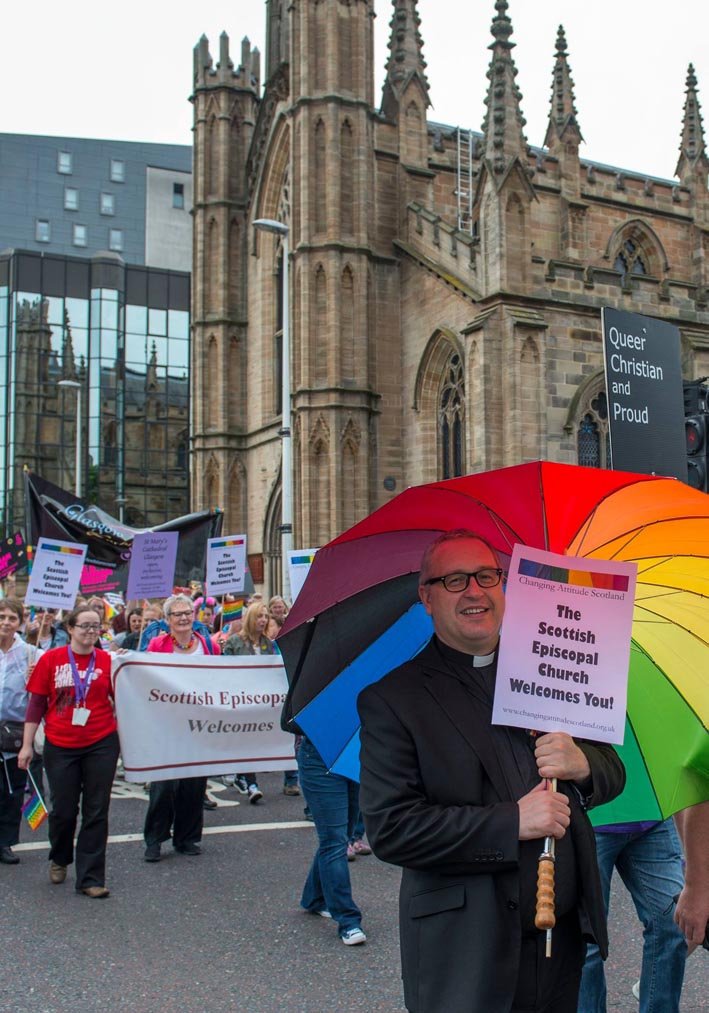 I rejoice in the progress that we’ve made. But I’m impatient for more. I’ll carry my placard on Saturday at Pride and put a smile on my face. Blessed Are The Fabulous I’ll proclaim and I’ll mean it. But I’ll still be walking on streets in which it only feels safe for most same-sex couples to walk hand-in-hand for a couple of hours a year during Pride itself.
I’ll also be marching wearing a black suit, clerical shirt and a white clerical collar because of the thousands who will be there for whom that will be an extraordinary thing to witness and something that they can scarcely believe possible.
Yes, my own small corner of the world still has a lot of work to do. In my own diocese, the clergy asked clearly during the last Episcopal vacancy for intentional work to be done on racism, sexism and homophobia, recognising that these were all issues that were real in the diocese and that our attitudes to difference had played an ugly part in our attempts to try to choose a new bishop. A few years later, we are going into another Episcopal vacancy with none of that work done. And yes, what I experience as homophobia is deeply related to what my female colleagues experience and it is made out of the same basic material as the racist presumptions that black colleagues know well. And even since that time, anti-trans prejudice has grown and grown like an invasive new plant species. It poisons and diminishes all who taste its fruit.
There’s nothing new about that poison either. Lots of us know it all too well.
The easiest prejudice to counter is that which is most obvious. In-your-face discrimination is easy to point out if you are able to speak from a place of safety. Much harder is the bitter prejudice of the well meaning – that of those who couldn’t possibly be homophobic because they went to such a lovely wedding only last month, who can’t be sexist because isn’t it wonderful that we have lady vicars now and who couldn’t possibly be racist because that would be just unthinkable!
Prejudice is part of the psychological air we breathe. It forms part of who each of us are.
Think you don’t have any yourself?
Think again.
Think I don’t have it?
I wish.
How long will it be before it is unthinkable that women colleagues will ask whether another woman will ever be elected as a bishop due to accusations being made about the alleged behaviour of a bishop who happens to be a woman right now? How long before the qualifications of those who arrive in the church who happen to be black will be treated as being on a par with those who happen not to be? How long before I can simply sit and eat a pie?
For all these reasons and 10000 other micro and macro aggressions, I’ll be marching at Glasgow Pride on Saturday.
Anyone who shares the dream of a world where we are all treated equally and treated well is welcome to join me.
Blessed are the fabulous.
And blessed are the impatient too.


Leave a Reply