
• Can you backdate a marriage?

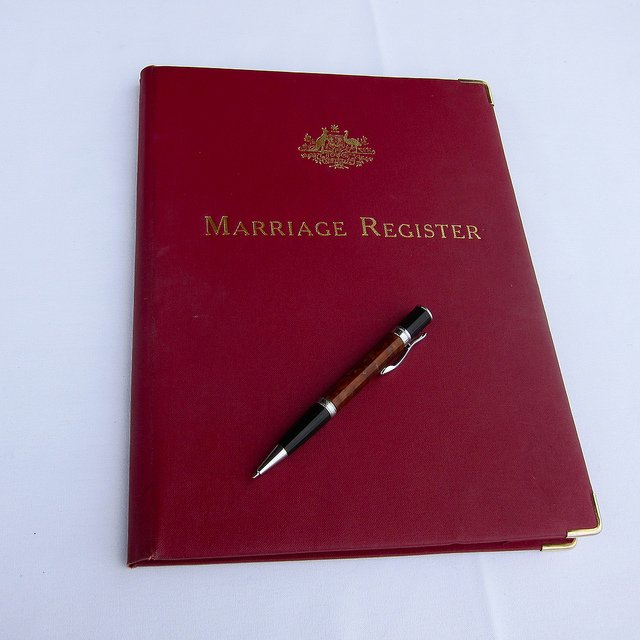
    Marriage Register

    How interesting to learn about the new rules that will govern couples in England and Wales who have been in a Civil Partnership who wish to change (upgrade?) their relationship status to a marriage.

    It seems that they are going to be able to do so easily and will receive a “backdated” marriage certificate which will state that their marriage began when they entered into their Civil Partnership.

    I’ve some reservations about this but I know it will be warmly welcomed by many and it would be churlish to oppose it.

    It is interesting though and there will be pressure now in Scotland for the Scottish Government to do the same.

    Here are some obvious issues.

    • It is quite odd to think that some might find themselves to have been married without their, at the time they entered into their marriage, believing that they wanted to be married.
    • People who have been blessing Civil Partnerships are going to find that they’ve been blessing marriages all along.
    • People will be able, I think, to find themselves married who never went through any ceremony at all – they may simply have signed the papers. (This is a new thing).
    • There’s no doubt going to be some grumpiness from those who trusted the politicians who said that Civil Partnerships were definately not marriages and that it had been invented in order to do something different to marriage.
    • In a sense, it is rewriting history. People are going to have marriage certificates that date from a time when they were not in fact married at all.
    • The Bishops of the Church of England in the House of Lords might feel that the Government has pulled the rug out from under them.
    • I think, that people can end up married whose proposal to marry has never been published either by banns on in a registrar’s office. I’ll be interested to see whether the registrars publish the names of those converting their status. My guess is that they won’t and thus people will end up married in law who have never had their intent to enter marriage advertised to anyone.
    • It is quite odd to think that a status like marriage can be backdated. Is there any comparable status that can be changed like that?

    Personally, I would have preferred the solution to be that people would get new full marriage certificates when they requested to change their relationship status into a marriage. I think this because I think that marriage ought to require a clear statement of consent at the time it is entered into. (Indeed, many of the rules surrounding marriage are about getting unambiguous consent from both parties, freely given).

    Interesting times. Uncomfortable times for the churches, particularly the Church of England.

    Photo Credit – Dale Gillard Copyright: Creative Commons Attribution-NonCommercial-ShareAlike 2.0 Generic (CC BY-NC-SA 2.0)


24 responses to “Good Vicar, Bad Vicar”

  1. Josh Avatar

    Being a good vicar to stony, unreceptive hearts might require a pickaxe to reveal gemstones within. It must be tough to minister to jerks and meanies, no? We lose faith in people easily – I certainly do. But a good vicar – a loving parent – doesn’t give on up one’s children.

    A good vicar might depend on the eye of the beholder. Whether you believe vicars and congregations are intrinsically good or evil might get you called a Pelagian or an Augustinian depending on who you ask. Faith in the work of a vicar or the reception of the congregation depends on good faith and co-operation – what then do we place our faith in? Hardly Protestant thinking, when faith is dependent on work, manifestation, and epiphany. A bad vicar might be sent to good people. A good vicar might be sent to bad people. Whether a vicar or congregation is subjectively or objectively good is a difficult question to answer.

    It is then that I prefer to see both the vicar and congregation not as “good” or “bad” but rather as equally “beloved”. However large the congregation, or even the vicar’s skill shouldn’t matter then. But that raises the question: Who then do we love if we are so beloved by God? Perhaps love might be the answer. A vicar and congregation who sees and knows themselves as equally and lavishly beloved of God will love each other. Love makes congregations meaningful and precious, no matter how small they might be.

  2. Josh Avatar

    And if I might add to my previous comment – And love also makes vicars meaningful and precious, no matter how small the congregation might be.

  3. Rosemary Hannah Avatar
    Rosemary Hannah

    Yes – things which make the practicalities of small congregations include:
    the laity in most senior positions find it hard to see the inclusive love of God and to see the value of prayer and spiritual exercises, a shortage of laity with administrative abilities, a tiny handful of parishioners prepared to insist on unhelpful things all the time (the oldest liturgies every week, the kind of behaviour small children cannot sustain all service long, particular dress in those at church on Sunday to name but a tiny selection). In a larger church these things can be contained (one nasty comment for lady x outweighed by five or six lovely ones or simply finding somebody to be treasurer who can cope with the job). In a small church, however good the vicar, the nasty comment carries more weight, and the sorting out of the finances may take days of clergy effort. It is always hard to get from a tiny congregation to a large one.

    That said, I have sat through sermons so mind-numbingly boring and inappropriate that I have actually moved to another church.

  4. Paul Waddington Avatar
    Paul Waddington

    If one looks at the larger picture, the Archbishop’s optimism seems misplaced.

    According to the 1851 census, about five million people attended a Church of England service on the census day (a Sunday). The population of England and Wales at the time was about 17 million. These are round figures and I know that there were difficulties with the religious census, but they are good enough to demonstrate my point. Roughly speaking, about 30% of the population attended a CofE that Sunday.

    Recently published figures estimate average Sunday attendance at CofE churches at about 900,000. That is about 2% of the population of England. Wales is now excluded.

    So taking the long view, the trend is rather depressing for the CofE. Compared with 1851, fourteen out of fifteen no longer attend church regularly.

    As an aside, the 1851 census indicated a church attendance for Catholics of about 350,000. That is about 2% of the population. I understand that the current figure is very similar for Mass attendance is also around 900,000 or 2% of the population.

    Other recent research has indicated that the age range of CofE congregations is skewed towards the upper end. Certainly in my local parish, it is unusual to see anyone under the age of 60. I do wonder how many there will be in, say, 15 years time.

    1. Kelvin Avatar

      Thanks Paul – I find that bishops generally tend to accentuate the positive when it comes to thinking about numbers in church. Whether that is because they only go to events that are comparatively well attended or whether it is actually because it is their job to be upbeat about possibilities is not clear to me.

  5. Pam Avatar
    Pam

    It is complicated – ‘good’ and ‘bad’ – poor adjectives. The rector is the leader of the congregation and needs support and trust. But, I think, no longer is the vicar held in such esteem as not to have to earn that support and trust. A good thing, mostly. Churches grow for all sorts of reasons – the level of involvement with non-believers, a prominent noticeboard and outstanding bikke and slice-makers all help.

Leave a Reply

Your email address will not be published. Required fields are marked *

Previous Posts

  • Potpourri

    Well, the proposals have been published which will allow Anglican clergy to more easily defect to Rome. I’ve not heard of any Episcopal clergy in Scotland interested in taking up the offer. It is said that the Traditional Anglican Communion is joining up. But then I’ve never heard of them nor do I know anyone…

  • Hue and Cry

    Goodness, we don’t lack for drama at St Mary’s some weeks. This morning we had a bag stolen from the hall and a resultant hue and cry, with members of the faithful chasing the person believed to be responsible up the street. Following a hasty 999 call, the Polis turned up. I can’t say any…

  • Bible Study for Preachers

    Just back from Bearsden where I had been at a day on the Gospel of Luke which we start reading in church from Advent Sunday. It was a day for preachers from all around the diocese and very well spent. John Riches from St Mary’s was our facilitator for the day. Introduction to what is…

  • New Blogger – Cliff Piper

    Could you all go over and see Cliff Piper over at http://morayrosscaithness.blogspot.com/ He is obviously not getting enough attention as the Dean of Moray, Ross and Caithness so he has started a blog. He is taking his first steps in the Blogosphere and needs our encouragement and compassion. He says on twitter that its scary.…