
Some years ago now, I introduced readers of this blog to the twin churches of St Eucalyptus on the Rocks and St Anaglypta by the Skerry. They were dreamt up by me in order to illustrate a point. I was trying to get people to think about whether bread and wine could be consecrated by a priest who couldn’t be in two places at once but who could connect them virtually in some way. This was a long time before the pandemic made those questions pertinent to far more people than had bothered to think about them previously.
From time to time I’ve revisited these two churches to turn over ideas relating to the ways in which doing things digitally can disrupt (or enhance, depending our perspective) the things that Christians do.
So, it was natural that when I was testing out an AI image generator recently I decided to give it the task of showing me what St Eucalyptus by the Rocks actually looks like. I gave it a very simple instruction and it came up with quite an impressive image.
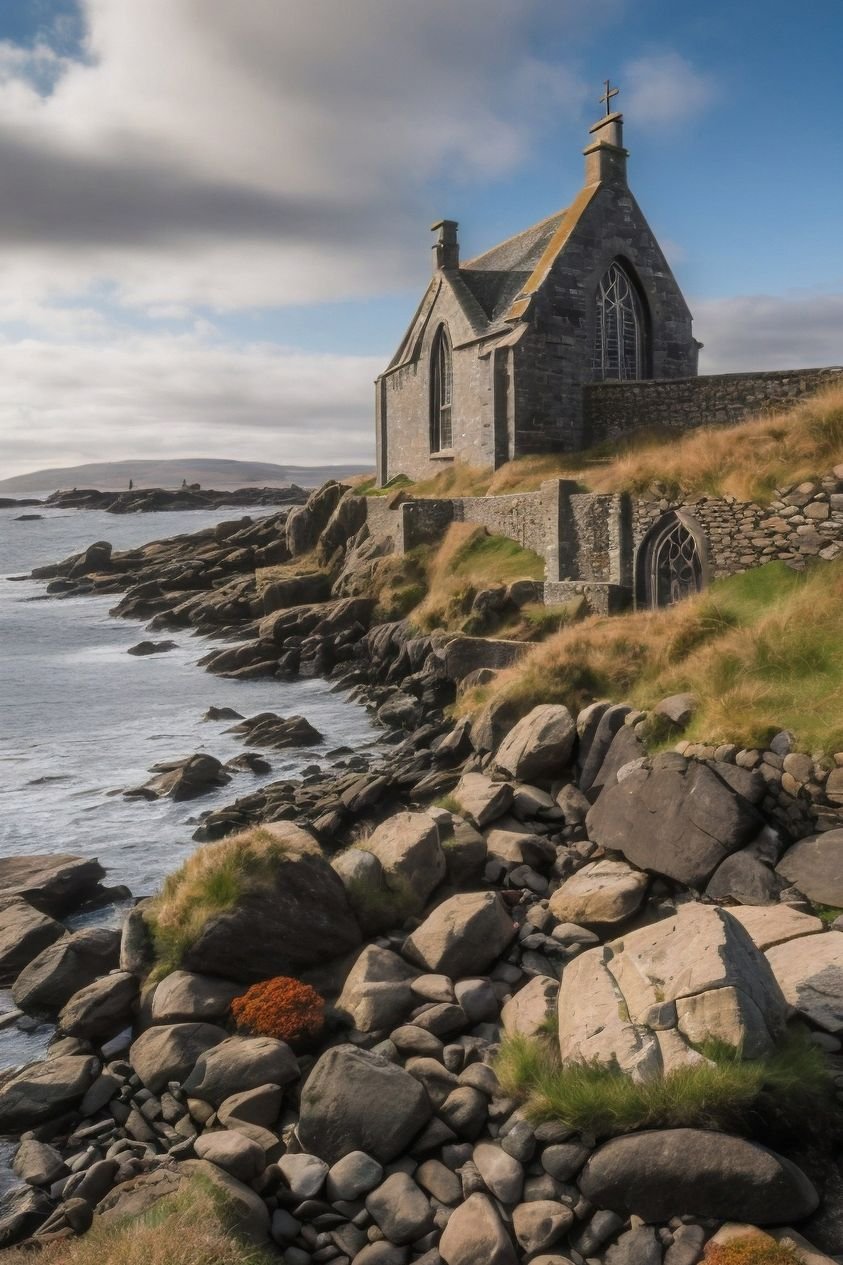
I published this image on Facebook along with a comment suggesting that this is one of my favourite Scottish Episcopal Churches.
The reaction was swift and interesting. Some people immediately knew that this was an artificially generated image and made comments which suggested that they knew what was going on. Others didn’t recognise it as being artificial though and I was quickly inundated with people asking me where the church is in order that they could visit it.
I told people that the church was close to St Angalypta’s, which you can just see in the distance in the picture and that one of them lay in the Diocese of Argyll and The Isles and the other lay in the Diocese of Moray, Ross and Caithness but that the dioceses could not agree on which was in which. This piece of nonsense might have given the game away to some people but others received this as being typical of the way that the church functions. A little detail seemed to confirm the reality of the picture that they saw before their eyes.
The picture contains a very odd looking window that is set into the rocks almost at sea level and so I gave an explanation for this too, saying that it was there to give light into the cave where St Eúchlyphátius herself used to pray the Celtic rosary every day.
Now, there is no such thing as the Celtic rosary. Nor is there any such saint as St Eúchlyphátius but somehow the faux Gaelic accents on her name made her seem to some to be even more the genuine article.
Again I got responses from people – some in public online, some in private online and some offline. And it remained the case that some people saw this for what it was immediately and others wanted to head off north and west and find the exact spot from which the “photograph” had been taken. It would look great on Instagram after all. At least one American friend with an interest in all things Celtic wanted full details so they could visit on their next trip across the pond.
On something of a roll, I decided to let ChatGPT write a history of the church and it responded with some glorious prose that could well have come out of a local history of a country church.
In the picturesque highlands of Scotland, nestled amidst rolling hills and serene landscapes, stands the enchanting Church of St. Eucalyptus of the Rocks. This small Scottish Episcopal church holds a captivating history, deeply rooted in the spiritual traditions of the region.
Legend has it that centuries ago, a hermit named St. Eucalyptus, a woman of great devotion and wisdom, sought solace and divine communion within the rugged beauty of the highland landscape. Drawn to the mystical energy emanating from a hidden cave, St. Eucalyptus made it her sacred sanctuary, devoting her life to prayer and contemplation.
It was within this cave that St. Eucalyptus began a daily ritual of reciting the Celtic Rosary—a unique form of prayer that combined ancient Celtic spirituality with Christian devotion. The rhythmic repetition of prayers, accompanied by the natural sounds of the surrounding wilderness, created a spiritual harmony that resonated deeply with the saint’s soul.
As word of St. Eucalyptus’ profound spirituality spread, pilgrims and seekers from far and wide journeyed to the highlands to witness the transformative power of her prayers. Inspired by her unwavering faith and the miracles attributed to her, a humble community of believers gradually formed around the cave.
Recognizing the need for a more permanent place of worship, the community embarked on an ambitious project to build a church in honour of their beloved saint. They chose a spot near the cave, where the ancient rocks seemed to embrace the faithful with a sense of awe and wonder.
Construction of the church commenced, using locally sourced stone and guided by the skilled hands of the villagers. With each stone meticulously laid, the church gradually took shape—a testament to the enduring faith and dedication of the community.
The Church of St. Eucalyptus of the Rocks, with its simple yet elegant architecture, stands as a tribute to the saint’s legacy and the spiritual traditions she inspired. The interior exudes a sense of tranquillity, adorned with Celtic symbols and artwork that pay homage to the rich heritage of the highlands.
Over the centuries, the church has become a spiritual haven for those seeking solace, guidance, and a connection to the divine. Pilgrims, locals, and visitors alike are drawn to the church’s serene ambiance and the spiritual presence that seems to linger in the air.
Today, the Church of St. Eucalyptus of the Rocks continues to thrive as a place of worship and spiritual refuge. The Celtic Rosary, once recited by the saint in her secluded cave, is now embraced by the congregation as a cherished tradition, passed down through generations.
The church’s small community holds dear the legacy of St. Eucalyptus and remains dedicated to preserving the traditions and spiritual practices that she embodied. The annual Feast of St. Eucalyptus is celebrated with great joy and reverence, drawing pilgrims from near and far to honour the saint and partake in the rich tapestry of highland spirituality.
As the sun sets over the highland landscape, casting a golden glow on the Church of St. Eucalyptus of the Rocks, the prayers of the faithful mingle with the whispers of the wind—a testament to the enduring power of faith and the timeless presence of St. Eucalyptus, forever entwined with the sacred beauty of the Scottish highlands.
Again, the more detailed fragments seemed to convince people all the more that they were looking at an actual church on the West coast of Scotland.
Again I was asked for the exact location. I was asked for more details about St Eucalyptus, I was asked whether this was the closest church to the sea in Scotland and I’m convinced that if I’d been selling St Eucalyptus Celtic Rosaries online I’d be a richer man now than I was then.
Now, all of this might make us think a bit. Is the Church of St Eucaluptus real or isn’t it? Since I conjured it up in my imagination over a decade ago, many have thought about its congregation. The details of the saint’s life are at least as much connected to reality as some of the stories about Scottish saints who actually are in the calendar of the church. Is the story of St Eucalyptus telling her beads and saying her prayers in the cave more or less true than the stories of St Gilbert of Caithness slaying a dragon or St Mungo raising a dead robin to life?
In a religion based on someone who claimed that he was the way the truth and the life, it is worth pausing from time to time and asking what we mean by truth. Is it simply the dull reality of that for which we have proof? Do angels still surround the blessèd. Do demons still stalk the unwary? Does the devil still goeth about prowling like a lion seeking whom he may devour?
Religion has an interesting relationship with the truth, at times insisting that it is the very arbiter of objective reality and at other times using reality not merely as a plaything but as a revealer of holy mysteries.
I’ve been to many communion services in which I have been present with the Lord and the flakey disciples in an upper room yet I’ve never myself set foot in Jerusalem.
The stories that religious people tell are all the more interesting because sometimes it is important to know whether they are stories that stand up as objective chronicles of events and because sometimes it isn’t important to know that for sure.
Dragons still need to be vanquished either way.
People still need to be healed.
The world is a better place when you know that angels dance and sing.
I suspect that this won’t be the last that we hear of St Eucalyptus on the Rocks. That little congregation clings onto the ebbing and flowing of truth in our minds just as it has clung onto the rocks by the shore for so many centuries.
And you gentle readers are all Friends of St Eucalyptus now.


Leave a Reply