
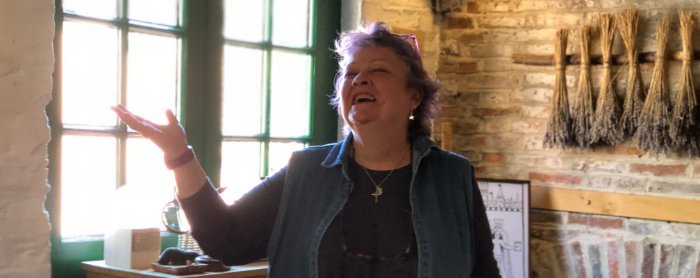
• Ruth Innes RIP

    Mother Ruth

    This week the funeral will take place of an extraordinary priest, the Rev Canon Ruth Innes of the Diocese of Edinburgh.

    Ruth served various congregations in that diocese – St Fillan’s, Buckstone, Christ Church, Falkirk, St Mark’s, Portobello and St Peter’s (formerly St Mildred’s) in Linlithgow along with St Columba’s, Bathgate.

    Ruth never worked in large churches. Each of these places had their own vulnerabilities. But to her, each of her charges were for the time she was with them, My Little Flock. She was defensive of those she cared for too. Not so much a mother hen as a mother lion.

    People will remember her as pastoral, caring and imaginative. Some will also remember her with that double-edged description – that she was colourful.

    Ruth’s outrageous sense of humour and extravagant love could make some nervous of her. However, Ruth was not merely colourful in the sense of being slightly quirky – she wasn’t slightly anything. Her personality lit up the world and made it far more vibrant.

    Despite working as a rector only in relatively small congregations, Ruth was widely known throughout Scotland and beyond. She cultivated her friendships and they lasted many years. Some of these came from the Cursillo movement, some from people she met on conferences and some from friends she holidayed with. Ruth put her friendships to work too in her pursuit of justice. She was a founding member of Changing Attitude Scotland and a key person in the early years of the movement to enable same-sex couples to get married in church. She turned up as a priest in a clerical collar to Pride marches long before it was fashionable to do so.

    She cared about the poor. She cared about her family, including her two sons.  She cared about the sick. She cared about the dying. She cared about the homeless and spoke, to the considerable surprise of many who heard her, of her own experience of homelessness.

    My guess is that when others were making decisions about whether Ruth should be ordained she was described as coming from a “non-traditional background for a priest”. Most clergy don’t have years of experience as a cocktail waitress to draw on after all. Ruth did and she knew much about how people tick as a result. She also brought a sense of fun and good humour to every room she entered.

    Ruth was an adult convert to Christianity having been captured by the beauty, peace and joy she found in the church of St Michael and All Saints in Edinburgh one day when she wandered in. These things turned her life around completely.

    In recent months, Ruth knew she was dying and was brave and honest throughout. She had been present at the deathbeds of many in her care. She knew the consolations of religion without ever being sentimental about them. She knew that God loved her very much and she loved God greatly in return.

    Spirituality is a personal matter. For Ruth it included a love for religious tat. In life, she gathered many icons, statues and rosaries. Some were exquisite. Some were exquisitely camp. None gave her more joy than the pectoral crucifix which also operated as a cigarette lighter – the flame appearing as if by magic above the head of the crucified Lord. She loved all these things but as death approached, she started to let them go. Visiting friends would get to choose from the tat collection but nothing could be removed without one first hearing about the story of where the object came from and what it represented.

    Most treasured of the things she gave me was an icon that Ruth always described as Ugly Mary. Having noticed it in a monastery shop, she realised that no-one else would take home such an ugly icon of Our Lady and that thus it fell to her to rescue her and love her. “Why should Mary always be pretty, anyway?”

    There is a tendency when someone dies to represent them as either a saint or an angel. Ruth was neither of these. She was something much more – a human being fully alive. Devout, fully alive and full of fun.

    May she rest in peace.

    And rise in purple.


    [Many thanks to Kimberly Bohan for the picture]

24 responses to “Good Vicar, Bad Vicar”

  1. Josh Avatar

    Being a good vicar to stony, unreceptive hearts might require a pickaxe to reveal gemstones within. It must be tough to minister to jerks and meanies, no? We lose faith in people easily – I certainly do. But a good vicar – a loving parent – doesn’t give on up one’s children.

    A good vicar might depend on the eye of the beholder. Whether you believe vicars and congregations are intrinsically good or evil might get you called a Pelagian or an Augustinian depending on who you ask. Faith in the work of a vicar or the reception of the congregation depends on good faith and co-operation – what then do we place our faith in? Hardly Protestant thinking, when faith is dependent on work, manifestation, and epiphany. A bad vicar might be sent to good people. A good vicar might be sent to bad people. Whether a vicar or congregation is subjectively or objectively good is a difficult question to answer.

    It is then that I prefer to see both the vicar and congregation not as “good” or “bad” but rather as equally “beloved”. However large the congregation, or even the vicar’s skill shouldn’t matter then. But that raises the question: Who then do we love if we are so beloved by God? Perhaps love might be the answer. A vicar and congregation who sees and knows themselves as equally and lavishly beloved of God will love each other. Love makes congregations meaningful and precious, no matter how small they might be.

  2. Josh Avatar

    And if I might add to my previous comment – And love also makes vicars meaningful and precious, no matter how small the congregation might be.

  3. Rosemary Hannah Avatar
    Rosemary Hannah

    Yes – things which make the practicalities of small congregations include:
    the laity in most senior positions find it hard to see the inclusive love of God and to see the value of prayer and spiritual exercises, a shortage of laity with administrative abilities, a tiny handful of parishioners prepared to insist on unhelpful things all the time (the oldest liturgies every week, the kind of behaviour small children cannot sustain all service long, particular dress in those at church on Sunday to name but a tiny selection). In a larger church these things can be contained (one nasty comment for lady x outweighed by five or six lovely ones or simply finding somebody to be treasurer who can cope with the job). In a small church, however good the vicar, the nasty comment carries more weight, and the sorting out of the finances may take days of clergy effort. It is always hard to get from a tiny congregation to a large one.

    That said, I have sat through sermons so mind-numbingly boring and inappropriate that I have actually moved to another church.

  4. Paul Waddington Avatar
    Paul Waddington

    If one looks at the larger picture, the Archbishop’s optimism seems misplaced.

    According to the 1851 census, about five million people attended a Church of England service on the census day (a Sunday). The population of England and Wales at the time was about 17 million. These are round figures and I know that there were difficulties with the religious census, but they are good enough to demonstrate my point. Roughly speaking, about 30% of the population attended a CofE that Sunday.

    Recently published figures estimate average Sunday attendance at CofE churches at about 900,000. That is about 2% of the population of England. Wales is now excluded.

    So taking the long view, the trend is rather depressing for the CofE. Compared with 1851, fourteen out of fifteen no longer attend church regularly.

    As an aside, the 1851 census indicated a church attendance for Catholics of about 350,000. That is about 2% of the population. I understand that the current figure is very similar for Mass attendance is also around 900,000 or 2% of the population.

    Other recent research has indicated that the age range of CofE congregations is skewed towards the upper end. Certainly in my local parish, it is unusual to see anyone under the age of 60. I do wonder how many there will be in, say, 15 years time.

    1. Kelvin Avatar

      Thanks Paul – I find that bishops generally tend to accentuate the positive when it comes to thinking about numbers in church. Whether that is because they only go to events that are comparatively well attended or whether it is actually because it is their job to be upbeat about possibilities is not clear to me.

  5. Pam Avatar
    Pam

    It is complicated – ‘good’ and ‘bad’ – poor adjectives. The rector is the leader of the congregation and needs support and trust. But, I think, no longer is the vicar held in such esteem as not to have to earn that support and trust. A good thing, mostly. Churches grow for all sorts of reasons – the level of involvement with non-believers, a prominent noticeboard and outstanding bikke and slice-makers all help.

Leave a Reply

Your email address will not be published. Required fields are marked *

Previous Posts

  • Scottish Shia Community shows us how to do interfaith work

    It was a great honour and privilege last night to be a guest of the Scottish Shia community at an Eid meal to celebrate the end of Ramadan. The photograph shows me with Sayed Ali Abbas Razawi, the Director General of the Scottish Ahlul Bayt Society. There are many reasons why we need to have…

  • The Affirmation of a Transgender Person

    There’s yet more debate online about people calling for a special service to be approved by the Church of England in order to recognise and support someone following their transition from one gender to another. I happen to think that it would be an interesting thing for the Church of England to consider. However, we’re…

  • Joyful Songs of Praise

    Was delighted to be on Songs of Praise yesterday along with two members of the congregation who were talking about the blessing of their civil partnership last year which was part of their journey into marriage. I think I’ve had more feedback from this than any other piece of broadcasting I’ve ever done, overwhelmingly positive.…

  • Bathsheba, our Sister

    Here’s the sermon I preached on Bathsheba on 27 June 2015 Sermon preached by Kelvin Holdsworth on 26 July 2015 It so happens that later today I’m going to be on the television in a short slot on Songs of Praise. Blink and you’ll miss me – it won’t be long. From time to time…