
• Review: Nixon in China – Scottish Opera – ****

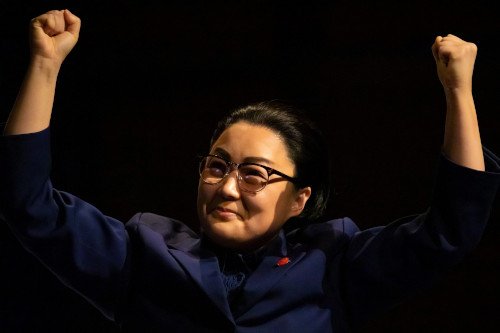
    Madame Mao
    Hye-Youn Lee as Madame Mao. Photograph: James Glossop

    Do we make history or does it make us?

    Scottish Opera’s co-production of Nixon in China is a timely and intelligent piece that asks questions about things that many in the audience will remember yet provides no easy answers. This is not a simple morality tale, nor a love story, nor a tragedy. It is an opportunity for every audience member to reflect on the swirling currents of modern political life. It is a piece that is at once about how strange the past seems to be and how even stranger, the present.

    The dominant theme in John Fulljames’s production is looking back. The whole story is told as a retrospective study of documents within an archive storage facility. Everything is either memory or historical record.

    This is an innovative staging making clever use of video throughout. Some of this is simply projected pictures. More interestingly though, much is seen in the form of layers of documents laid down under a digital vizualiser on a desk on the stage.

    The bold scoring of the arrival of the plane in China (Landing of the Spirit of ’76) is matched with a particularly fabulous kaleidoscope of projected images on stage.

    Joana Caneiro’s conducting shows some restraint throughout the evening. Both orchestra and singers seem a little underpowered. There was no trouble with balance between the pit and the stage but as the action and the theatre heated up, the sound of the fans on the large digital projector in the auditorium were more of a distraction than they should have been.

    None of this took away from the sheer excitement of the score. This is a phenomenal musical work. The retrospective mood on the stage perfectly matches the retrospective mood of much of the music, referencing, Wagner, Stravinsky, dance tunes and so forth. This is a production which also emphasises that though radical in some ways, the piece is fundamentally rooted in an operatic tradition. The various set pieces between the six characters, the three female secretaries singing in a semi-chorus, the quotes from other musical works and librettist Alice Goodman’s teasing playfulness with rhyming couplets all emphasise that this is a piece that refreshes a tradition that we already know well.

    The singing honours have to be awarded to the two female principals. The arrival of Hye-Youn Lee as Madame Mao in the second act was brilliantly exciting. The role demands an agile coloratura soprano and Hye-Youn Lee did not disappoint. Julia Sporsén’s portrayal of Pat Nixon was also astonishing and she completely dominated Act II. Indeed, there was the creeping realisation that there’s an ambiguity in the title of the work. Which Nixon are we celebrating coming to China – Richard or Pat? John Fulljames missed a trick in not bringing Ms Sporsén on last to receive the audience’s appreciation at the end of the evening to make the point that the piece is largely about Pat Nixon rather than her tricky husband. This was particularly seen throughout the revolutionary ballet when the action was entirely focused on Pat. Throughout everything her voice and hair were coiffed to perfection. She looked and sounded impeccable.

    Amongst the men, Eric Greene’s Richard Nixon was interesting and even vulnerable and Nicholas Lester’s final valediction as Chou En-lai the Premier of China moving, elegiac and world-weary.

    As the final archive box was put away with its characters in it, one felt thankful that this work had been brought out of storage by those intelligent enough to make it compelling and interesting. In a world still functionally unable to make sense of the relationship between power and the people this was a production that seemed necessary. I came out at the end of the evening feeling that I understood the world better than I did before. I also came out feeling that the world was also more perplexing than it seemed earlier in the evening.

    Both things can be true.


    Rating: ★★★★☆

    This review was published first by Scene Alba.

9 responses to “Turning Up and Being Counted”

  1. Lesley-Ann craddock Avatar
    Lesley-Ann craddock

    Thank you Kelvin
    What a read, I really enjoyed it, all of it. You have touched on the 3 things that I too have been wrestling with.
    Liturgy , turning up to be counted, and being open and real with our peers and counterparts.
    Hmmm I wonder if those aspects of being church in this post pandemic implosion of society will somehow be a catalyst to become braver clergy and have proper discussions about what matters to Gods church in its own context. Can we be diverse and not divided, can we lock into our heritage and yet be able to change too. Can Branson pickle save us. X

  2. Christine McIntosh Avatar
    Christine McIntosh

    Great stuff, Kelvin!

  3. Robert MacDonald Avatar
    Robert MacDonald

    Good points well made. We find some church members, who organise a community lunch on a Wednesday, then regularly say ‘we won’t make it on Sunday’. Seems the wrong way round – attendance on a Sunday should come first.

  4. Peggy Brewer Avatar
    Peggy Brewer

    Reading this made my day and contributes to my celebration of the season! Thank you!

  5. Calum Wyllie Avatar
    Calum Wyllie

    Reading this, I feel like it could have been written about me. I couldn’t have been more deeply involved with my church (felt deeply rooted in the weekly liturgy, sat on the PCC, led on diversity and inclusion, set up online streaming for the first time during lockdown), yet I haven’t been back in two years. There is definitely an element of that link of continuity having been broken, and it’s up to me to make the effort to reforge it again. But the anger is also real, and hard to pin down. When somewhere no longer feels like home, when you feel excluded (even when that person was responsible for leading on inclusion!), how do you find the courage to return? When the link with spirituality feels more present in other places (even when I used to absolutely value liturgy, the Eucharist, the community), how do you find a way forward? Too much thinking, and not enough getting on and doing, perhaps…

  6. Meg Rosenfeld Avatar
    Meg Rosenfeld

    Wow–this article is not only thought-provoking, and, to someone who’s a church-goer, extremely easy to identify with, but also entertaining and therefore all the more memorable. As one whose parish church (in San Francisco’s notorious Haight Ashbury neighborhood) nowadays gets about 15 people in the congregation on a “good” day, I do often wonder whether we’re ever going to bounce back from this expletive-deleted pandemic. Personally, I have no choice: I am, on the aforementioned good day, 50% of the alto section, and on other days, 100% thereof. All you folks out there don’t know what you’re missing–except, of course, those of you who are watching on your home computers.

  7. Father Ron Smith Avatar

    Well said, Kelvin Perhaps we clergy don’t stress enough the fact that the Host at our worship is not the clergy, but the Incarnate Son of God; who empowers us to the extent that we are willing to be empowered for daily life and work. I still think of that lovely phrase “Turn towards HIM and be radiant”. What a thrill!

  8. Kennedy fraser Avatar
    Kennedy fraser

    Yes,I still wonder if we have counted all those spiritual communions

  9. John Davies Avatar
    John Davies

    My church (suburban, evangelical Anglican in Birmingham, UK) took a long time to really recover from the lockdown and subsequent fears, but seems to be close to its pre-shutdown numbers again. What my wife and I noticed was that for quite some time the congregation was largely made up of its elderly members – ie those who are not perhaps so nifty with the electronic gadgetry of our age and, also, those who most wanted company. Younger families took a lot longer to return, but are now coming out of the woodwork again.
    One interesting point is that my old church reported a big increase in deaf people watching their zoom or youtube services, because one of the congregation provided signage at the front. Their new found audience felt greatly enabled to join in when they may otherwise never have done so. Is this something worth thinking more about?

Leave a Reply

Your email address will not be published. Required fields are marked *

Previous Posts

  • Prayers for Remembrance

    Last Sunday evening we had an extraordinary Choral Evensong. The idea was simple – to mark the start of the First World War by singing some of the music that the cathedral choir was singing 100 years ago. The idea came from Pam Barrowman, one of the members of the choir whose historical research includes…

  • Jericho, Berlin and what wall next?

    I remember going on a school trip to Germany when I was a young teenager. I don’t remember that much about the visit to be honest, but I do remember the wall. We were not in Berlin but we were staying near enough to the border between East Germany and West Germany to warrant a…

  • Somewhere over the rainbow

    I’ve just heard that I’ve been included in the Independent on Sunday’s Rainbow List. This is the new name for the Pink List – a list of gay, lesbian, bi and trans people whom the newspaper wants to celebrate as people who have made a difference in the past year. To be honest I’m surprised…

  • Becoming a Welcoming Cathedral

    Someone who is visiting Glasgow at the moment and who has been to St Mary’s a couple of times, said to me this week, “Well, whatever you are telling those people about Welcome, they are actually doing it.” It reminded me of someone in the congregation who said early on in my ministry here, “You…