
OK listen up. Moocs are the future.
Now before we go any further, let’s get the usual responses out of the way. The usual responses are twofold:
- What’s a mooc? (Most people)
- *rolls eyeballs* (lots of academics, including quite a few in my congregation)
Firstly, a mooc is a term used for a new form of education that you engage in online. It stands for Massively Open Online Course. Such things have been around for the last couple of years and there’s a good wikipedia page on the concept.
The basic idea is that you do a course online along with many thousands of other people all at once (massive) which you have easy/free (open) online (online!) access to. It is a way for someone to teach many people. Many, many people. I’ve just finished doing a mooc where a team of three people were attempting to teach 13000 students all around the world.
But why the eyeball-rolling from clever people?
Well, any teacher worth their salt is going to say, “Ah, but wait a minute? Hang on there… what do you mean…. that’s not a learning experience that is equivalent to what I can do in a classroom.”
And you know what? It isn’t.
However, it is here, it is now and it is going to develop in the future all the same.
Now, are you thinking you’ve heard all this before – are you thinking this is just a glorified correspondence course? Sure you are. But this is a bit more than that. Typically in a mooc, you get video lectures or other content to download, maybe on a weekly basis. You work through that stuff and you get online quizzes and exercises that you do along the way. If the course is well designed, you get instant feedback on how you are doing and can go back and review any of the bits that you didn’t understand.
But here’s the thing – it isn’t just you. It is social. There’s a whole bunch of people out there doing the same course as you. And you can get to interact with them on the forums. Indeed, some of the ways that the mooc is assessed may include interaction on the forums. (Cue eyeball rolling from academics who can’t work out that this is the equivalent of giving a mark for interaction in class discussions, which is a relatively common practise in some institutions).
Then, when all is done, you may well have a final piece of work to submit and this will be marked. But hey, how do you mark 13000 pieces of work? Well, if it is not machine markable material (multiple-guess questions) then the mooc method is to get students to peer review. In the mooc I’ve just participated in, we were encouraged to produce a final video and to pass the course you had to, not only submit your own video, but assess three (or more) others.
Then you get your certificate and there is much rejoicing.
Now, here’s where the Eyeball Rollers have started to harumph loudly. “What use is a certificate when no-one qualified has seen the work? Isn’t this the dumb assessing the dumber?”
Well, the truth is, such a certificate is worth precisely nothing in terms of the educative processes that we have been used to.
But get this, moocs are not really about what the certificate is worth. The satisfaction comes from having learned something new. Getting the certificate is just icing on the beans. Yet getting that certificate is oddly fulfilling – it is part of the gamification of learning. You get a certificate, you want another. You unlock a level badge, you go back to try to accomplish the next level.
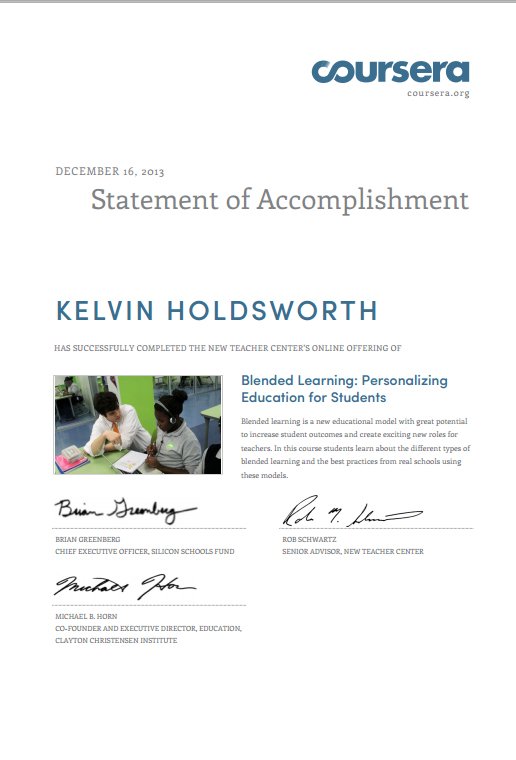
Anyway at the end of this post is my certificate from the mooc I recently completed. I don’t care what you think about its value – for me it represents a whole bunch of skills that I just learned. It is for a course that was really for school teachers on Blended Learning – that’s about how to mix learning that takes place in an online setting with more traditional face-to-face teaching. I took the course because I want to be able to offer some online courses at St Mary’s as well doing what we already do. It seemed sensible to do the course and also learn from completing the mooc itself.
What does this mean for the church at large – well it means that education needs to get slicker. In the same way that new technology has meant that we need to up our game in religious circles in the way we communicate with people, so we need to do the same with how we teach. That scrappy stapled-together church magazine is a great means of communicating but it does so on two levels. On one level, it communicates to those who have always received it that things are carrying on just the same as ever and even lets them know whether they are on the coffee rota on Sunday. To the more casual reader, however, it probably communicates that you are not terribly professional, have low expectations which will carry forward into worship and that you are desperate for someone to join the coffee rota to try to replace the people who are dying off.
It is the same with education. Sitting around a flipchart with half a dozen people is something that I continue to do. However, increasingly as I do it, I’m aware that the ways in which people learn are changing. Gamification (rewards – yes, sometimes silly little rewards) is here to stay. Blending of online and offline worlds is how people are doing everything from shopping to looking after their health so why shouldn’t that affect how we learn about Things That Matter in church circles? And yes, self directed learning is here to stay.
There’s new technology on offer here. Who knows what we’re going to do with it?
And here’s my certificate, which I’m terribly proud of, can you tell?


Leave a Reply