
• Why I’ll be Marching at Pride (2024)

    I slipped into an unknown pub in Middle England to get out of the rain and have a pub lunch. It was welcoming and cosy. Steak and ale pie, since you ask.

    The part of the pub I was sitting in was right next to the bar. A small snug. The kind of room where you can hear everyone else’s conversations though it wasn’t too busy. Just a group of fifty-something men in for their pies a table a few feet from me, right next to the bar. It wasn’t terribly busy and so our host behind the bar joined in with their conversation, which soon turned to the result of the General Election. Everyone was interested in what it might mean for them. (Bartenders round here want firm action on business rates, I can tell you.)

    After a while, one of the pie-eaters suddenly said for all to hear, “Did you know that 61% of the new MPs are gay?”  The others at his table and the host at the bar expressed surprise that it should be as high as that. “It just isn’t right – not that number, that’s far too many of them. How have we become a country where 61% of our MPs are gay?”.

    And I remained silent.

    I remained silent because I was in a strange place and didn’t want to risk any unpleasantness.

    Well no, I remained silent because homophobia stalks my world. I remained silent because I didn’t know how anything I might say might be taken. It probably wouldn’t have led to a punch in the face but the truth is, you never know.

    The person making the claim about the number of gay MPs was wrong. Spectacularly wrong. I suspect he’d been told that 61 MPs were gay and had heard it as 61% and accepted that as being true. It was true in his inner world, a world in which the gays were getting above themselves. It was also a believable fact for those around him. They were surprised it was 61% and yes, that did seem a bit high. And yes, the gays were getting a bit above themselves.

    I gather that a few more LGBT+ MPs exist than 61 – the number is about 66. That means that it is about 10% of the MPs in the House of Commons. LGBT+ people are sometimes estimated to account for about 10% of the population. So 60-odd members of parliament who fit that profile is something to be celebrated as a good example of representation. Once upon a time, every one of those MPs would have been subject to blackmail or worse. Once upon a time, every one of them would be silent.

    Me remaining silent in the pub for 10 minutes and then, after finishing the pie, going off without a word, is minor when compared with the violence that many gay people face on a daily basis in other parts of the world.

    Yet that incident played in my mind the rest of the day. I went over it again and again. Should I have spoken up and called out this nonsense? I can argue that both ways. But the thing that I care more about than putting someone right in a pub is that this nonsense claim inhabited my head for half a day. Not so much the absurdity of the suggestion that 61% of MPs were gay but the commonplace assumption, held by a group of apparently nice people in an agreeable country pub, that yes, the gays were getting above themselves. Too many in parliament. Too many in power.

    Power that should, apparently, be exercised by the dominant majority. By people who are not like me.

    How many gay MPs should we have anyway? And how many is too many?

    It is these thought patterns which form the framework in which homophobia thrives.
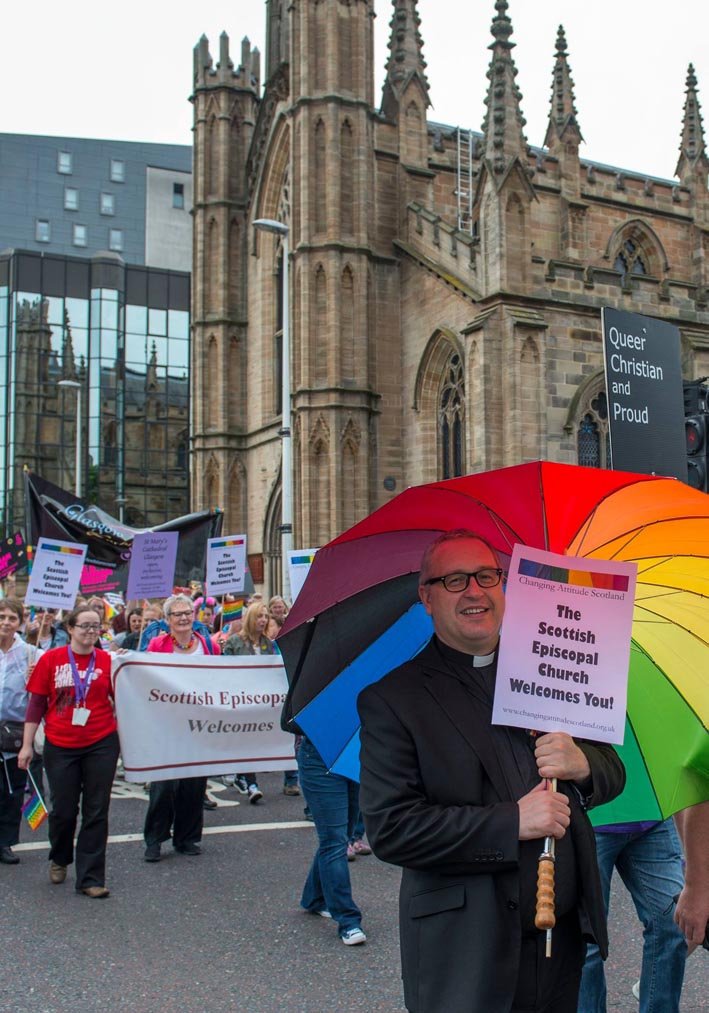
    Kelvin Holdsworth at Pride MarchI rejoice in the progress that we’ve made. But I’m impatient for more. I’ll carry my placard on Saturday at Pride and put a smile on my face. Blessed Are The Fabulous I’ll proclaim and I’ll mean it. But I’ll still be walking on streets in which it only feels safe for most same-sex couples to walk hand-in-hand for a couple of hours a year during Pride itself.

    I’ll also be marching wearing a black suit, clerical shirt and a white clerical collar because of the thousands who will be there for whom that will be an extraordinary thing to witness and something that they can scarcely believe possible.

    Yes, my own small corner of the world still has a lot of work to do. In my own diocese, the clergy asked clearly during the last Episcopal vacancy for intentional work to be done on racism, sexism and homophobia, recognising that these were all issues that were real in the diocese and that our attitudes to difference had played an ugly part in our attempts to try to choose a new bishop. A few years later, we are going into another Episcopal vacancy with none of that work done. And yes, what I experience as homophobia is deeply related to what my female colleagues experience and it is made out of the same basic material as the racist presumptions that black colleagues know well. And even since that time, anti-trans prejudice has grown and grown like an invasive new plant species. It poisons and diminishes all who taste its fruit.

    There’s nothing new about that poison either. Lots of us know it all too well.

    The easiest prejudice to counter is that which is most obvious. In-your-face discrimination is easy to point out if you are able to speak from a place of safety. Much harder is the bitter prejudice of the well meaning – that of those who couldn’t possibly be homophobic because they went to such a lovely wedding only last month, who can’t be sexist because isn’t it wonderful that we have lady vicars now and who couldn’t possibly be racist because that would be just unthinkable!

    Prejudice is part of the psychological air we breathe. It forms part of who each of us are.

    Think you don’t have any yourself?

    Think again.

    Think I don’t have it?

    I wish.

    How long will it be before it is unthinkable that women colleagues will ask whether another woman will ever be elected as a bishop due to accusations being made about the alleged behaviour of a bishop who happens to be a woman right now? How long before the qualifications of those who arrive in the church who happen to be black will be treated as being on a par with those who happen not to be? How long before I can simply sit and eat a pie?

    For all these reasons and 10000 other micro and macro aggressions, I’ll be marching at Glasgow Pride on Saturday.

    Anyone who shares the dream of a world where we are all treated equally and treated well is welcome to join me.

    Blessed are the fabulous.

    And blessed are the impatient too.

8 responses to “Synod Review – things you might have missed”

  1. kelvin Avatar

    COMMENTING POLICY

    Someone has tried to leave an anonymous comment making an allegation against someone in our church, that specific instances of bullying have been covered up.

    Whatever my sympathies are about the issue in general or what it being said in this case in particular, it is my view that dealing with this kind of thing through leaving an anonymous comment on a blog is neither an appropriate nor fruitful way forward. Indeed, my guess is that any anti-bullying policy worth its salt would argue that such a comment was itself an inappropriate behaviour in church circles.

    There is a grievance procedure in the church. If the person who left the comment would like to contact me by email or phone, I would be happy to point them towards the most appropriate way of dealing with the unfinished business which is causing them concern.

  2. chris Avatar

    Glad you had the energy to write this up so soon. I’d be interested in the further pursuit of the perceived irregularities with the Reserved Sacrament – but right now I have to get out to an entirely lay-led RS communion …

  3. Sarah Murray Avatar
    Sarah Murray

    It would be great to see the stats more widely available, they are quite difficult to get hold of- having written a paper on secularization and the SEC this year- stats were the first place to start to look at the trends and whether they matched the general trends etc. however I had to go around the houses to find them and then there were some considerable gaps. The census data unfortunately doesn’t include SEC as a separate category and therefore we have no picture from that data either. The patterns and the implications are hugely important picture for the future of the church.

  4. Suz Cate Avatar
    Suz Cate

    First, I offer thanks for the glimpse at a sister-church’s inner workings. Fascinating!

    I’m so sorry to hear that your preparation for ordained ministry included bullying. My personal experience here in TEC of the USA has been entirely supportive and not a bit confrontational (which isn’t to say it hasn’t been probing at times), but I’m aware of colleagues whose “process” has definitely included some bullying, and it is disgraceful.

    Your observation that “by such small mercies that great social change happens” is apt. I’ve seen that principle in action in our diocesan convention, in the pews of multiple parishes, and, more significantly for a native of the southern US, in the hundreds of daily situations in which persons of all different sorts have access to what were in former times the exclusive privileges of white upper class.

    The fact that there are still unspoken and unseen barriers to truly free access (here I’m thinking of my African American friends who feel the need to teach their sons to avoid encounters with the police, for instance) bears witness to the need to include as contributors and consultants the subjects of projects such as the Grosvenor Essay.

    Data matter. Even outliers are meaningless without the context of the data.

  5. Melissa Holloway Avatar
    Melissa Holloway

    I believe in small mercies – but the genesis of the small mercy mentioned here is a voice of leadership and power. In my southern USA diocese, as far as I can tell, the bishop’s voice goes in a different direction.

    Also, there is a ‘once upon a time’ that I think pertains not just to the Anglican Covenant, but also to the full inclusion of gay people in the church:

    “Once upon a time, I would have been on my feet encouraging, threatening, cajoling. I’d have been sowing fear, uncertainty and doubt. I would have been at work behind the scenes, bending people’s ears, twisting people’s arms – ”

    To risk being coy- as I was recently exhorted, we wait for the holy spirit here.

    I rejoice for this episode in the Scottish Episcopal Church, but it doesn’t make me feel so sanguine about my own life in the church. I hope for the day when a bishop I can claim says such a thing in a diocesan convention and then also for the day when everyone just wonders what the nibbles will be.

  6. revruth Avatar

    I wasn’t there nor did I manage to catch up on the talk about the deaconate online, but I wonder if anyone mentioned how this was going to be financed. Ordaining lots of deacons might be a very nice thing indeed, but I wonder if there is money for this. I reckon there are few churches who could afford both, so…?

  7. Christian Avatar
    Christian

    Fr Kelvin,

    It’s sad but not surprising to read your reporting on the SEC Synod debate about ministry. I am utterly perplexed to read that folks in this day and age think that someone coming straight from college knew nothing about the world. This is one of the reasons why I think that SEC will continue to struggle to attract younger members of our communities if they will not be accepeted (given the opportunity) and recognized for who they are and what they bring–Freshness, passion, zeal, strength, etc.

    However, I thank God for the grace and boldness given to our Primus to respond robustly to such ill-thought notions like: [There were calls for more non-stipendiaries working “not in the parish but in the world” and also for us to focus on those who have “life-experience” to be sought for ministry and not those coming “straight from college who know nothing about the world”.]

  8. Julie Avatar
    Julie

    Provost Kelvin

    It was refreshing to read the various reflections in the special edition of Inspires on-line post Synod 2012.
    Where there were any differences, when I compared the above with your Review, from my perspective, I felt your description was more measured & accurate.

Leave a Reply

Your email address will not be published. Required fields are marked *

Previous Posts

  • Statement on the fire at Notre Dame

    The fire at Notre Dame Cathedral is a tragedy not only for Paris and the people of France but for the world. Those who know the building will be unable to see the pictures of the fire without feeling heartbroken. So many different things that make up the building are priceless – the medieval roof,…

  • If I had just one more sermon to preach…

    During Lent, members of the clergy at St Mary’s are giving addresses at Choral Evensong on the theme “If I had just one more sermon to preach…” Here’s mine: In the name of God, Father, Son and Holy Spirit. Amen. If I had just one more sermon to preach, I’d tell people that God loved…

  • Statement on the Christchurch Terror Attacks Against Muslims

    Glasgow in Scotland and Christchurch in New Zealand are linked by the fact that each contains a cathedral built to an identical design. Christ Church Cathedral and St Mary’s Cathedral, Glasgow were built to identical plans. Christian hearts and Muslim hearts are made to the same design as one another. Today we weep for all…

  • Teaching sermon on Confession and Absolution

    During Lent, I’m preaching giving simple teaching addresses focussing on different things that we do during the Eucharist. In the name of God, Father, Son and Holy Spirit. Amen. I don’t know whether you’ve given something up for Lent. These days I often tend to think of taking something up for Lent rather than giving…