
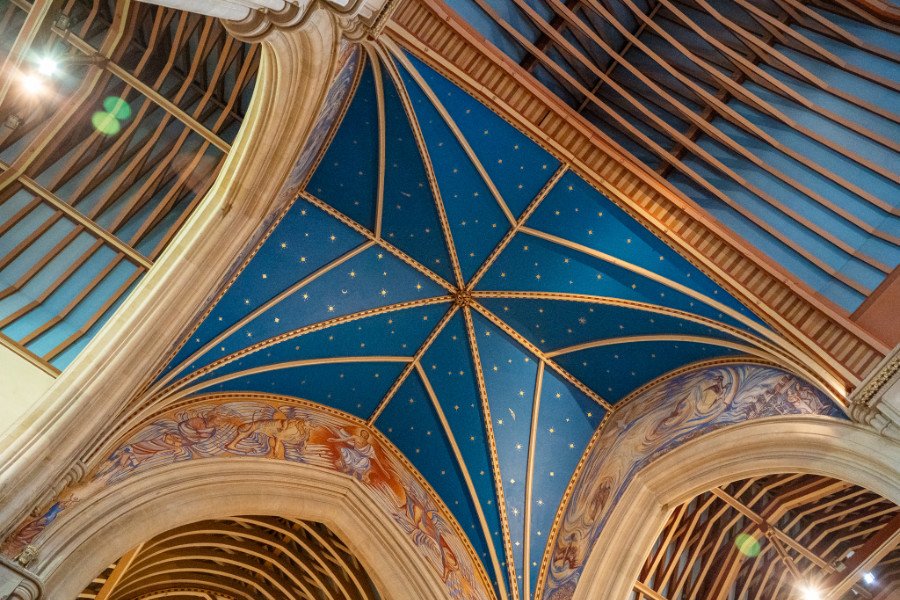
This Quiet Revival thing is real you know. At least, it feels real around here.
For a number of years, I’ve been aware that young adults now seem to have different attitudes to religion to young adults of perhaps 20 years ago. Specifically, young adults of today do not seem as negative towards religion, and particularly organised religion, as their predecessors did. It has always been the case that there has been a minority of people interested in churchy things and a larger minority of people who would be prepared to acknowledge that they were interested in things that might broadly be termed spirituality. However there seems to me to be more younger people around these days who are explicitly looking for a different narrative to live by. And they are asking big questions.
I think there have been signs of the Quiet Revival for a while – quite a while actually. But it is getting more obvious to more people and showing up now in significant pieces of research.
I think about my ministry not so much in terms of the number of years that I’ve been in the job that I’m currently in but in terms of the colleagues that I have worked with.
About 10 years ago, I worked with a Vice Provost, who devised a programme for those enquiring about the faith which was called The God Factor. The fundamental, core feature of the programme was the first meeting of the group, which was a gathering of the questions that the group most wanted answers to. Again and again we ran the programme and again and again we found that people wanted to talk about big themes. They wanted to talk about God. They wanted to talk about salvation. They wanted to talk about theology. And we worked out a number of set piece sessions where we could explore some of these big questions in fun ways in a series of group sessions.
More recently, I worked with a different Vice Provost. Together, he and I were appointed as the Episcopal Chaplains at the University of Glasgow. The pandemic was upon us but still we tried to work out what we might do with higher education students when it was possible to gather together again.
“Oh, it is easy,” I said, “I’ll just get out my guitar again and we’ll order in some pizza and try to gather a wee group”.
You see, I’d done University Chaplaincy twice before in times when it seemed to me that it was difficult to get anyone interested in the church. There always had to be a lot of coffee or a lot of pizza to get anyone to come near.
I could see my colleague’s face fall at my talk of guitars and pizza. He was, after all, so hip that he’d just written a dissertation about hipster religion and he proceeded to tell me the several different ways that I was wrong. He was gentle but determined. I never heard him shout but he may be the only person I know who can speak in capital letters quietly.
“THEY ARE NOT LOOKING FOR THAT ANY MORE” he said.
And I grew to understand from working with him that there was a new interest in the transcendent – the glory and the wonder of worship was suddenly something that people might be curious about.
“So what are we going to do then? High Mass and Evensong?”
“EXACTLY!”
And thus began an interesting and creative period of University Chaplaincy work quite unlike anything I’d done before.
And instead of the half a dozen people I thought we might gather, we found ourselves with a congregation of 40, 60 or even for Ashes and Allegri, a hundred and twentyfold.
Now, I’m working with a new colleague. And the thing that we’re talking about is that younger adults are turning up in greater numbers than they were. We put on a programme for people finding a way into the congregation called A Rough Guide to St Mary’s. We usually put it on a couple of times a year. We’ve just had to run an extra one much sooner than we usually would at this time of year simply because there were people about who needed it. Each time we do it, we get 10 or a dozen folk whose age range is varied, but most will be under thirty and most will not be Anglicans or Episcopalians by tradition. Some will have come from other church backgrounds but some will have come from no obvious church connection previously. And some will come clutching philosophy books that they’ve been reading. Plato and Simone Weil somehow send them here.
Now, I’m long in the tooth and grey of the head so I can’t speak directly for what this feels like to be a young adult. But young adults can’t speak about how young adults have changed either because they were not around before. The truth is, something seems to have been changing over those years.
Yes, we are seeing more young men than we used to. Yes, we are seeing people attracted to quite structured forms of worship. Yes, it feels as though this is growing somehow.
Last year for the first time in our history, St Mary’s Cathedral, Glasgow baptised more adults that children. We’re likely to do the same this year too.
I’m hearing stories like this from other Episcopal churches in the city. I know of one which is putting on unexpected Discovery groups to allow people to talk about the faith. I’m intrigued by this, not least because I’m fairly convinced that the phenomenon that we are seeing has little to do with Diocesan Mission Strategies or Whole Church Mission and Ministry policies or anything like that.
I don’t seem to be hearing about this happening in the Church of Scotland but that may simply be because of the circles that I move in. Whether happening or not, the recent listing for sale, of Culross Abbey, a thirteenth century monastic church that is literally at the start of an up and coming pilgrimage route seems incredible. It seems extraordinarily tone deaf to do this in a world where people are looking for deeply rooted faith connections and where younger Christians are longing for the transcendent.
Based on what I’m listening to though, the wind seems to have changed spiritually, and I’m not surprised at all that this is starting to show up in statistical surveys. The biggest of these is a large piece of work that the Bible Society commissioned about which there has been a lot of online chatter. It is in connection with its findings that the term The Quiet Revival has been used.
I suspect that it will be a while yet before this shows up in denominational statistics – not least because published church stats are often a little out of date by the time they are published and it is hard to see what it going on when some congregations are experiencing a gentle revival and some are still experiencing gentle (and not so gentle) decline.
Round here, the Quiet Revival doesn’t seem to be quite the great resurgence of traditionalism that some conservative voices seem to be excited about – it is happening in churches which are consciously liberal. There does seem to be an attraction to fairly structured worship and carefully thought through philosophy. This simply seems to be a new season where younger people are looking very seriously at faith and making deep commitments. Belief is being taken very seriously indeed. So is religious practice. (And as I’ve said for years, we need to talk more about practice).
The simple reality, is that liturgy is back.
I have a number of questions about the Quiet Revival that I’m trying to think through at the moment and I’d be interested in comments from others.
Are other faiths experiencing something similar – it wouldn’t particularly surprise me if that was true?
If other faiths are experiencing it, which ones are experiencing it? Specifically, is the current yearning for something to live by bringing people more to organised forms of religion, which each have their systems, narratives and beliefs, rather than more do-it-yourself forms of faith which are more about picking what you need from a set of spiritual practices?
Is this longterm, or is it just a flash in the post-pandemic pan?
I see this happening in urban liberal, liturgical churches. But that’s because I’m the Provost of St Mary’s Cathedral in Glasgow. Where else is it happening and what are the common themes?
What new resources do we need to help people to find a Christian way of living in a world which seems so angry, violent and out of control?
25 responses to “Same-Sex Marriage Consultation Responses”
Rosemary Hannah
I was so proud to be a member of St Mary’s when I read this, especially as I knew that for some vestry members it was very contentious issue. It is so good we can have strong views and hold together despite them. It is also good to know that we are unafraid to actually say something – something real.
Your last point on the situation vis-a-vis transgendered people is well made, though would require the Gender Recognition Act of 2004 to be revisited and amended, since it is that (which is, admittedly, propped up by the current definition of marriage) which requires the dissolution of marriages and civil partnerships where one partner’s gender is legally changed. That being the case, we can’t eliminate the potential injustice to transgendered people you refer too without updating the legislation on civil partnerships alongside changes to marriage. I enlarged somewhat on that point here:
It is heart-warming to read this. It is the compassionate side to Christianity that can be seen too infrequently. It does make me proud, to be even vaguely associated with the Episcopal church, reading something so positive regarding same sex marriage. It speaks volumes for St. Mary’s that the vestry as a whole produced this response.
It is understandable that ‘pride/heart warming’ feelings have taken over in St Mary’s this week among those who genuinely believe that they are advancing equality etc and so offering more fulfilling days for those who engage in homosexual activities.
The silence of another perspective which lies behind Rosemary’s statement [for a spectrum on this issue exists in every christian church, albeit not so wide as in society in general] “for some vestry members it was very contentious issue” suggests that it doesn’t seem to be what one does in St Mary’s,namely, to express openly[at least in this blog], any serious concerns about the trajectory being pursued. Or any concern that the approach being followed may be incurring God’s displeasure, and may be leading many well meaning members to find themselves under God’s judgement.
Surely in any christian church one cannot just assume or have a settled conviction that such a God is not the God with whom we have to do. If that is the only view that is espoused at St Mary’s then again is that because the opprobrium which would follow [as this comment will produce] is too powerful to withstand.
As in CoS I recognise that the Episcopal hierarchy are representing the broader view, and St Mary’s own statement recognises another understanding – but this blog is not yet exhibiting that balance, hence my encouragements to another outlook to make known its thinking to the world.
Let me add, however, that the aim of such an encouragement is not simply to expose diversity, rather it is to encourage genuine biblical dialogue, so that the christian church may exhibit to the world the mind of its King and Head, the Lord Jesus Christ.
The apostle Paul, quoting earlier prophets in Israel, had to say of those who were known in the ancient world as God’s people that the name of God was being blasphemed among the Gentiles because of their hypocritical behaviour.
Do only Christians get married William? Of course not. Do only anti-gay Christians have an interest in getting married? Again, of course not. I’d imagine also that St.Mary’s vision statement shares some of your theological language and is considerably grander (in the best sense) and less dehumanising than ” offering more fulfilling days for those who engage in homosexual activities.” (which frankly sounds more suitable for a 70s-based STD clinic) . Your attempted contrast between the “biblical” view and the mere “broader” (and presumably broad for broad’s sake?) alternative understanding of relevant opinion is absurd.
You know, William, Kelvin is being just too nice. (Words he never thought he would see me write, those). The whole point is that the Vestry has recorded that there was more than one opinion among it members, and recorded both or all sides, and yet put forward the majority view. The point is that mature people can disagree, and still respect each other, still further the views which they do not share.
Gay people marry for the same reasons that straight people do – they love each other. Ad yes, you are right – it is more fulfilling to live with somebody you love rather than to meet them for brief, clandestine moments. I wish I could be sure you will be able to understand why – the reason is that it is hard to live with somebody, and to keep putting their needs and interests first. It is a whole heap easier to live alone, and have cornflakes for tea if that is what you want, and not have anybody else to consider, but just casual sex if you fancy it. Only, that way one tends not to grow up very much. Go figure. And go spot the links between paragraphs one and two of this little post.
Rosemary, Kelvin is always nice, and even when we don’t agree, not only can we respect one another but love one another enough so that we would want to take each other’s thinking forward together as we seek to approximate to the mind of Christ. Didn’t Paul set that paradigm before us in his epistle to the Romans?
That’s the nature, indeed the purpose of us together forming the body which is the church of Jesus Christ – a living organism united by the same Holy Spirit.
“Gay people marry for the same reasons that straight people do ”
There’s a statement which needs not only explication of at least four of its terms, but more particularly exploration of its intent – and that’s the matter that was not being explored in this current blog theme of ‘heart warming’ contentment.
I am not calling for people to be direspectful of those with whom they ‘disagree’, or of the majority perception in St Mary’s of ‘same sex relationships’, but for robust biblical dialogue – but nobody seems to feel free, in the present regime there, to identify with any other perspective than the ‘majority’ one espoused in St Mary’s Response.
Maybe it’s because Kelvin is too nice!
I think you will find William that quite a lot of people are attracted to St Mary’s because they find it to be a church where the kind of pseudo-biblical judgementalism that you advocate is almost entirely absent, even when we are discussing things where we have clear differences of view. It just isn’t how people behave here. I’m guessing that folk here would generally find that positive rather than negative. There are plenty of churches where people behave in the kind of manner that you seem to want to impose from afar on St Mary’s. The truth is, people here just don’t behave like that.
That’s what the deal is, you see. That’s one of the reasons people turn up.
That’s why we are growing too.
Though I fit into that ethos rather well, for once in my life I can say with all honesty: “It isn’t all about me.”
This is part of what I wrote to one member of the Vestry prior to that response coming out: “I think that part of what makes us an inclusive church and something that we as a church do tend to be quite good at, not just on this topic but on most topics, is that we don’t always agree with each other and that we do always make room for one another’s opinions.”
William, as you seem to be reading only what you want to read, let me spell this out:
The Vestry response to the question on same sex marriage contains an introductory paragraph explaining that there are differing views on this within St Mary’s. It then spends 77 words explaining the views of those in favour of same-sex marriage, and 101 words explaining the views of those who are not in favour of same-sex marriage.
I do not understand how you can possibly read that in such a way as to think that only one view is expressed in the response or interpret it to mean that nobody within St Mary’s feels free to express differing opinions.
Beth, I never had any doubt about the Vestry consultations, as Rosemary indicated – nor did I fail to recognise the differing views incorporated within St Mary’s Response –
[ my blog 8 Dec “St Mary’s own statement recognises another understanding “].
I was responding to this blog theme of “heart warming/ pride” which initially and is right up to your comment not exploring the view held by the majority in the christian church – even the Scottish Episcopal Church – that the bible may not sustain a ‘revisionist trajectory’, to use Church of Scotland language.
That would be the same Scottish Episcopal Church that, back in 2005, said it had no problem with gay people (and no, not only the celibate kind) being clergy? And that in all of Glasgow has precisely one church that beats the anti-gay drum in the manner you’d deem biblical? And of course, one hopes that you are busy informing said anti-gay churches that really ought to listen to the voices of gay people in the interests of “balance”.
You did allude to the fact that the St Mary’s response recognises a ‘different understanding’, but the way you have written that sentence suggests (to me) that you’re saying that the St Mary’s response is different to that of the SEC hierarchy. You have elsewhere in this thread said that “nobody seems to feel free under the present regime [at St Mary’s] to identify with any perspective other than the ‘majority’ one espoused in the Vestry response”, that “some views are not expressed too openly at St Mary’s”, and that “it doesn’t seem to be what one does in St Mary’s, namely, to express openly any serious concerns about the trajectory being pursued”. The point that I am trying to make is that, contrary to what you have said here, various members of the congregation identify with perspectives that disagree with the Scottish Government proposals, they have expressed these views openly, and their opinions have been incorporated into the Vestry response.
Perhaps part of the issue is that you seem to be having trouble differentating between this blog and St Mary’s and therefore trouble understanding that there is a difference (an enormous chasm of a difference, in fact) between the expression of one’s views on a personal blog and the dictatorial imposition of those views on one’s cathedral.
Kelvin, I think you’ve just exposed why some views are not expresed too openly at St Mary’s – the ethos implies that such thinking is “pseudo-biblical judgementalism”
And even the unwritten assumption “That’s what the deal is, you see”
I am not trying to ‘impose’ anything in St Mary’s from afar, but it would seem you certainly are.
The fact that numbers are growing – I wonder why you chose to enter that fact? – as you well know, proves nothing, albeit I’m encouraged to hear that any church has an increasing attendance these days.
Every blessing.
What you need to do william is to come and worship at St Mary’s – where you will find a warm welcome and an un-cowed congregation loudly expressing all of its views very openly. I don’t think imposing views is something Kelvin is much tempted to – but if he was I would advise him to find another congregation on which to do it. However, you will also find a lot of gay people. People know we have gay as well as straight clergy, and that means gay people know they will be welcomed there and not looked-down-on. Since that assurance is a moderately uncommon thing, we attract gay Christians. And it is, by and large, a very liberally-minded congregation. It means that somebody like me can worship there and know that I am not going to be harangued or looked-down-on for my views either, or find I am alone in openly expressing my views, which is exhausting. And not just views on equal marriage. I was made to feel criminal in another church for disliking one particular theory of atonement, and by the priest too. This freedom to think and argue is the very thing that makes it a congregation likely to hold views closer to Kelvin’s than to yours.
Ooh, that reminds me, Fr Vice Provost did a workshop on atonement theories the other night that sounded really good. I think he described it to me as an Atonement Supermarket – several different theories all laid out in the room and people invited to position themselves in the room according to what theory or theories attracted them most. Excellent idea – worth repeating, I think.
It seems I can’t reply to your reply to my reply. OOOh – no wonder I love St M’s – you will be intuitively there before me when I say I am not great on cosmic child abuse.
[…] arguments against changing the law. She finds support from What’s in Kelvin’s Head? who reports that his congregation have sent in a response that’s in favour of the […]
Some years ago now, I introduced readers of this blog to the twin churches of St Eucalyptus on the Rocks and St Anaglypta by the Skerry. They were dreamt up by me in order to illustrate a point. I was trying to get people to think about whether bread and wine could be consecrated by…
Content Warning. This gospel reading contains scenes which some viewers might find disturbing. Content Warning. Viewer discretion is advised. Content Warning. This exegesis contains strong language which some listeners may find offensive. Content Warning. The language used in this interpretation of the gospel contains expressions which were in common use at the time which may…
I have a question for those of you who went to Sunday School when you were young. What’s the least appropriate thing you remember being taught there? As we’ve been going through the stories from Genesis over the last few weeks, I keep thinking to myself – gosh, I remember learning this story in Sunday…
The first thing that I tend to notice is that there seems to be more sweet things in the shops in Great Western Road than usual. And then on the day itself it is obvious that there’s more people going about their business all dressed up for an occasion. Some of them are carrying food.…
Leave a Reply