
• Listen up! Moocs are the future

    OK listen up. Moocs are the future.

    Now before we go any further, let’s get the usual responses out of the way. The usual responses are twofold:

    1. What’s a mooc?  (Most people)
    2. *rolls eyeballs* (lots of academics, including quite a few in my congregation)

    Firstly, a mooc is a term used for a new form of education that you engage in online. It stands for Massively Open Online Course. Such things have been around for the last couple of years and there’s a good wikipedia page on the concept.

    The basic idea is that you do a course online along with many thousands of other people all at once (massive) which you have easy/free (open) online (online!) access to. It is a way for someone to teach many people. Many, many people. I’ve just finished doing a mooc where a team of three people were attempting to teach 13000 students all around the world.

    But why the eyeball-rolling from clever people?

    Well, any teacher worth their salt is going to say, “Ah, but wait a minute? Hang on there… what do you mean…. that’s not a learning experience that is equivalent to what I can do in a classroom.”

    And you know what? It isn’t.

    However, it is here, it is now and it is going to develop in the future all the same.

    Now, are you thinking you’ve heard all this before – are you thinking this is just a glorified correspondence course? Sure you are. But this is a bit more than that. Typically in a mooc, you get video lectures or other content to download, maybe on a weekly basis. You work through that stuff and you get online quizzes and exercises that you do along the way. If the course is well designed, you get instant feedback on how you are doing and can go back and review any of the bits that you didn’t understand.

    But here’s the thing – it isn’t just you. It is social. There’s a whole bunch of people out there doing the same course as you. And you can get to interact with them on the forums. Indeed, some of the ways that the mooc is assessed may include interaction on the forums. (Cue eyeball rolling from academics who can’t work out that this is the equivalent of giving a mark for interaction in class discussions, which is a relatively common practise in some institutions).

    Then, when all is done, you may well have a final piece of work to submit and this will be marked. But hey, how do you mark 13000 pieces of work? Well, if it is not machine markable material (multiple-guess questions) then the mooc method is to get students to peer review. In the mooc I’ve just participated in, we were encouraged to produce a final video and to pass the course you had to, not only submit your own video, but assess three (or more) others.

    Then you get your certificate and there is much rejoicing.

    Now, here’s where the Eyeball Rollers have started to harumph loudly. “What use is a certificate when no-one qualified has seen the work? Isn’t this the dumb assessing the dumber?”

    Well, the truth is, such a certificate is worth precisely nothing in terms of the educative processes that we have been used to.

    But get this, moocs are not really about what the certificate is worth. The satisfaction comes from having learned something new. Getting the certificate is just icing on the beans. Yet getting that certificate is oddly fulfilling – it is part of the gamification of learning. You get a certificate, you want another. You unlock a level badge, you go  back to try to accomplish the next level.

    Anyway at the end of this post is my certificate from the mooc I recently completed. I don’t care what you think about its value – for me it represents a whole bunch of skills that I just learned. It is for a course that was really for school teachers on Blended Learning – that’s about how to mix learning that takes place in an online setting with more traditional face-to-face teaching. I took the course because I want to be able to offer some online courses at St Mary’s as well doing what we already do. It seemed sensible to do the course and also learn from completing the mooc itself.

    What does this mean for the church at large – well it means that education needs to get slicker. In the same way that new technology has meant that we need to up our game in religious circles in the way we communicate with people, so we need to do the same with how we teach. That scrappy stapled-together church magazine is a great means of communicating but it does so on two levels. On one level, it communicates to those who have always received it that things are carrying on just the same as ever and even lets them know whether they are on the coffee rota on Sunday. To the more casual reader, however, it probably communicates that you are not terribly professional, have low expectations which will carry forward into worship and that you are desperate for someone to join the coffee rota to try to replace the people who are dying off.

    It is the same with education. Sitting around a flipchart with half a dozen people is something that I continue to do. However, increasingly as I do it, I’m aware that the ways in which people learn are changing. Gamification (rewards – yes, sometimes silly little rewards) is here to stay. Blending of online and offline worlds is how people are doing everything from shopping to looking after their health so why shouldn’t that affect how we learn about Things That Matter in church circles? And yes, self directed learning is here to stay.

    There’s new technology on offer here. Who knows what we’re going to do with it?

    And here’s my certificate, which I’m terribly proud of, can you tell?
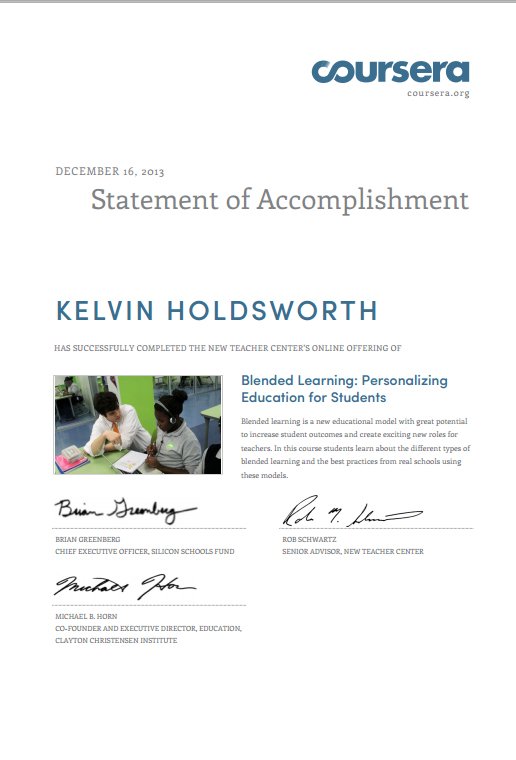
    Blended Learning

23 responses to “What if this is the end of the Eucharist?”

  1. Thomas Scott Avatar
    Thomas Scott

    Just noticing here that DGD (of happy memory) seems to have left out of his catalogue of joyous, sad, perilous, and solemn occasions any instance of celebrating during a plague or pestilence. I’m not worried about the mass. The eucharist need not be celebrated as though it were a car battery, as if not offering it now would somehow allow the power to run down. It is not at risk, we are, which I think is your point. The questions asked are worth asking, of course.

  2. Mo Nicholson Avatar
    Mo Nicholson

    Mo Nicholson. This is an intriguing discussion and what I would like to add to it is the observation that I have had to learn the hard way that participation in the Eucharist being made impossible in no way diminishes an individual’s ability to worship God or be in fellowship with other believers. I am barred from receiving Holy Communion in the Catholic church because allergies make this impossible for me. The pain induced by this has little to do with feeling separation from God, in fact nothing at all as I do not feel that. It comes from feeling excluded from the community, different sections if which regard it as desirable or tolerable that a member of the community should be excluded in this way. This experience has made me understand as never before that if we place prime value on liturgical celebrations, ir indeed anything else, above charity, compassion, welcome and inclusivity, in other words love, then we have become the sounding gong which St Paul warned against. If we truly believe that God is love, as I do, then it is obvious that it is love for one another which makes us true children of God our Father, and in light of this we could begin to look at these present challenging circumstances as simply an opportunity to love more, to reach out to one another in whatever way possible in the knowledge that this is what actually matters and always did. Only perhaps we were tempted to almost make a fetish of our rituals, sacraments and so on. And perhaps this can show us a better way more adapted to the world we are supposed to serve.

  3. Lynsay Downs Avatar

    You and your conversation with Dave Roberts prompted me to write this. Does it resonate for you?

    https://astonishing.community/2020/05/06/conversations-in-coronatide/

    1. Kelvin Avatar

      Thanks Lynsay – yes, it does resonate with me very much.

      I’ve shared it on facebook. I think it is really helpful.

  4. Fr Keith Avatar
    Fr Keith

    Thanks again for such a thoughtful piece. With the Eucharist central to much of, at least Anglican/Episcopalian, worship in recent generations, we perhaps forget that the Church in these islands was, between the Reformation and the liturgical revivals of the 19th and 20th centuries, sustained by Mattins and Evensong as the regular diet of worship on Sundays. I’m not advocating a return to such times, but there is, as you suggest, work to be done on non-Eucharistic worship (though not defining it as a negative). Thanks again.

  5. Fenland Boy Avatar
    Fenland Boy

    For the record, I’m not in favour of lay presidency at the Eucharist. I believe, for better or worse, in an ordered church.

    Why are you concerned about lay Presidency?

  6. Chuck Avatar
    Chuck

    May I say respectfully, lighten up. Many Anglicans/Episcopalians lived on the edges of civilization in the nascent U.S. and various elements of the British Empire. Priests to celebrate the Holy Eucharist and to baptize were seldom seen, at most twice a year in many areas. (Bishops, only every several years.) The Church carried on in this manner decade after decade. If circumstances require, the Church will carry on again despite our profound sense of loss.

    I should add, to those who grew up under threat or reality of war, persecution, oppression, famine, other disease, etc, the present difficulty is not unfamiliar in many respects.

  7. Miriam MacCarthy Avatar
    Miriam MacCarthy

    Thank you! It is wonderful to read these serious, personal thoughts about the Eucharist. My feeling is that it has become celebrated to the point of boredom. Church, and what we do in it, is in danger of becoming simply a habit. It could just as well be crackerjack for a fast-asleep congregation. My heresy is that the direction Jesus gave is to “do this in remembrance of me”, and that means everything we eat at any time, whether alone or with others, in thanksgiving. If that is seriously done, it has vastly more meaning. It really gets ones attention and requires preparation. Would not become popular or usual, I predict!

Leave a Reply

Your email address will not be published. Required fields are marked *

Previous Posts

  • Random advice to someone newly ordained

    Treat everyone as though they are an adult. Especially children. When any hand is held out for communion, think WWJD? Don’t diss the Mothers’ Union You have been given the power to bind and loose. That means you have to say yes to everyone all the time, sometimes by saying no.

  • Guild of Servers

    To Hyndland yesterday to the annual festival of the Scottish Guild of Servers. Having previously chuntered to the guild office bearers about having the service in far-flung places (including our companion diocese of Argyll and The Isles, over the water), I decided that I had better turn up yesterday when it was just a couple…

  • Most commented

    Someone said to me that yesterday’s post looked like the most commented upon post on the blog. Not so, in fact. Most discussed posts so far have been: The Advent Candle Controversy – 47 comments and counting Two Literary Questions – 42 The Episcopal Brown Shoe Scandal – 33 Collecting things (the Collaborative Ministry thread)…

  • Liturgy should say what it means, and …

    The chiasmus that is so often quoted about liturgy these days is that liturgical writing should say what it means and mean what it says. By and large, I agree with that, though we do have to allow space for the times when we cannot grasp or explain all that God is. However, I have…