
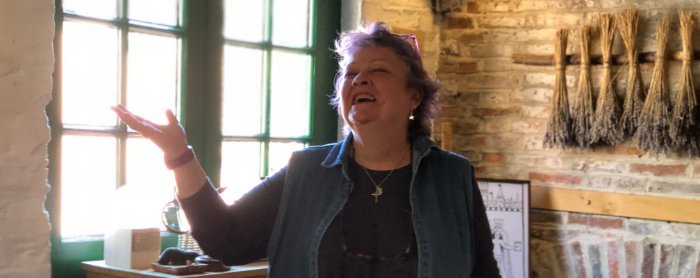
This week the funeral will take place of an extraordinary priest, the Rev Canon Ruth Innes of the Diocese of Edinburgh.
Ruth served various congregations in that diocese – St Fillan’s, Buckstone, Christ Church, Falkirk, St Mark’s, Portobello and St Peter’s (formerly St Mildred’s) in Linlithgow along with St Columba’s, Bathgate.
Ruth never worked in large churches. Each of these places had their own vulnerabilities. But to her, each of her charges were for the time she was with them, My Little Flock. She was defensive of those she cared for too. Not so much a mother hen as a mother lion.
People will remember her as pastoral, caring and imaginative. Some will also remember her with that double-edged description – that she was colourful.
Ruth’s outrageous sense of humour and extravagant love could make some nervous of her. However, Ruth was not merely colourful in the sense of being slightly quirky – she wasn’t slightly anything. Her personality lit up the world and made it far more vibrant.
Despite working as a rector only in relatively small congregations, Ruth was widely known throughout Scotland and beyond. She cultivated her friendships and they lasted many years. Some of these came from the Cursillo movement, some from people she met on conferences and some from friends she holidayed with. Ruth put her friendships to work too in her pursuit of justice. She was a founding member of Changing Attitude Scotland and a key person in the early years of the movement to enable same-sex couples to get married in church. She turned up as a priest in a clerical collar to Pride marches long before it was fashionable to do so.
She cared about the poor. She cared about her family, including her two sons. She cared about the sick. She cared about the dying. She cared about the homeless and spoke, to the considerable surprise of many who heard her, of her own experience of homelessness.
My guess is that when others were making decisions about whether Ruth should be ordained she was described as coming from a “non-traditional background for a priest”. Most clergy don’t have years of experience as a cocktail waitress to draw on after all. Ruth did and she knew much about how people tick as a result. She also brought a sense of fun and good humour to every room she entered.
Ruth was an adult convert to Christianity having been captured by the beauty, peace and joy she found in the church of St Michael and All Saints in Edinburgh one day when she wandered in. These things turned her life around completely.
In recent months, Ruth knew she was dying and was brave and honest throughout. She had been present at the deathbeds of many in her care. She knew the consolations of religion without ever being sentimental about them. She knew that God loved her very much and she loved God greatly in return.
Spirituality is a personal matter. For Ruth it included a love for religious tat. In life, she gathered many icons, statues and rosaries. Some were exquisite. Some were exquisitely camp. None gave her more joy than the pectoral crucifix which also operated as a cigarette lighter – the flame appearing as if by magic above the head of the crucified Lord. She loved all these things but as death approached, she started to let them go. Visiting friends would get to choose from the tat collection but nothing could be removed without one first hearing about the story of where the object came from and what it represented.
Most treasured of the things she gave me was an icon that Ruth always described as Ugly Mary. Having noticed it in a monastery shop, she realised that no-one else would take home such an ugly icon of Our Lady and that thus it fell to her to rescue her and love her. “Why should Mary always be pretty, anyway?”
There is a tendency when someone dies to represent them as either a saint or an angel. Ruth was neither of these. She was something much more – a human being fully alive. Devout, fully alive and full of fun.
May she rest in peace.
And rise in purple.
[Many thanks to Kimberly Bohan for the picture]
Leave a Reply