
The days after Christmas often seem strange to people. Boxing day is St Stephen’s Day, 27th December is dedicated to St John and then on 28th you get the Holy Innocents. Collectively these three days are known as the Comites Christ or Companions of Christ.
Lots of people and lots of churches have run out of energy for keeping these feasts by the time they get through Christmas but we keep them at St Mary’s and a dedicated band of folk will turn out for them. I rather like keeping simple Eucharists after the wonders of Christmas are done. There’s something in the simplicity of keeping these feasts whilst the glories of the great feast we’ve just kept in such magnificent style linger in the memory like smoke from a well tended thurible.
I’m sure that there’s much to discover in the spirituality of these days for everyone but I’m particularly struck by the way that they speak to an LGBT sensibility.
It is important when reading the bible that we read it, at least sometimes, through the lens of our own experience rather than simple accepting what we have been told. The bible speaks most directly when we put away our assumptions and discover the web of connectedness between the biblical experience and our own lives.
Very often gay and lesbian people have become excited at discovering the story of David and Jonathan or the story of Naomi and Ruth and seen there prototype gay couples. There’s problems with that though that are not difficult to see. David and Jonathan were both married to women – so should the excitement of their experience with one another give bisexual folk today more cheer than anyone else? And Ruth and Naomi are mother-in-law, daughter-in-law couple and that’s a fairly strange place to begin building an apologetic for gay lives today.
To a certain extent, I think that regarding these couples as speaking of an experience that can inspire LGBT people today can also fall into the category of things that we’ve been told to to accept that might not, in all circumstances, be helpful.
We should not look at the bible and expect it to provide neat gay characters that suddenly emerge to justify our modern lives. If we start doing that, we risk justifying modern straight people suddenly taking a liking to killing their enemies with the jawbones of asses.
Instead of asking whether a given character in the bible “is gay” those of us who read from that perspective would be better to ask of all the characters – what are you saying to our lives? In what way does your experience and my own relate. What do I have to learn from you and in what way does my perception of what I read about you need to be informed by elements from my own life as well as the scholarship of others?
Take Stephen, for example.

Now, Stephen is probably not top of the list of “gay” characters in the bible, but I remember doing a most fascinating bible study with a group of lesbian and gay people in which we looked at Stephen and found all kinds of things in his story that we recognised. We were fascinated by the story of an apparently gentle soul who wanted to live out his witness to Christ by offering loving-kindness to widows and orphans and who ended up losing his life. We all had stories to tell of people being threatened for holding to their own experience of Christ – after all, gay Christians sometimes get oppressed by the gays and by the Christians.
We read the story of him being stoned with Saul/Paul standing by and we recognised that we knew very well the Sauls – the religious leaders who stand by and do nothing whilst gay lives are sacrified. We felt we recognised the experience of Stephen when “all who sat in the council looked intently at him, and they saw that his face was like the face of an angel”. We could imagine other young men who’ve looked like angels who have been beaten up because their beauty antagonised those who had grudges against them. We read the story of his stoning and quite naturally for us started to talk about gay-bashing incidents that we had known. And every one of us knew the experience of being frightened to be ourselves around people. Especially religious people. Stephen, first martyr to Christ spoke to us through the pages of scripture because his experience was interwoven with our own when we started to talk about him.
It is the same with John the Evangelist who gets celebrated next.
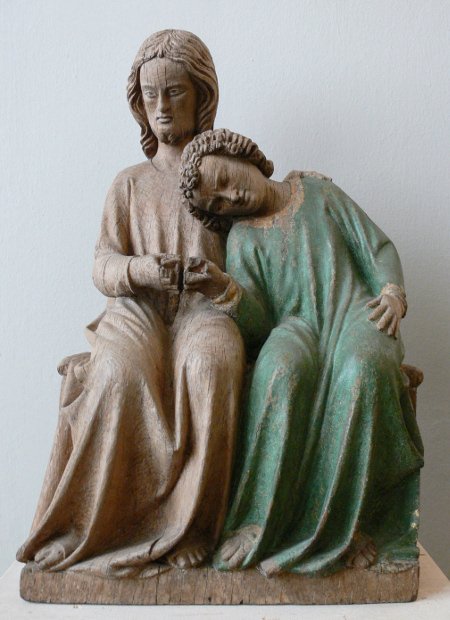
Now, suppose you were overhearing an LGBT group talking about John the Evangelist. What might you hear?
Well, you would surely hear someone begin by talking about the beloved disciple, presumed to be John snuggling up next to Jesus at the last supper, his head upon Jesus’s breast. That intimacy might well prompt a conversation about whether people are looking more for sex or for intimacy. Then someone might chime in with a story about going to Patmos on a holiday to the Dodecanese and reflecting on the proximity of biblical culture with a Greek culture which always seemed to be much more at ease with same-sex affections. Then someone might tell a story about going to Ephesus and going to the House of Mary there and reflecting on the story of Jesus committing his mother to John’s care. That’s a cue for gay men in particular to talk about their mothers and their substitute mothers and their relationships with both. And where mothers are being talked about, coming out stories are being talked about. It is inevitable – it goes with the territory.
And then maybe a conversation about beauty – for the basilica of St John in Selçuk near Ephesus has an extraordinary beauty and to visit a place associated strongly with John is to understand anew his fascination with the Light. That might lead to a discussion of whether gay people are particularly good at curating beauty or whether that is just a stereotype. The discussion might end with a chance to talk about whether gay people are so strongly represented in the creative arts because they have been forced there by a heteronormative society or whether in fact they are particularly and peculiarly good at such things. (You might not hear any conclusion to this argument). But John will himself be referred to in the conversation as someone reminds us that John is almost always depicted as a rather beautiful, rather soft young man. This leads to another conversation about stereotypes and whether the use of the word soft is an example of latent inner homophobia or whether the world is in fact incomplete until men can be soft when they need to be.
And the Holy Innocents.

Well, you don’t need to work too hard to make the connections between a group of human beings threatened by a tyrant simply for being born and the experience of gay men and women do you?
Whilst you are thinking about the holy innocents being wiped out, you might ask yourself what the consequences of all the research that is done on The-Genetic-Causes-Of-Homosexuality might be. If they came up with a pill that mothers could take to ensure that their child were less likely to be gay, should it be marketed? Should it be taken? What are the ultimate consequences of gay people themselves wanting to prove that they were born like that?
The holy innocents might remind us also of those who were killed for being in the wrong place at the wrong time. Might remind us of Pride parades being attacked by the authorities in Russia and in parts of Africa. Might remind us of the silent tyranny of poorer heath-care for gay and lesbian people. Might remind us of teenage suicides. As we reflect on a voice being heard in Ramah – great mourning and weeping, as Rachel weeps for her children we might think of the tears of so many mothers.
The comites christi, the feast days following the birth in Bethlehem are ways of thinking about those whom Christ keeps company with. In keeping their feast days and thinking about their stories we may find ways to experience the bibilical experience for ourselves.
And remember, straight people may be able to do this too. (But only once they’ve come out to themselves as straight – not when they’ve just assumed that they are normal).
Comments welcome.


Leave a Reply