
• Fake Pope Quote Posts

    One of the more bizarre developments in social media has been the rise in fake quotes from popes appearing online.

    One might think that Roman Catholics would be particularly at the forefront of this kind of activity, but that’s not necessarily the case. Anglicans seem to love a good fake pope quote. I’ve seen them posted by an incredible number of people including several senior clerics.

    I am bewildered as to why people post things and in doing so say something like “Isn’t it amazing that we’ve got a pope who said…?” and don’t pause for a moment to ask whether it might be the case that someone has just made it up. Incredulity might well be a pathway to common sense.

    The sad thing is that there’s plenty of profound things that popes do say that are worth repeating. It seems a terrible shame that Pope Francis might be remembered not for his genius in addressing the Climate Crisis in Laudato Si’ but for a series of invented platitudes about hospital walls.

    Particularly puzzling are those, and again, I have senior clerics in my mind, who post these things and then when told that they are not by the pope in question respond by saying that they are going to leave the post up on social media because it sounds like something the pope might have said or that they agree with the sentiments anyway.

    I can’t think of a clearer example of bearing false witness than leaving something published that you have claimed to be written by someone when you know that in fact it was not.

    But anyway, I have a more entertaining response to this from today than just outraged spluttering on other people’s facebook posts, which is to suggest to anyone desperate for a fake pope quote to post online that they ask ChatGPT to come up with a new one rather than recycling someone else’s.

    Here’s how it goes. You open up ChatGPT and you give it this kind of prompt:

    write a fake quote from Pope Leo XIV that is about 450 words long. Make it sound vaguely plausible but the message is the everyone is welcome in the church, even those who think they are not. Use the kind of language of the self-help and empowerment movement to suggest that the pope wants to change the church and that he alone has a vision to do this.

    And bless it, ChatGPT churns it out beautifully.

    There are many who believe the Church is not for them. They whisper to themselves, ‘Surely not me—not with my past, not with my doubts, not with my wounds.’ But I say to you today: the doors of the Church are not narrow—they are wide. They are not guarded by perfection—they are held open by grace.
    We must move beyond the old habit of exclusion cloaked in the language of tradition. We must stop drawing lines where Christ drew none. The Church is not a sanctuary for the flawless; it is a refuge for the broken, the confused, the seekers, the scarred. If you feel lost, unsure, uncertain of your worth—you are precisely who Christ called. You belong here.
    This is not a time for silence or shadows. It is a time for awakening. Too long have we accepted a Church that feels distant, judgmental, fearful of difference. But the Gospel was never about fear. It was always about radical welcome. About the love that does not check credentials at the door.
    I envision a Church reborn—not in doctrine, but in posture. A Church that speaks less about rules and more about renewal. A Church where questions are not threats but invitations. A Church where you do not have to hide who you are to be loved as you are.
    This vision is not shared by all. Some will say it is too soft, too open, too modern. But I say it is simply faithful—to the Jesus who touched the unclean, who ate with sinners, who forgave before they asked, and who never once said, ‘Come to me, but only if you’ve already cleaned yourself up.’
    I do not seek to dismantle the Church—I seek to return it to its heart. That heart is mercy. That heart is hospitality. That heart is Christ.
    If you are gay, divorced, disillusioned, poor, angry, unsure if you even believe anymore—come. If you have been hurt by the Church, forgotten by the Church, judged by the Church—come. If you are full of joy or full of rage—come.
    You will not find a perfect community. But you will find a people trying—trying to be more like Christ, one small, stumbling step at a time. That is all any of us can do.
    The future of the Church is not behind us in stone and ritual. It is ahead of us—in compassion, in courage, and in the willingness to welcome those who thought there was no place left for them. I have seen this future. And I believe it begins now.”
     
    Isn’t that genius? “Not a time for silence or shadows” – completely meaningless and yet exactly the kind of thing that people love posting. I just love “The future of the Church is not behind us in stone and ritual…”. No pope would ever say that. Priests do tend to like a bit of ritual after all and if any pope got near saying that then I’m sure that they could count on those that surround them to prevent them making a fool of themselves and alienating all their clergy.
     
    “I envision a Church reborn—not in doctrine, but in posture.” Can you imagine anyone other than perhaps a C of E bishop commenting on the latest draft of Prayers of Love and Faith ever saying anything so absurd? Yet I’ve seen plenty of even sillier fake pope quotes purporting to be the real deal.
     
    People do love this kind of thing. And that’s exactly the kind of post that I’ve seen posted and liked and reposted dozens of times in the last few weeks.
     
    Might I suggest that we put a stop to it? For as the medieval pope Kelvinius the First said in 1524…
     
    Let not thine idle hands inscribe falsehoods in the name of the Holy See, for to speak a lie in the voice of Peter is to forge chains for thine own soul. Be on guard for the truth. For the truth shall set you ChatGPTFree.
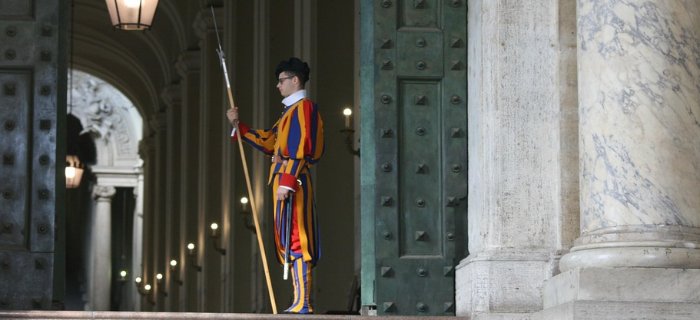
     
     
    Picture of a Swiss Guard on guard.

52 responses to “Inclusive Language – again”

  1. ryan Avatar
    ryan

    Kelvin – that cracked me almost as much as your last tweet on the left of your blog ;-)!

  2. Jimmy Avatar

    Ryan, although you address your comment to Kelvin like I am not there. I assume you are referring to my poem, I can assure you that it does not crack me up watching you making any opinion you may have untenable.

    1. kelvin Avatar

      No Jimmy – I think Ryan was indeed referring to my last comment, above.

  3. Jimmy Avatar

    Thank you Kelvin and Sorry Ryan.

  4. ryan Avatar
    ryan

    No worries! Was indeed referring to the v.amusing coming out day tweets at the side.

    I’m not sure there’s ever existed anyone, anywhere,at any time, of whom it could be said that *all* their opinions are ‘untenable’, so such rhetoric is dehumanising at best. Apropos nothing, I was moved to google the poetic stylings of the great David Brent. Who needs Auden? 😉
    http://murfinsandburglars.com/2009/04/14/bad-poetry-for-tuesday-david-brent-edition/

  5. Peter Avatar
    Peter

    Kelvin; no, I think it distracts. It simp;ly reminds us that this is how your mind works: you make connections and delight in that sort of word-play. However, to sharpen up my point. Thank you for helping me to realise that, for some, ‘family’ is not a positive word in the way in which I experience it. For my part, this willl mean that I will be more careful about its use when others might feel excluded (and therefore hurt). Mutatis mutandi can you accept that I feel offended by what seems to be merely a casual linking between family and the f word? These are sensitive areas, but sensibilities are by no means confined to those who find family a painful or unhelpful concept.

  6. Simon Avatar
    Simon

    I am slightly nervous aboaut the alternatives to the 1982 Liturgy, not because I don’t share the inclusive sentiments expressed above (I do). I fear that, as so often in the history of the church, the steps we take to avoid one kind of mistake in the way we talk about God can lead us into another. The avoidance of pronouns as a measure to achieve inclusivity produces inelegant, strained and stilted English. How would it be if one were to use it in day-to-day speech? ‘I saw John this morning. I asked John’s how John’s health was. John said that John was over his flu, and hoped to be back at work on Monday’. This may not in itself seem to be a problem. But in fact, what very quickly happens when we adopt this idiom in addressing/expressing God, is that the very idea of a personal God begins to recede. My basic instinct is that the church’s language of pulbic prayer is properly anchored in that of the scriptures. There are dangers in departing from this. The perceived problem (rightly perceived) is perhaps better tackled by good teaching about the nature of God, than by linguistic contortions that produce stilted prayers, and possibly a less real and vivid idea of God.

  7. Melissa Avatar
    Melissa

    About the family imagery – another reason to drop it in church is for the sake ones who, like me, do actually have the signifying family relationships.

    There is too much pressure on day to day life with children when that life is forced to serve as some kind of example or testimony or witness to the world – or more likely one’s church friends – about the nature of God.

    I think it sours love because in that kind of scheme loving children is more fundamentally a means to an end.

Leave a Reply

Your email address will not be published. Required fields are marked *

Previous Posts

  • The English Heresy

    A long time ago and in a land far away, by which I mean Fife, I was a theological student. It was a good time in my life. By and large I was in the company of clever people, learning clever things from clever people. Theological education can be exciting and that was an exciting…

  • Turning Up and Being Counted

    I’m currently going through a strange time. I’m away from my congregation on sabbatical. It is a good thing to do and I’m having a great time, meeting fantastic people and learning a thing or two by stopping for a while to breathe. There’s always things that you miss when you are away from the…

  • 12 Things I’ve Learned About Preaching

    At the moment, I’m on sabbatical and am not preaching regularly. However, I recently had the opportunity to preach to a congregation largely made up of apprentice preachers – those who are training for ordained and lay ministries in the church in the future. A number of them have asked me to share some wisdom…

  • It was 30 years ago today…

    It seems extraordinary to me that it is thirty years since I stood with others in Deans Yard in London outside the meeting of the General Synod of the Church of England waiting for news. It was a long day and one that many had worked towards tirelessly, for many years. It was the day…