
• Going out and coming in

    8930043700_df73058f5d_z

    This week I’ll have been at St Mary’s for nine years. It is the anniversary of my installation on Sunday. And this year I’ve decided to give myself an anniversary treat.

    When I came to St Mary’s there was much to try to understand and much to take in. Just trying to get your head around how things work in a new congregation is always tricky. Every place does things almost the same. But almost the same means that every place does things differently. Slightly differently – and that’s much more difficult to cope with than learning something completely new.

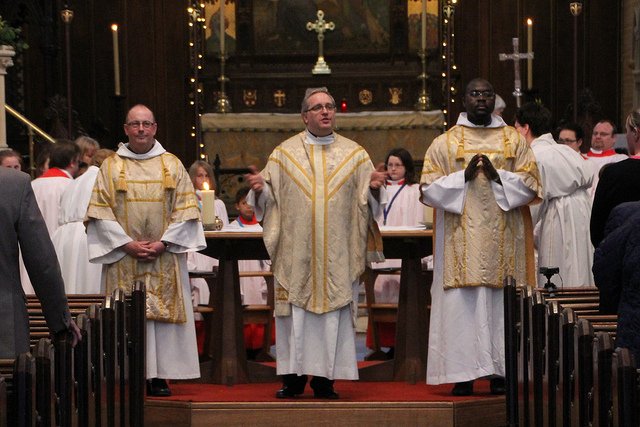
    One particular conundrum presented itself to me on my first Sunday. How did we get in? Did the clergy and choir go in singing a hymn and then turn and greet the people or did we process in, turn, greet and sing a hymn?

    Trying to learn from those who ought to know, I took a couple of people aside and asked them. Their responses were enlightening.

    Person number one told me very assuredly that the choir and clergy processed in singing and then greeted the people.

    Person number two told me just as assuredly that the choir and clergy processed in, greeted the people and then we sang the hymn.

    This was less than helpful. As the days counted down towards my first Sunday I needed to know.

    The only thing I could do was ask another person and take their answer as the tiebreaker. And so I did.

    “Oh, Provost, we do whatever the Provost would like us to do,” was the answer.

    It was a slightly disturbing answer because one of the things that I knew I needed to be here was to be someone who didn’t have all the answers and who could let St Mary’s find a way of being where all the questions didn’t get thrown at the Provost to answer.

    However, without being able to get a definitive answer from anyone, I did in the end say what we were going to do in order to get ourselves into place.

    The trouble is, I’ve been regretting one detail ever since, particularly recently.

    What I said would happen is that we would process in. Then the choir and clergy would bow to one another from either side of the communion table, the clergy would turn, greet the people and then we would sing a hymn.

    It looks smart, it means we all start knowing what we are doing and we don’t flap about with music as we are processing.

    But the thing that has been bugging me recently is that it only really includes those who are at the sharp end of the church.

    We bow to one another to signify that God is present – that God is amongst us; that God is about us and within us.

    But what about the bulk of the congregation? Isn’t God in them too?

    This has been bothering me for some time and I found myself talking to Richard Giles about it on Saturday.

    Now, Richard Giles is one of the most interesting liturgists to have emerged in the last few years. And on Saturday he looked me in the eyes and said the magic words – “Well, if you are not happy with it, just change it. It isn’t too late….”

    And he was right.

    So, we’re going to change things from this Sunday.

    From this week, the choir and clergy will process in. They will then bow to one another from either side of the table. And then the clergy will turn and bow to the congregation who are invited to return the bow.

    We’re all in this together.

    The smallest of gestures can mean a great deal in the world of liturgical worship.

    We’re going to try this one for a bit and see whether it works. My last thought on the subject has served us well for nine years, but it is time for a change.

    Odd what Provosts give themselves as anniversary presents, isn’t it?

52 responses to “Inclusive Language – again”

  1. ryan Avatar
    ryan

    Kelvin – that cracked me almost as much as your last tweet on the left of your blog ;-)!

  2. Jimmy Avatar

    Ryan, although you address your comment to Kelvin like I am not there. I assume you are referring to my poem, I can assure you that it does not crack me up watching you making any opinion you may have untenable.

    1. kelvin Avatar

      No Jimmy – I think Ryan was indeed referring to my last comment, above.

  3. Jimmy Avatar

    Thank you Kelvin and Sorry Ryan.

  4. ryan Avatar
    ryan

    No worries! Was indeed referring to the v.amusing coming out day tweets at the side.

    I’m not sure there’s ever existed anyone, anywhere,at any time, of whom it could be said that *all* their opinions are ‘untenable’, so such rhetoric is dehumanising at best. Apropos nothing, I was moved to google the poetic stylings of the great David Brent. Who needs Auden? 😉
    http://murfinsandburglars.com/2009/04/14/bad-poetry-for-tuesday-david-brent-edition/

  5. Peter Avatar
    Peter

    Kelvin; no, I think it distracts. It simp;ly reminds us that this is how your mind works: you make connections and delight in that sort of word-play. However, to sharpen up my point. Thank you for helping me to realise that, for some, ‘family’ is not a positive word in the way in which I experience it. For my part, this willl mean that I will be more careful about its use when others might feel excluded (and therefore hurt). Mutatis mutandi can you accept that I feel offended by what seems to be merely a casual linking between family and the f word? These are sensitive areas, but sensibilities are by no means confined to those who find family a painful or unhelpful concept.

  6. Simon Avatar
    Simon

    I am slightly nervous aboaut the alternatives to the 1982 Liturgy, not because I don’t share the inclusive sentiments expressed above (I do). I fear that, as so often in the history of the church, the steps we take to avoid one kind of mistake in the way we talk about God can lead us into another. The avoidance of pronouns as a measure to achieve inclusivity produces inelegant, strained and stilted English. How would it be if one were to use it in day-to-day speech? ‘I saw John this morning. I asked John’s how John’s health was. John said that John was over his flu, and hoped to be back at work on Monday’. This may not in itself seem to be a problem. But in fact, what very quickly happens when we adopt this idiom in addressing/expressing God, is that the very idea of a personal God begins to recede. My basic instinct is that the church’s language of pulbic prayer is properly anchored in that of the scriptures. There are dangers in departing from this. The perceived problem (rightly perceived) is perhaps better tackled by good teaching about the nature of God, than by linguistic contortions that produce stilted prayers, and possibly a less real and vivid idea of God.

  7. Melissa Avatar
    Melissa

    About the family imagery – another reason to drop it in church is for the sake ones who, like me, do actually have the signifying family relationships.

    There is too much pressure on day to day life with children when that life is forced to serve as some kind of example or testimony or witness to the world – or more likely one’s church friends – about the nature of God.

    I think it sours love because in that kind of scheme loving children is more fundamentally a means to an end.

Leave a Reply

Your email address will not be published. Required fields are marked *

Previous Posts

  • Bishop David on the Big Questions

    Fr Primus was on the Big Questions yesterday morning. For those who have not seen it, the Big Questions is a questiontimesque religious programme that goes out on a Sunday morning when lost of us are out at church. The questions this week were: Should an earthquake shake your faith? Is porn bad for society?…

  • Lent Booklist

    Someone over on facebook asked me to make a suggestion for something to read during Lent. I thought I’d done that before on the blog and was planing simply to link back to it but I can’t find it, so here’s a new Lent Book List. Worship-shaped Life (Canterbury Studies in Anglicanism) is well worth…

  • Redesigning the Cathedral Website

    I’ve been redesigning the Cathedral website this week. Forgive the fact that some of the rest of this post may be written in Geek. (I don’t speak pure Geek either more Demotic Geek). It may not look a terribly major revision, but actually it is. Although the look and feel are more or less the…

  • The King’s (and the Provost’s) Speech

    OK – so I came rather late to this one. Spent an afternoon off yesterday in the cinema watching The King’s Speech. I guess that most of you have already seen it and are immune to my enthusiasm. Actually, I spent a fair portion of the movie with tears very gently streaming down my chops.…