
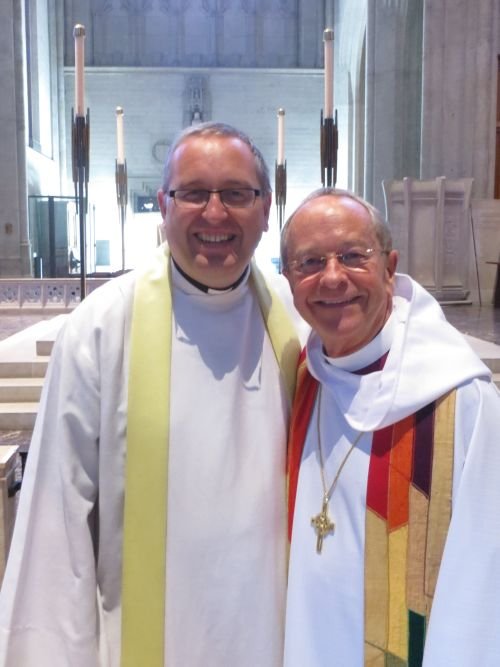
• Here’s to you, Bishop Robinson

    Gene small

    The Church of England is in full brouhaha mode today over gay bishops once again. Before saying anything about that, I think it is important to give a shout out to the Rt Rev Gene Robinson who is retiring today as Bishop of New Hampshire. It was obvious when he was elected and consecrated that the issues which excited people so much about him were going to be coming to churches all around the world. So it has proved.

    I caught up with Bishop Gene in September in San Francisco. He was the preacher in Grace Cathedral whilst I was there on my sabbatical trip. I could see him trying to work out who I was from across the sanctuary. When I reminded him that I was the person who invited him to celebrate the eucharist in Glasgow during the Lambeth conference, a time when he was said to be banned from every altar in England, his face lit up. Indeed, he described the visit to Glasgow as a “lifesaver” at a very low time.

    I’m grateful to him for his ministry here, one of the most electric Sunday mornings since I came here. I’m also grateful to him for keeping the faith, preaching the gospel and standing up to injustice. And yes, I’m proud of having known the first out gay man in a partnership (marriage now…) who became a bishop.  So, here’s to you, Bishop Robinson, Jesus loves you more than you can know. And I’m thankful for what you shared about that love whilst Bishop of New Hampshire.

    Bishop Gene seemed full of beans and pleased to be alive. He has good cause. When I stood next to him in 2008 in St Mary’s there were serious threats being made to his life and he couldn’t even distribute the communion elements because there was a fear that someone would stab him. Thank God things were more relaxed when I saw him recently. It was the Feast of St Francis in San Francisco itself and he and I got involved in blessing dogs, cats and a rather lively macaw.

    It is abundantly clear today that it is not all about Gene Robinson any more. The compromise that has been announced in England in the last 24 hours only turns the clock back by about 18 months and I’m genuinely surprised by all the excitement in the media about it. Nothing has changed since yesterday. The key facts remain the same:

    • The Church of England behaves badly to gay people in leadership
    • The public discourse of the Church of England at major festivals is dominated by a prurient interest in Jeffrey John’s private life.
    • The media don’t understand it but like the fuss and use any excuse to put nutters on the television

    I see only two ways in which this could end. Either one side or the other will win or alternatively there will be an agreement within the church that different views about human sexuality may be held with integrity. I rather favour the latter. It would need some common understandings about sexual ethics that focused on fidelity, passion and love rather than this uninspiring display of public disagreement but I think that could be achieved.

    I see no other options.

    Here in Scotland, I think that it is quite likely that a majority of people in the church would agree with me though it has not been tested. Meanwhile, our College of Bishops and our Faith and Order Board continue to behave as though a winner takes all approach to these issues (whereby we are all supposed to have our actions limited by the opinions of some) is the answer to what is wrong.

    The truth is, that attitude is not the answer, it is the problem. And somehow or another we need to move towards something more sensible, for our good and the good of all God’s holy church.

    Amen.

52 responses to “Inclusive Language – again”

  1. ryan Avatar
    ryan

    Kelvin – that cracked me almost as much as your last tweet on the left of your blog ;-)!

  2. Jimmy Avatar

    Ryan, although you address your comment to Kelvin like I am not there. I assume you are referring to my poem, I can assure you that it does not crack me up watching you making any opinion you may have untenable.

    1. kelvin Avatar

      No Jimmy – I think Ryan was indeed referring to my last comment, above.

  3. Jimmy Avatar

    Thank you Kelvin and Sorry Ryan.

  4. ryan Avatar
    ryan

    No worries! Was indeed referring to the v.amusing coming out day tweets at the side.

    I’m not sure there’s ever existed anyone, anywhere,at any time, of whom it could be said that *all* their opinions are ‘untenable’, so such rhetoric is dehumanising at best. Apropos nothing, I was moved to google the poetic stylings of the great David Brent. Who needs Auden? 😉
    http://murfinsandburglars.com/2009/04/14/bad-poetry-for-tuesday-david-brent-edition/

  5. Peter Avatar
    Peter

    Kelvin; no, I think it distracts. It simp;ly reminds us that this is how your mind works: you make connections and delight in that sort of word-play. However, to sharpen up my point. Thank you for helping me to realise that, for some, ‘family’ is not a positive word in the way in which I experience it. For my part, this willl mean that I will be more careful about its use when others might feel excluded (and therefore hurt). Mutatis mutandi can you accept that I feel offended by what seems to be merely a casual linking between family and the f word? These are sensitive areas, but sensibilities are by no means confined to those who find family a painful or unhelpful concept.

  6. Simon Avatar
    Simon

    I am slightly nervous aboaut the alternatives to the 1982 Liturgy, not because I don’t share the inclusive sentiments expressed above (I do). I fear that, as so often in the history of the church, the steps we take to avoid one kind of mistake in the way we talk about God can lead us into another. The avoidance of pronouns as a measure to achieve inclusivity produces inelegant, strained and stilted English. How would it be if one were to use it in day-to-day speech? ‘I saw John this morning. I asked John’s how John’s health was. John said that John was over his flu, and hoped to be back at work on Monday’. This may not in itself seem to be a problem. But in fact, what very quickly happens when we adopt this idiom in addressing/expressing God, is that the very idea of a personal God begins to recede. My basic instinct is that the church’s language of pulbic prayer is properly anchored in that of the scriptures. There are dangers in departing from this. The perceived problem (rightly perceived) is perhaps better tackled by good teaching about the nature of God, than by linguistic contortions that produce stilted prayers, and possibly a less real and vivid idea of God.

  7. Melissa Avatar
    Melissa

    About the family imagery – another reason to drop it in church is for the sake ones who, like me, do actually have the signifying family relationships.

    There is too much pressure on day to day life with children when that life is forced to serve as some kind of example or testimony or witness to the world – or more likely one’s church friends – about the nature of God.

    I think it sours love because in that kind of scheme loving children is more fundamentally a means to an end.

Leave a Reply

Your email address will not be published. Required fields are marked *

Previous Posts

  • Jerry Springer the Opera

    Well, I'm looking forward to the BBC screening Jerry Springer the Opera o­n Saturday evening at 1000.Having missed it at the National and then missed it again when I was last in London, I feared that I had missed it altogether. So, delighted to get the chance now.

  • Organ Safari

    Off to listen to organs today, one in Cramond, the other in Greenock. Not a terribly convenient journey, however it will be useful to be able to compare two instruments from two different companies on the same day. There are worse ways to spend a day.

  • Tsunami

    Richard Holloway has a go at the questions the Tsunami raises in an article in the Herald.The full url is http://www.theherald.co.uk/news/30782-print.shtml

  • Banner of Truth

    In yesterday's sermon, I made mention of an article about the Tsunami that Rowan Williams wrote for o­ne of the newspapers. It was the Telegraph, which I've heard o­ne bemitred o­ne call the Banner of Truth. I contrasted the article (which concluded that these things have happened before but that faith survives them) with the headline…