
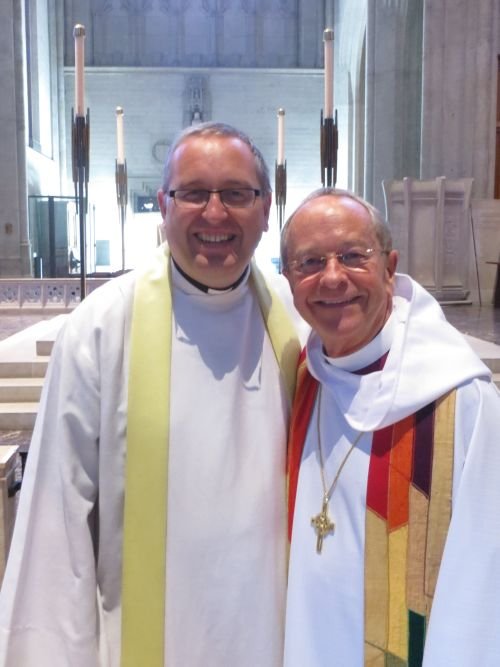
• Here’s to you, Bishop Robinson

    Gene small

    The Church of England is in full brouhaha mode today over gay bishops once again. Before saying anything about that, I think it is important to give a shout out to the Rt Rev Gene Robinson who is retiring today as Bishop of New Hampshire. It was obvious when he was elected and consecrated that the issues which excited people so much about him were going to be coming to churches all around the world. So it has proved.

    I caught up with Bishop Gene in September in San Francisco. He was the preacher in Grace Cathedral whilst I was there on my sabbatical trip. I could see him trying to work out who I was from across the sanctuary. When I reminded him that I was the person who invited him to celebrate the eucharist in Glasgow during the Lambeth conference, a time when he was said to be banned from every altar in England, his face lit up. Indeed, he described the visit to Glasgow as a “lifesaver” at a very low time.

    I’m grateful to him for his ministry here, one of the most electric Sunday mornings since I came here. I’m also grateful to him for keeping the faith, preaching the gospel and standing up to injustice. And yes, I’m proud of having known the first out gay man in a partnership (marriage now…) who became a bishop.  So, here’s to you, Bishop Robinson, Jesus loves you more than you can know. And I’m thankful for what you shared about that love whilst Bishop of New Hampshire.

    Bishop Gene seemed full of beans and pleased to be alive. He has good cause. When I stood next to him in 2008 in St Mary’s there were serious threats being made to his life and he couldn’t even distribute the communion elements because there was a fear that someone would stab him. Thank God things were more relaxed when I saw him recently. It was the Feast of St Francis in San Francisco itself and he and I got involved in blessing dogs, cats and a rather lively macaw.

    It is abundantly clear today that it is not all about Gene Robinson any more. The compromise that has been announced in England in the last 24 hours only turns the clock back by about 18 months and I’m genuinely surprised by all the excitement in the media about it. Nothing has changed since yesterday. The key facts remain the same:

    • The Church of England behaves badly to gay people in leadership
    • The public discourse of the Church of England at major festivals is dominated by a prurient interest in Jeffrey John’s private life.
    • The media don’t understand it but like the fuss and use any excuse to put nutters on the television

    I see only two ways in which this could end. Either one side or the other will win or alternatively there will be an agreement within the church that different views about human sexuality may be held with integrity. I rather favour the latter. It would need some common understandings about sexual ethics that focused on fidelity, passion and love rather than this uninspiring display of public disagreement but I think that could be achieved.

    I see no other options.

    Here in Scotland, I think that it is quite likely that a majority of people in the church would agree with me though it has not been tested. Meanwhile, our College of Bishops and our Faith and Order Board continue to behave as though a winner takes all approach to these issues (whereby we are all supposed to have our actions limited by the opinions of some) is the answer to what is wrong.

    The truth is, that attitude is not the answer, it is the problem. And somehow or another we need to move towards something more sensible, for our good and the good of all God’s holy church.

    Amen.

9 responses to “RSA Animations”

  1. annie t Avatar
    annie t

    Fascinating stuff; like watching a (very) animated Paulo Freire! Loved the insight ‘collaboration is the stuff of growth’. Interesting implications for a congregational paradigm for theological education. Thanks Kelvin.

  2. kelvin Avatar

    Yes – I was also reminded of my synod question about TISEC, which I still don’t think I’ve received an adequate answer to, which was something like this: “Is learning through TISEC driven by normalised marking or learning outcomes?”

  3. Kimberly Avatar

    presumably neither, but by the grace of God?

    (‘normal’, ‘outcomes’, and ‘TISEC’ all in the same sentence could lead to much fun. But I suspect I’d head down the via negativa again.)

    1. kelvin Avatar

      The answer that I got was “both” though I’ve never believed that can be possible. I do believe that TISEC at one time or another took on the trappings of each of those learning models, but that is not the same thing at all.

  4. Rosemary Hannah Avatar
    Rosemary Hannah

    Can I gently suggest that the Tisec you love to hate has over the years changes significantly?

  5. kelvin Avatar

    TISEC has always claimed to be changing – in that way it always is the same.

    I do accept that things have changed but have no way of knowing whether they have changed for the better. I still know people whom it appears to suit and I still know people who get distressed by what is done to them within it. In that respect at least, again, it remains the same.

    I’ve said before now that one of the reasons that TISEC is something that still presents unresolved issues for some of us who went through it is that there was never any public accountability within the church over what was done to us. No-one was ever held responsible and even though TISEC itself went through several reviews, the reasons for those reviews being carried out were never transparent.

    I’d still be happy to receive a coherent answer to the question. Incidentally, when I was in TISEC, the answer was clear – it was driven by learning goals and outcomes.

    I was at the General Synod where we voted for TISEC to cease to be a teaching institution. That was a pretty strong decision and one which was enthusiastically celebrated by some. (I went to the celebratory lunch afterwards and some folk came up from England for it). That does make it hard to understand what has happened subsequently.

  6. Rosemary Hannah Avatar
    Rosemary Hannah

    More than it would be appropriate for me as a staff member to answer to, and more than I am the most appropriate person to answer to, educational theory not being my speciality. However, FWIW I can answer to the fact that normalised marking is firmly in place, and that our external examiner is more than happy with the standards our students achieve. Beyond doubt all those who get a diploma from us have achieved the educational equivalent of the first two years of University education.

  7. kelvin Avatar

    Well, this isn’t comparing like with like as the current external examiner acts for an institution (albeit one which may have a financial interest) that had nothing to do with TISEC when I was in it, however, I can say that the external reports on TISEC were always astonishingly good.

    All the more astonishing for those of us who were in TISEC at the time I was, actually.

    It would be interesting to compare the quantifiable academic achievements of Scottish ordinands over time. I’ve a notion that two years of university study falls short of the standards for ordinands which the General Synod was hoping for when it last voted on a report about TISEC.

  8. Rosemary Hannah Avatar
    Rosemary Hannah

    The current external examiner is, it is true, employed; however he is not a member of the qualifying institution. He is a member of another independent academic institution, thereby bringing to his examination direct knowledge of at least three bodies (theirs, ours and his as it were). The work of our students is scrutinised by two markers at Tisec, and each piece of work scrutinised by the external examiner who checks it is achieving the same standards as YSJ. The over-all standard of YSJ is likewise scrutinised to ensure it too is achieving work of the same standard for the same level as other Universities.

    The question of whether standards nationally have risen or fallen is a different question, and harder to ascertain. We may indeed have our own different opinions. But I think it beyond doubt that the general level of the work of Tisec students is the same as the level (qualification for qualification) as the standard of students nation wide. So very much work goes into ensuring this.

    Personally, I would not be prepared to grant a degree in anything involving Biblical studies without knowledge of the Biblical languages. However it is a fact that the Universities now often do this – and indeed even forty years ago it was possible to obtain a M. Theol at St Andrews with only Greek. However regrettable this is, insisting on a full degree will not restore this.

    For those who study for a qualification with Tisec while working, as indeed for those who study with other bodies while working, to achieve two years of degree level study while in a full time job is a considerable achievement. To reach degree standard would take another 18 months I suppose – and that is a decision for the church to take.

    While I would be very sympathetic to the idea of encouraging more students to undertake a full time degree at a University, the funding of such things is a decision for the denomination, not Tisec. To ensure this in the present economic climate would be expensive, and for students who already have personal commitments, not always possible. This is why most English dioceses offer part-time training. The brief for Tisec is to offer a course that those NOT taking a full-time a course can follow, together with specifically vocational study which the Universities do not provide.

Leave a Reply

Your email address will not be published. Required fields are marked *

Previous Posts

  • Cat politics

    The Conservative Party really are in trouble. I asked the cat what she had thought of the Tory conference. She has always been a Tory supporter and very dismissive of my campaigning. Flicking her tail into a pound sign, she announced that she had changed her allegiance. Furthermore, she indicated very clearly that she thinks…

  • Choosing Hymns

    One of the most difficult jobs to do well as a priest is choosing hymns. Just enough that is familiar to people to feel comfortable, just enough that is new to stop us getting caught in a rut. Music needs to be singable and the words need to make some kind of sense. We want…

  • Autumn

    I can never decide whether I like the autumn. I like it in theory, at a distance. The colours and the freshness of the air are lovely, but the dark nights drawing in. Oh, the dark nights.

  • Film Festival 2

    It was Cole Porter day at my film festival yesterday. High Society in the afternoon and the new biopic De-lovely in the evening. Both showing on the big screen in Falkirk. The music for both was sublime, whatever the merits of the films themselves. I’m not sure that I entirely bought the idea that Cole…