
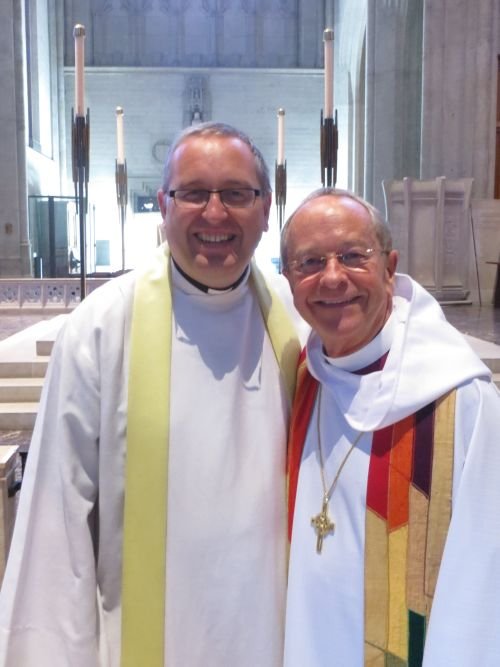
• Here’s to you, Bishop Robinson

    Gene small

    The Church of England is in full brouhaha mode today over gay bishops once again. Before saying anything about that, I think it is important to give a shout out to the Rt Rev Gene Robinson who is retiring today as Bishop of New Hampshire. It was obvious when he was elected and consecrated that the issues which excited people so much about him were going to be coming to churches all around the world. So it has proved.

    I caught up with Bishop Gene in September in San Francisco. He was the preacher in Grace Cathedral whilst I was there on my sabbatical trip. I could see him trying to work out who I was from across the sanctuary. When I reminded him that I was the person who invited him to celebrate the eucharist in Glasgow during the Lambeth conference, a time when he was said to be banned from every altar in England, his face lit up. Indeed, he described the visit to Glasgow as a “lifesaver” at a very low time.

    I’m grateful to him for his ministry here, one of the most electric Sunday mornings since I came here. I’m also grateful to him for keeping the faith, preaching the gospel and standing up to injustice. And yes, I’m proud of having known the first out gay man in a partnership (marriage now…) who became a bishop.  So, here’s to you, Bishop Robinson, Jesus loves you more than you can know. And I’m thankful for what you shared about that love whilst Bishop of New Hampshire.

    Bishop Gene seemed full of beans and pleased to be alive. He has good cause. When I stood next to him in 2008 in St Mary’s there were serious threats being made to his life and he couldn’t even distribute the communion elements because there was a fear that someone would stab him. Thank God things were more relaxed when I saw him recently. It was the Feast of St Francis in San Francisco itself and he and I got involved in blessing dogs, cats and a rather lively macaw.

    It is abundantly clear today that it is not all about Gene Robinson any more. The compromise that has been announced in England in the last 24 hours only turns the clock back by about 18 months and I’m genuinely surprised by all the excitement in the media about it. Nothing has changed since yesterday. The key facts remain the same:

    • The Church of England behaves badly to gay people in leadership
    • The public discourse of the Church of England at major festivals is dominated by a prurient interest in Jeffrey John’s private life.
    • The media don’t understand it but like the fuss and use any excuse to put nutters on the television

    I see only two ways in which this could end. Either one side or the other will win or alternatively there will be an agreement within the church that different views about human sexuality may be held with integrity. I rather favour the latter. It would need some common understandings about sexual ethics that focused on fidelity, passion and love rather than this uninspiring display of public disagreement but I think that could be achieved.

    I see no other options.

    Here in Scotland, I think that it is quite likely that a majority of people in the church would agree with me though it has not been tested. Meanwhile, our College of Bishops and our Faith and Order Board continue to behave as though a winner takes all approach to these issues (whereby we are all supposed to have our actions limited by the opinions of some) is the answer to what is wrong.

    The truth is, that attitude is not the answer, it is the problem. And somehow or another we need to move towards something more sensible, for our good and the good of all God’s holy church.

    Amen.

7 responses to “Whither the Kirk?”

  1. Pausing Place Avatar

    I missed last night’s programme, but I thought your comments were interesting.

    In a sense, perhaps it’s unsurprising if the SEC is inwardly more positive about itself than the CofS. My take is that in the recent past, at least, the SEC started from a lower common denominator, not being the “local” church in the same way as the Kirk, and so it doesn’t have to contend with others saying of it “look how the mighty have fallen” in quite the same way.

    As to the health of the Kirk (and the SEC for that matter), I think we need to reflect on our self-perception and to consider carefully the points and places in which a dying church (congregation or denomination) should be allowed to die gracefully, and the ways in which we might see new life emerge from the rubble.

    As a young(ish!), relatively new Christian I have seen examples of (both urban and rural) SEC and Kirk congregations where there are few signs of new growth, little to draw in younger (under 50 year olds, to pick a random-ish number) new folk, and much to sustain negative preconceptions of church as boring, irrelevant and so forth.

    We as a faith community need to get much better at stepping up to the mark in our creativity and engagement with our society. The sad truth is that most young adults do not know and have not heard about Jesus Christ, and unless we engage with them in ways culturally relevant to them, and which do not presuppose previous knowledge (too often taken for granted) they never will.

    It troubles me, but I do think it’s true to say that in the SEC and in the Kirk we have a church sustained by the traditions and cultural reference points taught to a previous generation. Culture has shifted radically, with the result that the same will not be able to be said in 20 years time.

    Our challenge is clear. Whether the Kirk and the SEC can step up to the mark to address what it means to live out the Great Commission in the 21st century is less so.

  2. Cal Avatar
    Cal

    I didn’t really understand who this programme was aimed at, or even what its aim was.

    Yes, numbers have fallen, but perhaps the small number of people who remain are there because they actually want to be, not because it’s the done thing on a Sunday morning.

    And personally, I rather like the idea of a church “sustained by traditions”. Clearly the church has to be relevant to modern society, but in abandoning the traditions of worship then you lose the centre of why the church exists in the first place.

    There was something very Presbyterian about the programme with its “we’re doomed” mentality. I find the SEC generally more positive in outlook.

  3. John Avatar
    John

    The only book the presenter seemed to have used in his research was ‘The Death of Christian Britain: Understanding Secularisation 1800-2000’ By Callum G Brown – indeed Callum Brown was one of the speakers. The thesis of this well argued sociological study is that “quite suddenly in 1963 something very profound ruptured the character of the nation and its people sending organised Christianity on a downward spiral to the margins of social significance”. That something he identifies as new media, new gender roles and a moral revolution which has dramatically ended people’s conception that they lived Christian lives.” It could be said to have happened as “sex began” between the end of the Chatterly ban and the Beatles first LP as the poet Philip Larkin so famously put it.”
    To balance this statistical decline the programme flagged up some of the “church without walls ” iniatives in a lame sort of way. All in all a most unsatisfactory programme that only told half the story.

  4. Kenny Avatar

    Good crit Kelvin. My reflection at the end of the programme was, “Lord, we visited this stuff over 30 years ago, and have come out of it stronger and better Church in the SEC.” Hopefully, we stopped longing for ‘the good old days’ a long time ago!

  5. MartinRitchie Avatar
    MartinRitchie

    I thinking “Pausing Place” makes a good point about needing to creatively engage with society. From my own experience of working with a CofS congregation, this creative engagement is a weak spot for many.

    As a counterpoint to the programme, interesting to note in the latest “Life and Work” a very positive article about a growing CofS congregation in Stornoway – and I mean really growing! So not all doom and gloom, and I’m sure there are many more examples of bright spots, just as there are in the SEC!

  6. Graham Vahey Avatar
    Graham Vahey

    If the C of S disappeared completely we would be at a loss. During the dark and bleak years of Thatcher’s reign she refused to visit Scotland for 5 years. When she did she expressed shock that we had Royal Regalia and ordered it to be removed immediately for safe-keeping to England. Her ‘Sermon on the Mound’ is now historical for its condescension to the Scots. She was none too pleased to be handed two reports on poverty in Scotland by the powerful Church and Nation Committee. Indeed, it was to this Committee that the population turned to for a moral lead during Thatcherism. When James VI (‘Jamie the Saxt’) became James I in England, the population turned to senior Scottish earls for a moral lead. Unfortunately, the Piskie Church does not give a moral lead in Scotland, apart from the work of the Scottish Constitutional Convention in the recent past. The RC Church does pronounce on moral issues. Could it not be conceivable that all the major Churches could unite in a Committee to pronounce for Scotland on moral issues as the Church & Nation Committee once did?

  7. Aldous N. Gaiters Avatar
    Aldous N. Gaiters

    Speaking as a Nonjuror myself I am sure the SEC has a right to a moral voice in Scotland. Taking the US daughter church of the SEC as a model you could see where the fissures would appear. There is room for a modern liberal Christian voice, but even I an old Liberal myself, would have to fear that such a voice might appeal to only a select few.

Leave a Reply

Your email address will not be published. Required fields are marked *

Previous Posts

  • Cat politics

    The Conservative Party really are in trouble. I asked the cat what she had thought of the Tory conference. She has always been a Tory supporter and very dismissive of my campaigning. Flicking her tail into a pound sign, she announced that she had changed her allegiance. Furthermore, she indicated very clearly that she thinks…

  • Choosing Hymns

    One of the most difficult jobs to do well as a priest is choosing hymns. Just enough that is familiar to people to feel comfortable, just enough that is new to stop us getting caught in a rut. Music needs to be singable and the words need to make some kind of sense. We want…

  • Autumn

    I can never decide whether I like the autumn. I like it in theory, at a distance. The colours and the freshness of the air are lovely, but the dark nights drawing in. Oh, the dark nights.

  • Film Festival 2

    It was Cole Porter day at my film festival yesterday. High Society in the afternoon and the new biopic De-lovely in the evening. Both showing on the big screen in Falkirk. The music for both was sublime, whatever the merits of the films themselves. I’m not sure that I entirely bought the idea that Cole…