
• Every Eucharist is a Virtual Eucharist

    Heaven

    Every Eucharist is a virtual Eucharist. Of course it is.

    We know this.

    We experience this.

    We forget this.

    Christianity – at least the bits of Christianity that are worth taking seriously – takes time and space so seriously that it knows that the particular cannot ever express the ultimate. Indeed, time and space are playthings in the hands of the religiously inspired.

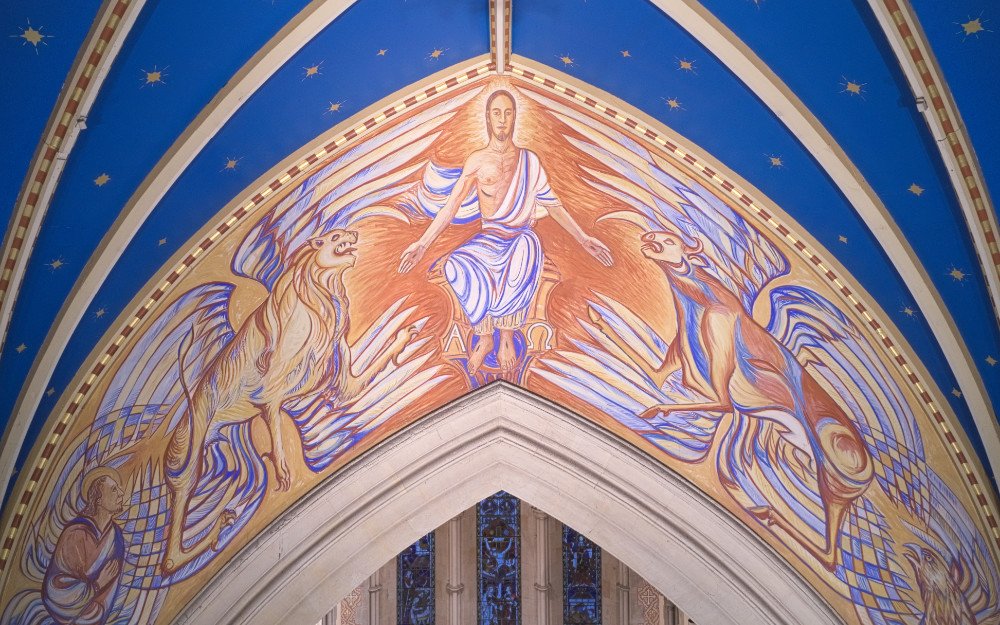
    Over the last few months it hasn’t been possible for my congregation to celebrate the Eucharist together in one space. But when we used to do that, we were never entirely in one space anyway. The very building itself is designed to transport people from the knowledge that they are a few yards from a busy thoroughfare in the Second City of Empire. Taking a few steps inside we find that we are in another place altogether. And in another empire, where the Emperor is servant of all and love is the essense of the law. The conceit that going into church takes you into a divine, heavenly realm is not an idea exclusive to the East. Coming into St Mary’s you are supposed to feel that you are stepping into heaven. It has been built to make you feel that. It has been decorated to make you feel that.  It does make people feel that.

    Whenever I take people into church I almost always hear them express a sense of wonder. We have the wow factor. It has been created by human skill to make you feel that the reality that you experience as you stand in the street is not the only reality that you can experience. It is a space that conveys that love, joy and peace might be possible and it does that without words. It is done with beauty and it takes people a few steps up the stairway to heaven.

    And it is the church playing with reality.

    That experience of going into a holy space and feeling part of something bigger is something common to religions that are divided on all kinds of doctrinal matters. It points to things that are best expressed through virtual reality and religious people are so used to virtual reality that they sometimes forget that it is all around them.

    When people come to the Eucharist in St Mary’s they are at once in Glasgow and simultaneously elsewhere. And elsewhere isn’t even singular either. At the Eucharist in Glasgow we are at one and the same time in an Upper Room in Jerusalem rather a long time ago and at the Wedding Feast of the Lamb at the ultimate consumation of all that is. The Last Supper and the Breakfast at the End of the Universe happen at the same table. At the same time.

    And as we gather at our table, we gather at every table and eat in communion with those who share in the same meal. Our fellowship with them isn’t prevented by circumstance. Our Eucharistic fellowship has never been prevented by circumstance or lack of physical proximity.

    We couldn’t keep the Triduum in Holy Week without virtual reality.

    Without virtual reality it would just be a way of making feet smell less.

    Without virtual reality it would just be a bonfire that would die.

    Christ is the celebrant at every Eucharist no matter which particular celebrant is standing there. Virtual reality becomes interwoven with the reality of the lives that we bring to the table and we are formed and changed and made new. It is how God’s love is expressed.

    This is virtual reality. Every Eucharist is a Virtual Eucharist. Cyberspace is one of the most powerful metaphors for prayer that human beings may ever develop.

    Our bodies are bound by physics.

    God’s love in this world isn’t.

    This is why religious buildings are important. It is also why they are not important.

    Every Eucharist is a Virtual Eucharist.

    Every Eucharist always was a Virtual Eucharist.

    Of course it was.

4 responses to “+Katharine Jefferts Schori – interview”

  1. ryan Avatar

    Hurrah! Evidence, like the interview with +Gene a few years back, that you’d make a great ecclesiastical chat show host Kelvin 😉 I’d watch it!

  2. Martin Ritchie Avatar
    Martin Ritchie

    Loved her vision of the church as holding different perspectives in tension. Hard work, but much better than settling for a monochrome church!

  3. Revd Ross Kennedy Avatar
    Revd Ross Kennedy

    Yes – a well produced and conducted interview. But why no quesions asked that might challenge +Katharine. E. g. why does she seem so determined to turn the TEC into a monochrome (i.e. liberal) church by driving out those who hold conservative theological views? Why is she so intent ( using the full weight of secular law) to grab the church properties from those Episcopal parishes which have decided to realign with another Province? Of course, legally in the USA the church buildings do belong to the denomination. But morally? After all most of those churches have been built and maintained by the local people with not a penny being contributed by TEC. Bishop Katharine impresses me in many ways although she is at the opposite end of the theological spectrum. I just find it so sad that since she became PB the TEC has become increasingly fragmented. And just in case I am asked – I do not support the action of parishes that have decided to defect. I believe they should stay and continue to witness to their understanding of the Faith.

    1. kelvin Avatar

      Well, I guess its a matter of perspective. I did kind of think that the oil spill affecting the US coast and the most devastating earthquake in recent history were kind of big stories. They also both related to the Synod that +Katharine was at. We were discussing ecological stuff quite a lot and we gave money directly to Episcopal Sisters in Haiti.

      It seems to me that the US church ownership thing is a bit of a non-story in the long run, however emotive it might be today. The SEC here and the Church of England down south would surely behave in exactly the same way to any vicar and congregation claiming they own the buildings and church fabric. Indeed, I think that in Scotland at least, it might well be the case that the charity regulations would make the Diocesan Trustees liable if they were not to press such a case.

      I’m no lawyer, I’m a priest. And I’m not as brave as you are, Ross, if you really think that the law of the land in the US (or in the UK) and moral values are not more closely linked than you seem to suggest.

      In Scotland we have no choice. Our canons acknowledge that our church will be governed in accordance with Scots Law.

Leave a Reply

Your email address will not be published. Required fields are marked *

Previous Posts

  • New Year Predictions 2015

    Here are my New Year Predictions for 2015   Those who voted YES in the Scottish Referendum will continue to behave as though they won. This may be unhelpful. Those who voted NO in the Scottish Referendum will continue to behave as thought he referendum never happened. This may be unhelpful. There will, I fear,…

  • Review of Last Year’s Predictions

    Well, clearly it behoves me to consider last year’s New Year Predictions and see how I did. Remember those people who used to say, “But what is a blog…?” Well this year you are going to be hearing them say, “But what is a mooc…?” Well, I think I got that partially right. Lots of…

  • Review of the year on the blog

    Well, everyone else is doing it so I might as well look back over the last year and pick out a few highlights from the blog. I began the year by declaring that The Archbishop of Canterbury is not a Pope and defended him from other people making demands that he rebuke the Nigerian Church.…

  • Ditching the sermon – a dialogue for Holy Innocents

    This morning I decided to ditch the sermon in favour of a dialogue with Bishop Gregor. It has been a difficult Christmas in Glasgow with a major tragedy in the centre of the city as people were doing their last minute Christmas shopping. Bishop Gregor was himself there in the square just after the incident…