
• We worship a non-binary God. Don’t we?

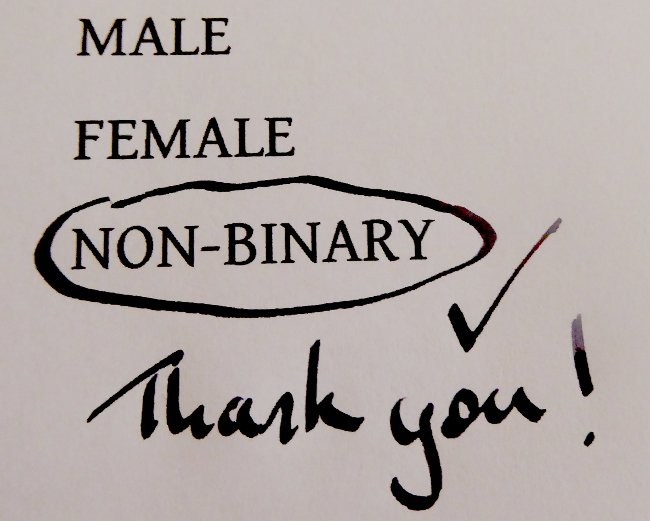
    male, femals, non-binary form

    Just over a week ago there was something called the Scottish Church Census. Churches all over Scotland were asked to count how many people were present and to account for the gender diversity, ethnic diversity, age profile etc of the congregation.

    Those organising the census helpfully provided a brief form which people could use to tick the various categories in order to make an accurate return. Though this was helpful, I quickly realised that we couldn’t use the form that was supplied as using it was not going to be inclusive of everyone in the congregation. The first question on the form asked people to indicate whether they were male or female and I was aware that for at least one person in the congregation, that was not going to be a helpful question.

    I was aware that there was someone in the congregation who does not identify themselves in a way that would allow them to tick either box with any conviction, seeing gender as something rather more complex for themselves.

    Once you start to notice this, you realise that the world is full of forms that require one to identify oneself as either male or female, very many of them forms for which gendered information is completely and utterly irrelevant.

    Anyway, we ended up producing our own local version of the Scottish Church Census form with a third box. The options were now male, female and non-binary.

    When all the forms were gathered up and counted, it turned out that three people had ticked the non-binary box, one of them circling the words and writing “thank you” next to them.

    Thus I found out simply by asking the question, that there were three times as many people in the congregation that day than I would have estimated who would describe themselves as not male nor female but in some way non-binary.

    We’re going to hear quite a lot more about this in the coming years I think. In Scotland there’s going to be a consultation about allowing people to legally be regarded as being of a non-binary gender, the law neither regarding them as male or female. It is a change which should go ahead I think though one suspects that a great number of people have never thought it through.

    The three people describing themselves as non-binary in St Mary’s that Sunday were towards the younger end of the (very mixed) age profile that we have. This suggests to me that this way of identifying oneself is likely to become more common as time goes on and may be very helpful.

    Gender does push people’s buttons a lot and we don’t all agree. There’s a pernicious law being pursued in some parts of the USA trying to ensure that people use the “correct” toilets according to the gender they were assigned at birth. This is problematic for those who have transitioned from one gender to another, those who were born intersex and those for whom gender is simply more complex and who would regard themselves as non-binary.

    (We have both gendered and non-gendered toilet facilities at St Mary’s Cathedral. At home I only have a non-gendered toilet, like most people).

    But here’s the thing. Christians worship a non-binary God, don’t we?

    Haven’t we come (rejoicing) through  the days of feminists calling upon us to recognise that there is a female aspect to the divine which makes all talk of God as purely male to be inadequate?

    Haven’t we come to a point of recognising that God is beyond gender?

    When the government comes to the point of asking us all what we think of introducing a non-binary gender category, won’t the churches joyfully embrace it and support it because this reflects the God we know and in whose image and likeness we are made?

    Might the non-binary gender category that is increasingly going to become an option for people be a helpful way in which we might reflect on the nature of God?

    In congregations like my own, I suspect that will be the case very quickly but maybe for the whole church this shift in the way we regard gender may help us in the way we look at God.

    I wrote last week about the fact that anyone who insists on God being a male authority figure or even daddy is readily challenged by simply reading the bible where God is seen more by attributes that go way beyond gender. When we address God these days in my own congregation we are more likely (far more likely) to address God as “Eternal God” or “Loving God” than we are to talk of “Father God”. This is partly because not everyone has a good model of fatherhood in their own experience but far more it is because this simply isn’t the God whom the bible has introduced us to. Jesus used fatherhood as a metaphor for God but that has to be seen in the context of a book which speaks of God as a flower – the Rose of Sharon, a carnivorous wild animal – the Lion of Judah or weapon – sharper than a two edged sword, along with dozens of other complex rich and sometimes perplexing images.

    We worship a God who is beyond gender even though our tradition has sometimes embraced images of God which are highly gendered – sometimes I think, to distinguish the faith from other highly female gendered images of divinity with which Christianity was competing. (I’ve seen an effigy of Artemis of Ephesus and can honestly say I wouldn’t like to meet her during a dark night of the soul).

    Christian people are not in the business of dealing with a Mr God.

    And Christian people need to wise up fairly quickly to the questions about gender which are coming our way.

    Dear God who is beyond gender,
    give us a greater dose
    of your holy spirit of common sense
    in dealing with gender
    than we have seemed to the world to posses
    over your gift of sexuality.

    Amen


9 responses to “The Episcopal Way of Death”

  1. Rosemary Hannah Avatar
    Rosemary Hannah

    The greatest privilege I have ever had in the service of the people of the church was to be the person who received the coffin the night before the funeral and led Compline then. The church was on an island, and the coffins those of people I loved and honoured. It was deeply moving for everybody there. I hope one day that will be done for me and mine.

  2. Sr Alison Joy Avatar
    Sr Alison Joy

    I have prayed washed and dressed Sisters who have died and it helped me to see that death is not scary. I have lined a number of Sisters graves with flowers around the inner edge from the inside, also helpful. The body was received at Vespers in Chapel the day before, Solemn Requiem was the next day complete with asperges and incense. We returned from the graveside and when in Chapel sung a very joyful favorite hymn for the Sister we had just buried. It was always a sad, happy, remembering occasion I hope that I will be able to have most of this too.

  3. Sarah Lawton Avatar
    Sarah Lawton

    This is beautifully said.

    When my parents died in a car crash, we knew our Episcopal church would be too small to accommodate all the mourners; but the local Roman Catholic congregation saw our need and graciously offered the use of their space for our Episcopal funeral (including Eucharist led by two Episcopal bishops). They also offered their pall for the second coffin as we had only one. All the churches and the synagogue in town offered choir members and/or food for the feast after the service. An ecumenical, indeed, interfaith foretaste of heaven!

    We placed the two bodies in closed coffins in our Episcopal church the night before; we prayed Evensong and Compline, and received a long line of visitors; and then parishioners kept vigil with the bodies all night. In the morning we prayed over the bodies before beginning the procession to the larger RC church where the (Episcopal) funeral was to be held. In this sad, glorious service sang many, many Easter hymns, and I learned that it’s possible to sing and sing even through tears. I’m told that people reconciled that day who had not spoken in years – I’ve heard it from both parties (one now a bishop).

    All of which is to say: our Episcopal Way of Death can be a profound grace if we let it. It can be profound too when it’s a simple, small, quiet service for a person who has lived a long life and died of old age (unlike my parents). It’s the same words, the same truth of loss – all of us pass through this life but for a moment – the same mystery, the same words of affirmation and hope at the grave: alleluia, alleluia, alleluia.

    1. Kelvin Avatar

      Thank you for posting that – bearing witness to exactly what I was trying to say.

    2. Michael Povey Avatar
      Michael Povey

      Thanks Sarah. (Other readers, Sarah is a friend. I was at the Funeral and heard her offer the most profound Gospel Centred and Honest Grief eulogy I have ever heard)

      1. Sarah Lawton Avatar
        Sarah Lawton

        Dear Michael, thank you for saying that. Your presence that day was a blessing to our family. That gathering, for all the shock and sadness, really did feel like a foretaste of heaven, didn’t it? A great cloud of witnesses singing with us.

  4. Ronnie Smith Avatar

    Having attended a few funerals in our parish recently – one of them for our Vicar, who died on Easter Eve – and being nearer to the grave myself (at 85 and still active as a priest) I appreciate, Father Kelvin, the care you take over this special subject. The Church can be so close to families at this special time – giving them a taste of ‘The great love of God as revealed in the Son’ – precious at this time.

  5. Tony Whatmough Avatar
    Tony Whatmough

    There are sometimes good reasons for having the cremation first, as there was for my brother yesterday especially with people traveling and wanting to be able to bury the ashes on the same day. They key is to talk with the family about what they are looking for and how it can be done.

    1. Kelvin Avatar

      Dear Tony, I’m sorry to hear that you’ve lost your brother. May be rest in peace and rise in glory.

      There are always reasons why people want to have a cremation first and people always believe that they are good reasons. Every single time there are reasons. My contention is that I’m unpersuaded that any of them justify changing what we believe. (What we do and what we believe being utterly bound up with one another in such circumstances).

      My point about funerals is very precisely that the wishes of the family are important but that no tradition will survive if we simply abandon what we believe for reasons of convenience.

Leave a Reply

Your email address will not be published. Required fields are marked *

Previous Posts

  • Gay Booklist

    Several people have recently asked me for suggestions for some affirming reading material for lesbian and gay Christians and more generally for anyone wanting to find material to help them think around the topic. I published a list a couple of years ago. Here’s the link: http://thurible.net/20080429/lgbt-booklist/ There’s more stuff coming out (so to speak)…

  • God Factor

    The God Factor starts again on Sunday 22 April 2012 at St Mary’s. It is like some other courses that churches run in that people gather over food and talk about faith. Ideal for beginners and those wanting a refresher in faith or who just want to talk about the possibility of faith. It is…

  • What causes it?

    Interesting documentary on BBC3 last night about a young man who had a stroke and “woke up gay” afterwards. It was both interesting and perplexing. That there has been a huge shift in his character and personality is clear. That he once dated women and now is attracted to men is easily shown. That he…

  • Unremitting Joy

    Don’t forget that Easter is not just a day but a season – 50 days of unremitting joy in fact. We’re 10 days in. Should you be feeling the joy start to droop, I suggest you have a listen to this lovely Regina Coeli: I’m not sure that it is quite so lusty as we…