
• Pagliacci – Scottish Opera ****

    Paisley Opera House (aka a tent on Seedhill Playing Fields in Paisley)
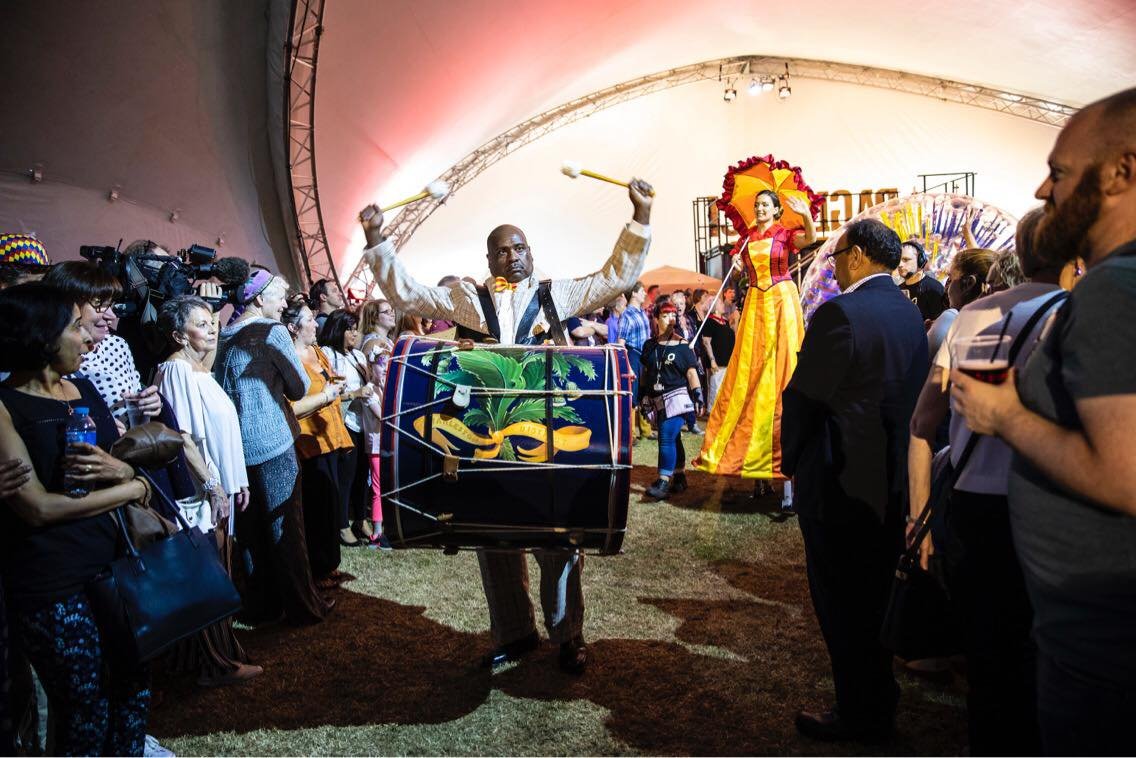
    Scottish Opera’s summer show in Paisley is a completely immersive bundle of fun that manages to be innovative and hugely entertaining.

    It isn’t difficult to see where the idea of putting this show on in a big tent comes from. Pagliacci (The Clowns) is all about a troop of performing players coming to town. It just happened that this troop had turned up in Paisley and were putting on a show for a local gala day – the Sma’ Shot festivities.

    There was a strong sense of local festival as soon as one entered the tent, with a range of sideshows – a magician, fortune teller and a real Punch and Judy show alongside games like Pin The Tail on the Donkey. It was a brave decision on the part of Scottish Opera to have an actual donkey wandering around too, given the recent debacle of the Eugene Onegin’s horse. However, no-one disgraced themselves and a good time was had by all, not least the three people who won the raffle and got to conduct the orchestra in some well-known operatic overtures.

    By the time the singing started, it felt as though the show had been going on for some time.

    With all the fun of the fair going on all around, the danger was that the singing might not matter that much. Fortunately this was a strong cast and in fact the singing was excellent. Particular praise must go to Ronald Samm for his utterly superb Vesti la guibba that ended the first act. The fact that he was surrounded at close quarters by the audience, who were invited to move about the tent to wherever the action was, didn’t distract him from an astonishing display of heartbroken anguish.

    A huge chorus of both amateur and professional singers were mingling with the audience throughout most of the production and it was genuinely thrilling for the singing and the action to break out all around you as you tried, generally unsuccessfully, to work out what might happen next. High points included the entrance procession of the players and the sudden, stunning reveal of the stage (made out of a road-truck) for them to play on in the second half.

    It is to the director, Bill Bankes-Jones’s credit that the pitiful tragedy of scorned love was perfectly balanced with the comedy and high jinks of a show that was hell bent on blowing away even the most jaded cynicism. By the end of the evening, what had we witnessed? A fun filled tragedy? A comedy beset by human misery? Both, surely, and more.

    One hour 40 minutes is a bit long for a promenade performance, particularly as the audience didn’t move about quite as much as I suspect they were expected to do on what was a very hot July evening. However, the standing about all felt well worth it for a surprise summer hit.

    The Orchestra of Scottish Opera were about the only ones who got to sit down all night and, apart from some repeated split notes in the brass section were on generally good form under Stuart Stratford.

    All in all it seems like a shame that this show will play for a run of just three performances. It was an enormous effort for a relatively small audience and could easily have sustained a longer run.

    The troop of performing players that rolled up into Paisley done good.

    Done very good indeed.

    Rating: ★★★★☆

    This review first appeared at Scene Alba:
    https://www.facebook.com/scenealba/posts/2091329810937212

9 responses to “The Lament Question”

  1. kimberly Avatar

    ask it in the singular, and the answer is: because you’re a four.

    you’ll have me playing the funeral ikos next.

  2. kimberly Avatar

    the other answer is about possibility being revealed in limits.

  3. kelvin Avatar

    Its not just me though, and not just fours.

  4. Aaron Orear Avatar

    I think because sorrow touches the core of the human condition – we are mortal but can perceive immortality. “He has made everything suitable for its time; moreover he has put a sense of past and future into their minds, yet they cannot find out what God has done from the beginning to the end.” (Eccl. 3:11)

  5. Erp Avatar
    Erp

    I understand Aristotle talks about catharsis and various philosophers have followed up on that idea.

    Perhaps it arouses sadness both from the art itself but also from our own sources festering within and allows us to let go. We feel better for the letting go, the lessening of our own internal sadness, and so perceive the art as beautiful.

  6. RosemaryHannah Avatar
    RosemaryHannah

    Kimberly was there before me. However, even I, a nine, can sometimes see the beauty in sad things. For me they do two things (may be more but two are most obvious). The first is the catharsis thing. The second is to make me less lonely. Look, here am I weeping, but all around me people sit in the same sorrow. It is not just my sorrow – I am not alone.

    I have long thought there is another answer, one I do not properly understand but I have (I think – and who am I to think it). Deep in God there is a huge well of sorrow. Unless we experience sorrow we cannot understand God. When we sorrow we tap into that well, and become closer to him.

    And being a nice cheerful nine, I will now add that I live in hope that having sorrowed with him, we will share also and even more fully in the joy which swallows the sorrow. Delete this last paragraph from your mind on reading, it will only spoil the joy of the sorrow.

  7. Elizabeth Avatar
    Elizabeth

    Edgar Allan Poe said the most beautiful thing in the world is a beautiful, dead woman. Nice, eh?

  8. Ritualist Robert Avatar
    Ritualist Robert

    Surely it’s because the concept of beauty is independent from concepts such as ‘sadness’ and ‘happiness’ – just as a G major chord might be loud or soft, but that volume has no effect on its G major-ness.

  9. Steve Avatar
    Steve

    I remember Augustine saying (don’t ask me where) that for a picture to be beautiful it requires dark colours as well as bright.

    There is also a hint of an answer in this poem by Edwin Muir:

    Yet still from Eden springs the root
    As clean as on the starting day.
    Time takes the foliage and the fruit
    And burns the archetypal leaf
    To shapes of terror and of grief
    Scattered along the winter way.
    But famished field and blackened tree
    Bear flowers in Eden never known.

    Blossoms of grief and charity
    Bloom in these darkened fields alone.
    What had Eden ever to say
    Of hope and faith and pity and love
    Until was buried all its day
    And memory found its treasure trove?
    Strange blessings never in Paradise
    Fall from these beclouded skies.

Leave a Reply

Your email address will not be published. Required fields are marked *

Previous Posts

  • Francistide at St Mary’s

    Today is St Francis’s Day – love and blessings to all Franciscans out there and a special thanksgiving for the ministry of the new Pope. Last year I was in St Francis’s own city – not Assisi, but San Francisco and was blessing animals on the labyrinth of Grace Cathedral with Gene Robinson. (No, really,…

  • Sermon for Michaelmas

    Once upon a time, in a land not far away, there was a seminary where lucky young men and lucky young women came to train for the priesthood and open their lives to all that God was hoping for them. It was a place that I knew but did not study in myself but a place that some…

  • I.D.

    Thinking Anglicans has the story that all of us in the Scottish Episcopal Church should be thinking about at the moment. One of the most important stories that concerns Episcopalians in Scotland for quite a while. It is to do with the recent release of figures from the last census – the one that was…

  • Taint

    The Church of England has a problem. Well, the Church of England has many problems, but the one that it is waking up to at the moment is that women bishops are getting closer and closer to it and it hasn’t quite worked out what to do. Why does it have to do anything? Ah,…