

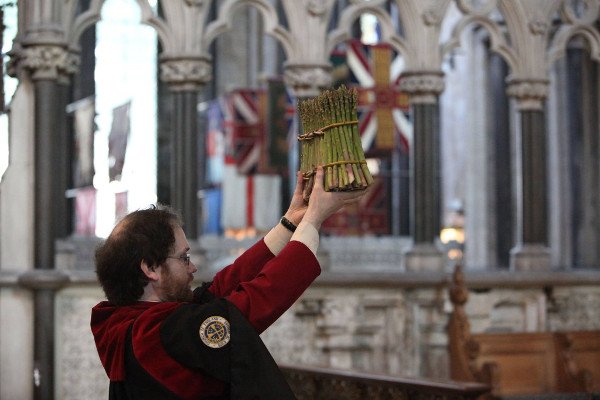
It seems that Worcester Cathedral recently had a service for the blessing of asparagus.
As this is a matter that might be seen to have consequences for the wider Anglican Communion, I thought I’d offer a few thoughts.
- There can be no justification for blessing asparagus as asparagus is never mentioned positively in the bible. There is simply no biblical case for blessing asparagus. None at all. If God had wanted asparagus to be blessed, then surely Jesus would have blessed asparagus at the last supper. (1 Corinthians 15:3)
- In fact, we know that asparagus should not be blessed because Genesis says so. “In the course of time Cain brought to the Lord an offering of the fruit of the ground, [asparagus] and Abel for his part brought of the firstlings of his flock, their fat portions. And the Lord had regard for Abel and his offering, but for Cain and his offering he had no regard.” (Genesis 4: 3-4). You can’t pick and choose what the bible says. God’s holy word is clear and lasts forever.
- The blessing of asparagus promotes and validates the asparagus lifestyle. How will the church as a whole be able to maintain moral standards in one part of the world if asparagus is blessed in another? (Matthew 5:48)
- If we start blessing asparagus then it automatically follows that people will demand blessings for other kinds of vegetables. Although one might not personally object to the blessing of asparagus, one must take into account where this might lead. God will not be faithful to those who bless asparagus. (Amos 5:14)
- It would be entirely acceptable to offer a Thanksgiving for the Picking of Asparagus provided there are no rings used to hold the asparagus and any blessing must be upon the asparagus pickers and not the asparagus itself. (Ezekiel 44:30). The blessing of asparagus itself is sinful.
- The Archbishops have issued the following statement: “No asparagus is a problem, or an issue. Asparagus is made in the image of God. All of the asparagus, without exception, is loved and called in Christ. There are no ‘problems’, there is simply asparagus. (Romans 8:28) However, in order to maintain the unity of the church, it remains the case that asparagus blessings fall outside of that which is permitted for clergy of the Church of England following the last agreed Lambeth Conference statement on the matter. Clergy should continue to explore the maximum freedom possible when encountering asparagus whilst remaining within current guidelines. (Philippians 4:5)
- It remains the case that we all strive towards good disagreement (Philippians 4:2) about asparagus blessings whilst forbidding entirely the actual blessing of asparagus
- You cannot serve God and asparagus. The love of asparagus is the root of all evil. Do not associate with other eaters of asparagus. (1 Corinthians 15:33)
- There is an additional argument against the blessing of asparagus which stems from tradition. There should be no blessings of asparagus until the major churches who have the apostolic succession make an agreed statement on asparagus. This might be achieved in the form of an Ecumenical Asparagus Council of the Church however there remains some disagreement about who has the authority to call such a Council. (1 Corinthians 11:2)
- Always remember that God loves asparagus and that there have been some fine and courageous examples of self-giving asparagus throughout history. Many people are able to testify that some of their best friends have even eaten [unblessed] asparagus. So long as the church exercises gracious restraint in blessing asparagus, it will be possible for people to hear about the unique gifts that asparagus brings to the world. It may even be that God has a purpose for asparagus. (Exodus 9:16)


Leave a Reply