
• Ditching the sermon – a dialogue for Holy Innocents

    dialogue with bishop
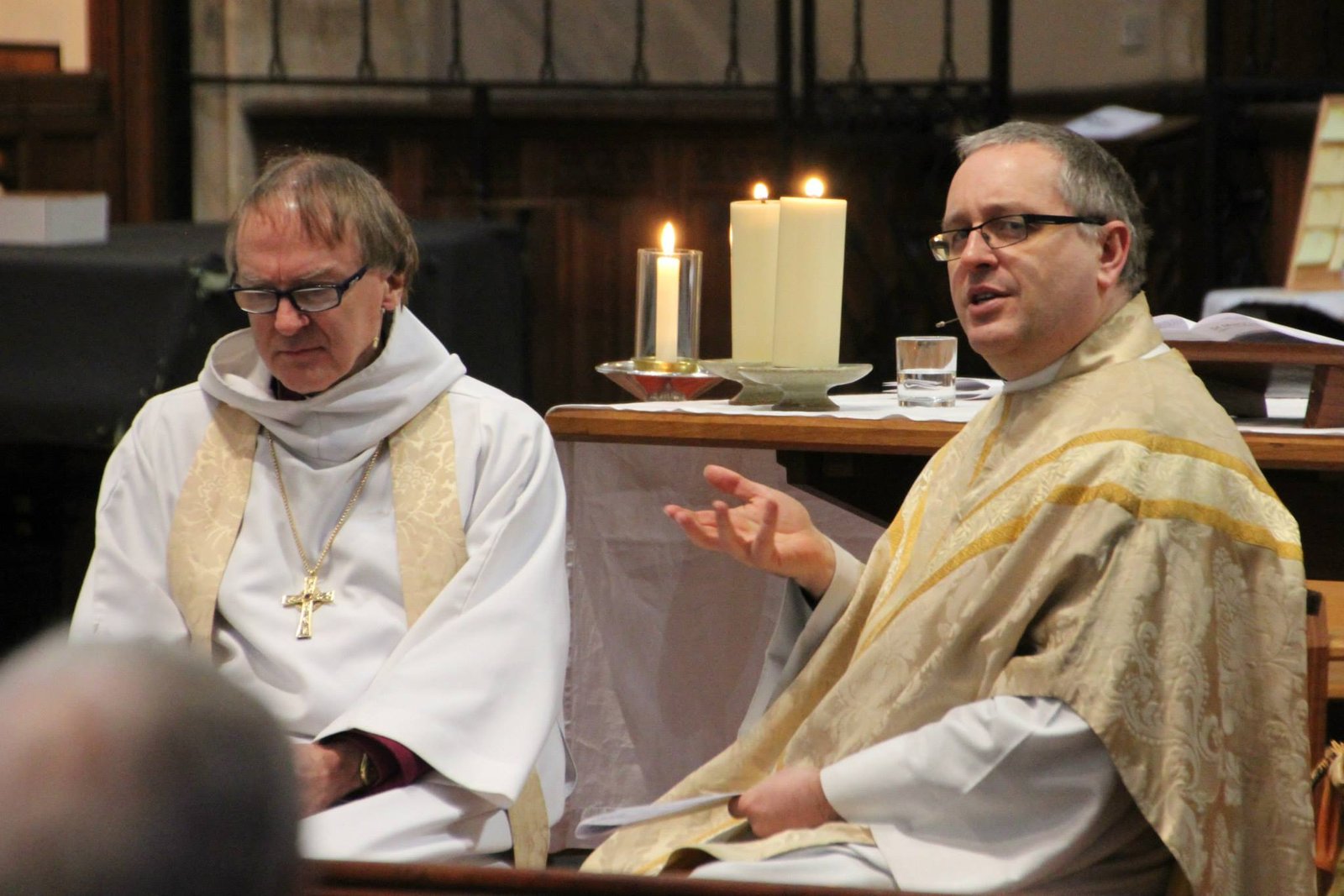
    This morning I decided to ditch the sermon in favour of a dialogue with Bishop Gregor.

    It has been a difficult Christmas in Glasgow with a major tragedy in the centre of the city as people were doing their last minute Christmas shopping. Bishop Gregor was himself there in the square just after the incident involving the bin lorry. In this conversation he describes what he saw, what he was asked to do and how he responded.

    Together we reflected on how Christians find God.

    This happened in the context of the Sunday morning Sung Eucharist instead of a sermon. It seemed the right thing to move the Feast of the Holy Innocents back to this day, it having originally been scheduled to be celebrated here tomorrow morning.

    As I said at the beginning of the service, Jesus wasn’t born into a fairy story, nor into a Christmas card – he was born into  the real world and sometimes we need to think about what that really means.

    Here’s the video:

    Dialogue between Kelvin Holdsworth and Gregor Duncan in Glasgow on 28 December 2014 from Kelvin Holdsworth on Vimeo.

4 responses to “Sunday's Lament”

  1. chris Avatar

    As I read that lament on Sunday, I was singing inside my head the wonderful Tomkins’ setting of the lament. As an alto, I could be accused of bias – the suspensions between the two alto parts are hair-raising in their beauty – but to me nothing can match it. You can hear it here

  2. RosemaryHannah Avatar
    RosemaryHannah

    Oh dear me, yes. Let’s all wear pink and have a celebration.

    Your video camera however does not let one get anything like the quality of the voice in space experience of last Sunday. And I write as one not musical.

  3. RosemaryHannah Avatar
    RosemaryHannah

    I think, too, it always would work best for a single male voice, because it is so heavily tied to a single male figure. It is superb writing, superbly put to music.

    I don’t want to ‘dis’ your only-too-correct comments on the space between our understanding and that of the Iron age. But I think that two things may offer a little light on how and why we read the succession narrative.

    The first is that it is an outstanding piece of writing by any standards at all. The terrible attempt by the lectionary to cut it on Sunday just pointed that up (not the first time I’ve wondered what the editors of it thought they were doing). Good story has its own power.

    Secondly, one has to ask who commissioned this account and why. I think the answer has to be Solomon’s court, as ’twere – thus not only does one have to explain why Solomon succeeded one also has to paint a very flawed but still in some ways great David. A man one might be glad to have as a father, and a man who it would be possible to offer a better alternative to. The last King, if a relative, should neither be too good or too bad. QED.

  4. revruth Avatar

    Oh my word! Why have I never heard this before? It is glorious and I am in love with it. There is absolutely nothing like a good lament. Dido’s Lament had better look out.

Leave a Reply

Your email address will not be published. Required fields are marked *

Previous Posts