
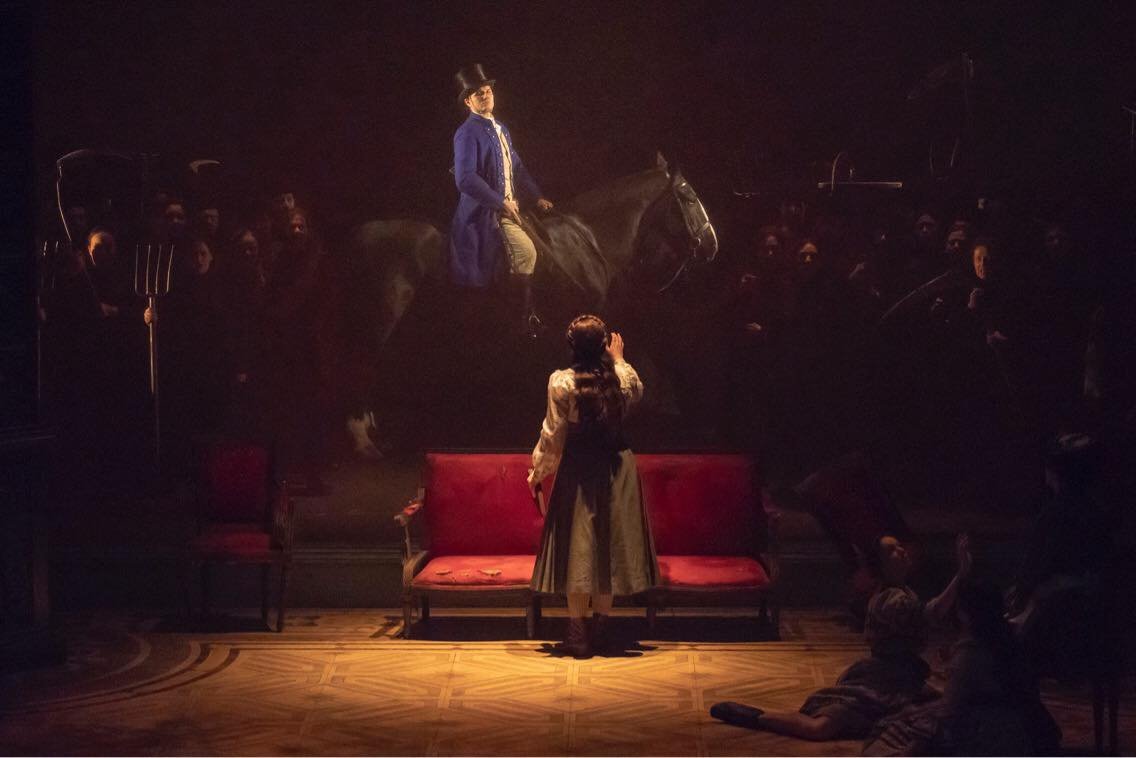
• Eugene Onegin – Scottish Opera – Review – ****


    Scottish opera reach the end of their rather thin main stage season with a well sung Eugene Onegin which brings with it a lot of surprises.

    The action begins, not with the overture but with silence. An older woman – Tatyana herself in old age, we are to discover, stumbles into the wreck of an old country house. A sense of melancholy pervades the scene even before she flings open tall window-shutters and lets in light and mist and music.

    The older Tatyana remains on stage throughout the evening and clearly we are seeing things through her memory. This doesn’t particularly get in the way though it is all rather reminiscent of the end of last year’s Scottish Opera season which saw La Boheme through the unlikely eyes of an older reminiscing Mimi.

    Director OIiver Mears keeps quite a lot of the action off stage – including everything to do with the chorus. When they are peasants, their singing can be heard through the tall windows and when they are at the ball later on they are kept behind a gauze at the back of the stage which, thanks to Fabiano Piccioli’s lighting design is sometimes the back wall of the room in the country house where we seem to be and sometimes dissolves to show a scene behind it. This sits rather well with an opera which never attempts to tell the whole story. Tchaikovsky picks and chooses individual scenes from Pushkin’s story of Onegin and so a lot of the action is happening off-stage anyway.

    In terms of the singing, there are great riches on offer. Onegin himself is played rather cool and aloof by Samuel Dale Johnson. His passions come to life at the end of the piece when he realises that he made a huge mistake in spurning the love of Tatyana. Why anyone should spurn Tatyana when she is played by Natalya Romaniw escapes me. Her singing was one glorious scene of passion after another. She seemed to completely inhabit the besotted Tatyana and it felt as though there was nothing that she wouldn’t do to get her man. Onegin’s friend Lensky was also well served, being sung superbly by Peter Auty.

    There was quite a lot to compete with the singing however, and certainly in the first act, the music was quite upstaged by some complex stage business. At one point the peasant chorus could be seen in dull light behind the gauze at the back of the stage. They parted in the manner of Moses parting the Red Sea to reveal the dim figure of Onegin sitting astride a horse. It took a few moments to realise that this was in fact a living and breathing real live horse.

    Indeed, although the horse was scarcely visible for more than 25 seconds of the production, it made the strongest impression possible, for it next appeared bounding onto the stage though one of the tall windows, still with Onegin on its back.

    Alas, for the singers, the horse also turned out to be a disgruntled opera critic and was soon followed by a Russian looking ostler with an all too necessary bucket and shovel.

    Sadly the horse did not receive the dignity of a namecheck in the programme.

    However, the musicians carried on regardless through all this and through other more successful pieces of stage business including the members of the chorus striking ball silhouettes, the sudden and rather unexpected appearance of Onegin standing naked in his bath and a group of figures who appeared around a table.

    Some of these scenes were seen through the back-wall gauze and were very effective. It worked well though one had to remember that for some of these scenes we seemed to be seeing what was in the head of a character who was comprised of the memories of another character, which takes quite a suspension of disbelief. Sadly too, there’s a price to pay for putting the chorus at the back of the stage and effectively behind a curtain and this left the second act which should be overwhelming feeling a little underpowered.

    There are a couple of rather odd historical oddities. Presumably the gloopy bubble-gum dripping off Onegin’s boot wasn’t meant to be there but it wasn’t at all clear how Tatyana managed to write with a fountain pen in the 1830s.

    Tatyana’s Pen was in fact sponsored by 19 donors, most of whom were named in the programme so clearly it wasn’t a last minute thought.

    Stuart Sutherland’s musical direction was assured and confident. Indeed, it was difficult to believe that this was the same orchestra who sounded so shambolic just weeks ago for Ariadne Auf Naxos.

    Tchaikovsky was clearly on the run from his own sexuality when he composed this piece. In Scottish Opera’s hands, the experience of unrequited and then impossible love and rejection never sounded so good.

    Do say – “that was a stunning end to Scottish Opera’s season”.

    Don’t say – “how do they train a horse to defecate in time to Tchaikovsky?”

    Rating: ★★★★☆

    This review appeared first in Scene Alba.

7 responses to “Twitter and the Church”

  1. Justin Avatar

    First, congratulations Kelvin on your appointment as I&C Board convenor, and thanks to you and all who contributed to the SEC’s Synod Twitter coverage, which worked really well.

    Some thoughts:

    Next year, as was suggested by some of the Synod ‘Twitterarti’ we should have a proper Synod 2009 Twitter account, like that set up by the Church of Scotland for their Assembly. And it needs to be integrated into the Synod pages on the Provincial website from the outset.

    It would also be good to integrate the #pisky Twitter stream into the Provincial site on a permanent basis, or to set up an SEC account for that purpose. I would also suggest making the site’s SEC blogroll more prominent. And the SEC Flickr streams.

    I understand the concerns some have about the impossibility of monitoring what’s said on Twitter and the blogosphere, and its undeniable that sometimes people will say insensitive and daft things that will offend and hurt.

    But that is part of the very nature of online communication. The days when organisations could manage their channels of communication through press releases and a limited number of printed publications are gone. The web has democratised communications media, offering a low cost platform for all members of an organisation: the concept of gatekeepers at the top approving and filtering information is redundant.

    Like all organisations the SEC needs to embrace and engage with things like Twitter, blogs and other social networking tools, or people will simply bypass the ‘official’ channels and jump straight to where the real conversation is happening, like your blog.

    It’s not just Twitter we need to embrace, but the existing web platforms we’ve already got in place. I’ve been honoured to be asked to develop a number of websites for the SEC over the past couple of years, including the Provincial site and a few diocesan sites.

    Some good use has been made of these – Kennedy in particular has been doing some great stuff on the Glasgow site over the past few weeks. But my perception is that the web still plays a very muted second fiddle to print as a means of communication within our church.

    At Provincial level I don’t see why all the good news material should be kept for inspires magazine. I think it should go straight onto the website as soon as it becomes available. If it’s kept in inspires nobody outside the church can see what’s going on. I don’t think subscription rates to the magazine would be affected at all if inspires material also appeared online: most commercial magazines have found that putting selected material online serves to promote rather than threaten their presence on the newstands. There are now more printed magazines than ever, and they all have websites.

    I think we should allow the boards and committees to post their material direct to the SEC News section. That would, I think, encourage far more of them to contribute their material to the website.

    The same applies at diocesan level: nearly all the good news is kept back for the diocesan magazines, and almost none of it makes its way to the website (again, I know Kennedy is doing his best for the Glasgow site).

    News and events functionality, RSS feeds, photo galleries: they are all there on the diocesan websites waiting to be used. I have to be frank and say that communicating our diocesan news through rather poorly designed newsletters (where the Comic-Sans wars are still taking place) received only by insiders, makes us look very old-fashioned and insular.

    I realise that sounds rather harsh, and that people are volunteering their time to put together the magazines. But I don’t see why we are spending so much time and money doing it that way when the web is there waiting to be used. I love the church and want it to grow, not continue to decline. The web is our friend, offering so many exciting possibilities, and its importance as a means of communication will not be grasped unless we keep banging on about it!

    My tuppenceworth. Very interested to hear what others think. Congrats again and best wishes in the new post.

  2. gaielle Avatar
    gaielle

    Congrats and Best Wishes indeed, Kelvin. A most demanding role and requirement.

    Encouraged by Justin, I shall add a penny-ha’pennies-worth.

    Communication in the world of today is a serious and complex undertaking, isn’t it, not least because there are so many across-generation and accessibilty issues involved, leaving the ‘non-tech’ community disenfranchised if the ‘old fashioned’ hard copy approach is neglected – or perceived to be neglected. Hard copy will continue to be an essential medium for a while yet – and rightly so.

    But equally important, and especially for reaching, including and empowering the youngest generations in the SEC, is the recognition and inclusion of new and newest technologies. Perhaps the teenagers in our midst have some useful insights to offer us for Developing Mission Outreach. The Good News was given to us to share – with everyone.

    Good – effective – communication is a great thing when you encounter it. Rare Creature tho it be. Fully – and clearly intended to BE – fully inclusive, and therefore encompassing and using ALL practical and available methods of communication.

    Problems in achieving Good Communication so often seem to be due to omission, oversight and a lack of appreciation of The Need To Try.

    So, for instance, I Receive Information From Other, I process this internally with every intention that my Final Response will then be shared comprehensively – but I first neglected to Assure The Other that I had Actually Understood What They Were Saying. In consequence the Information I have Taken On Board may be incomplete or flawed – hence I have (inadvertently no doubt) neglected that very important step of Ensuring My Understanding Of Information Matched what Was Being Said…….

    “What Is Said”, what is “Intended To Be Heard”, “What Is Heard” and “What Is Understood” are frequently 4 different things. However, effective/”good” communication requires a thorough appreciation of such likely mis-match, and also requires enormous strategic endeavour (until the skill becomes second nature) to outwit the intervention of MisUnderstanding.

    As with anything in life, a little digging, hoeing, watering, general nurture and attention will reap a fine result. It takes time, and it takes effort. Such, however, are well worth investment.

    But you will know these things. There is no need for me to be teaching you to suck eggs. I was just mulling out loud.

    All Very Best Wishes for balancing the new hat. (I assume the new post includes a hat ?)

  3. gaielle Avatar
    gaielle

    PS. If there is currently no hat, maybe we could invent one…………..

  4. Kennedy Avatar
    Kennedy

    Perhaps one of our issues is that in the absence of any centrally provided forums for discussion – eg. we don’t normally have a letters page in Inspires – then the blogs and other social media just step in and provide the forum for the sort of discussion that people obviously seek.

    If staff at GSO aren’t involved then the discussion is the poorer for that.

  5. jaye richards Avatar

    Just a little point, and I’m curious as to your thoughts on this, but how would you feel about someone tweeting during , say, one of your sermons or during a particularly uplifting piece of music ? is there a time and a place for this kind of communication, and might this include a religious service

  6. Kelvin Avatar
    Kelvin

    I’d be bothered if someone was disturbing others with their tweeting. However, I was chastened a couple of years ago when I became a little distracted by someone near the front apparently unable to sit still and seeming to send lots of text messages.

    It turned out however that he had the whole bible on his mobile phone and was simply looking up the passages as they were being talked about.

    So, I’m not bothered about discreet twittering, I don’t think, though someone might well choose not to twitter in order to be able to concentrate more on what was going on. Part of a spiritual life in most traditions is about learning not to be distracted sometimes, and choosing not to be distracted during worship would be an admirable path to try to follow.

  7. jaye richards Avatar

    I have to admit to being disturbed sometimes during conference presentations by those around me twittering, although I do it myself so perhaps I shouldn’t complain ! I do think there’s a time and a place though, and for me, anyway, a sacred service is not the place to tweet from.

Leave a Reply

Your email address will not be published. Required fields are marked *

Previous Posts

  • Sermon preached on 1 September 2013

    Quite often, Jesus talks about things that I don’t know much about. A man may have gone out to sow – but I know precious little about agriculture. A father may have said goodbye to a prodigal son but I know nothing about having a jealous brother. A young man may have been told not…

  • Atonement theory and the Naughty Step

    One of the parents in the congregation recently was saying how hard it is to answer good questions from children about why Jesus came and had resorted to trying to explain it in terms of the Naughty Step. I thought it might be helpful to lay out some of the main theories of the Atonement…

  • Intervention in Syria – does not meet criteria for a just war

    I am not a pacifist. If I was, then I would simply argue against intervention in Syria because armed intervention was always wrong. Instead, I think that there are circumstances where it is right (not by any means good) for armed force to be used. Christians have a fairly well developed tradition of thinking about…

  • Dido and Aeneas & Bluebeard’s Castle – Oper Frankfurt

    This review should appear in due course on Opera Britannia. Dido and Aeneas & Bluebeard’s Castle – Oper Frankfurt, Edinburgh International Festival Festival Theatre – 25 August 2013 Rating: “Please note, ” said the notice on the way into the Festival Theatre, Edinburgh, “this performance contains smoke, water-based haze, fog and nudity.” What they didn’t…