
• We worship a non-binary God. Don’t we?

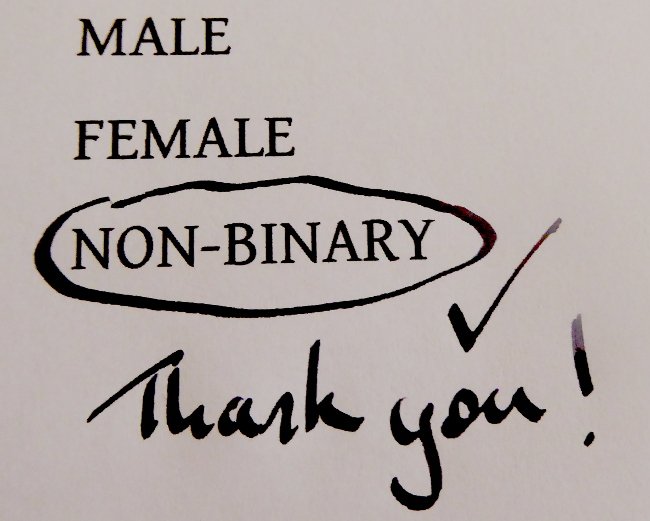
    male, femals, non-binary form

    Just over a week ago there was something called the Scottish Church Census. Churches all over Scotland were asked to count how many people were present and to account for the gender diversity, ethnic diversity, age profile etc of the congregation.

    Those organising the census helpfully provided a brief form which people could use to tick the various categories in order to make an accurate return. Though this was helpful, I quickly realised that we couldn’t use the form that was supplied as using it was not going to be inclusive of everyone in the congregation. The first question on the form asked people to indicate whether they were male or female and I was aware that for at least one person in the congregation, that was not going to be a helpful question.

    I was aware that there was someone in the congregation who does not identify themselves in a way that would allow them to tick either box with any conviction, seeing gender as something rather more complex for themselves.

    Once you start to notice this, you realise that the world is full of forms that require one to identify oneself as either male or female, very many of them forms for which gendered information is completely and utterly irrelevant.

    Anyway, we ended up producing our own local version of the Scottish Church Census form with a third box. The options were now male, female and non-binary.

    When all the forms were gathered up and counted, it turned out that three people had ticked the non-binary box, one of them circling the words and writing “thank you” next to them.

    Thus I found out simply by asking the question, that there were three times as many people in the congregation that day than I would have estimated who would describe themselves as not male nor female but in some way non-binary.

    We’re going to hear quite a lot more about this in the coming years I think. In Scotland there’s going to be a consultation about allowing people to legally be regarded as being of a non-binary gender, the law neither regarding them as male or female. It is a change which should go ahead I think though one suspects that a great number of people have never thought it through.

    The three people describing themselves as non-binary in St Mary’s that Sunday were towards the younger end of the (very mixed) age profile that we have. This suggests to me that this way of identifying oneself is likely to become more common as time goes on and may be very helpful.

    Gender does push people’s buttons a lot and we don’t all agree. There’s a pernicious law being pursued in some parts of the USA trying to ensure that people use the “correct” toilets according to the gender they were assigned at birth. This is problematic for those who have transitioned from one gender to another, those who were born intersex and those for whom gender is simply more complex and who would regard themselves as non-binary.

    (We have both gendered and non-gendered toilet facilities at St Mary’s Cathedral. At home I only have a non-gendered toilet, like most people).

    But here’s the thing. Christians worship a non-binary God, don’t we?

    Haven’t we come (rejoicing) through  the days of feminists calling upon us to recognise that there is a female aspect to the divine which makes all talk of God as purely male to be inadequate?

    Haven’t we come to a point of recognising that God is beyond gender?

    When the government comes to the point of asking us all what we think of introducing a non-binary gender category, won’t the churches joyfully embrace it and support it because this reflects the God we know and in whose image and likeness we are made?

    Might the non-binary gender category that is increasingly going to become an option for people be a helpful way in which we might reflect on the nature of God?

    In congregations like my own, I suspect that will be the case very quickly but maybe for the whole church this shift in the way we regard gender may help us in the way we look at God.

    I wrote last week about the fact that anyone who insists on God being a male authority figure or even daddy is readily challenged by simply reading the bible where God is seen more by attributes that go way beyond gender. When we address God these days in my own congregation we are more likely (far more likely) to address God as “Eternal God” or “Loving God” than we are to talk of “Father God”. This is partly because not everyone has a good model of fatherhood in their own experience but far more it is because this simply isn’t the God whom the bible has introduced us to. Jesus used fatherhood as a metaphor for God but that has to be seen in the context of a book which speaks of God as a flower – the Rose of Sharon, a carnivorous wild animal – the Lion of Judah or weapon – sharper than a two edged sword, along with dozens of other complex rich and sometimes perplexing images.

    We worship a God who is beyond gender even though our tradition has sometimes embraced images of God which are highly gendered – sometimes I think, to distinguish the faith from other highly female gendered images of divinity with which Christianity was competing. (I’ve seen an effigy of Artemis of Ephesus and can honestly say I wouldn’t like to meet her during a dark night of the soul).

    Christian people are not in the business of dealing with a Mr God.

    And Christian people need to wise up fairly quickly to the questions about gender which are coming our way.

    Dear God who is beyond gender,
    give us a greater dose
    of your holy spirit of common sense
    in dealing with gender
    than we have seemed to the world to posses
    over your gift of sexuality.

    Amen


18 responses to “To the synod office”

  1. Robin Avatar
    Robin

    > Would it be out of the question, Robin, for Ms Goldie to become the new Bishop of Glasgow and Galloway?

    As far as I know, it would be OK, since she’s baptised and over 30! And Glasgow & Galloway has had a Bishop Goldie before, so there’s precedent!

  2. kelvin Avatar

    Robin – we are in the process of removing the 30 year lower age limit for bishops this year. If Ms Goldie turns out to be younger than we think, she is still in with a shout.

    David – thanks for your post. It is similar to what’s been said to me in synod. To be honest, as someone whose formative years were mainly in a part of the country where the dominant industry was coal, the idea that the farming/rural economy has been particularly ill treated by either European or national government thinking has always seemed very puzzling.

    There are many things which bring town and country together. Clergy complain of the same degrees of isolation in town and country, for example. People also often complain about the ability of young people in the country to find affordable housing locally. However, to someone who has lived succesively in Perth, Bridge of Allan and the West End of Glasgow, that complaint again seems to unite rather than divide us.

    As for field sports, I feel less strongly about the sports themselves than I did when I was younger. However, I feel more strongly than ever that all of us, whatever sector of society we live in can only muddle along by a common respect for the law and it has sometimes been difficult for someone like me to perceive such a respect in those advocating certain field sports.

    I don’t think field sports are a human rights issue. And I don’t think that civil disobedience (ie lawbreaking) is an appropriate or proportionate response to the banning of hunting with hounds.

  3. Robin Avatar
    Robin

    > Robin – we are in the process of removing the 30 year lower age limit for bishops this year.

    Is this to remedy the understandable confusion potentially caused among electors by your being eminently ‘episcopabile’ while you still look as if you’re well under 30?

  4. kelvin Avatar

    I’m ridiculously flattered on all counts. But no – I’m 42.

    Lower age limits are being removed from ordination canons because of the risk of it being seen as age discrimination.

    (Well, actually, because it was clear age discrimination).

  5. Robin Avatar
    Robin

    > But no – I’m 42.

    So you *are* the answer to the riddle of the Universe!

    I’d have imagined there would have been an exemption for such things. An 18yo Bishop would be a bit ridiculous, to say nothing of the risk of being stuck with her/him if she/he proved a bad choice. However, I don’t expect it will make any practical difference. Even under the existing Canon, did we ever have a Bishop as young as 30? The youngest I can think of was my own mentor, Bishop George Sessford, who was 42 when he was consecrated . . .

  6. Robin Avatar
    Robin

    I meant to write,

    “being stuck with her/him for half a century if….”

  7. David Bayne Avatar
    David Bayne

    “Annabelle, our Bishop” has a certain something, don’t you think?

    The age restrictions on Ordination that we are in process of removing did have a point. They were introduced across most post-Reformation denominations (I’m not sure about the RCC) to prevent beardless youths being presented to (with!) prosperous and influential livings by well-connected parents. My favourite Scottish example is Alexander Stewart, the illegitimate son of James IV who was made Archbishop of St. Andrews in 1504 at the age of 14 – or, possibly, 11. The archdiocese didn’t have to cope with a half-century episcopate, though: he died fighting beside his father at Flodden.

    Being of a slightly earlier vintage than The Provost, it’s the moving of the upper limit that has me exercised. Combined with the hole in the pension fund, it hints at a return to “ad vitam aut culpam” By the time people are worried about me having done 50 years in CD, I’ll be 97………..

  8. Andrew Avatar
    Andrew

    I think that it is nearer to the mark to describe ‘The Scottish Field’ (or was when we lived in Bromley and it was the most exciting post of the month) as ‘Unionist’
    The Editor in the 1950’s lived about 2 miles away in South London so The Scottish Field kept us in touch with Jimmy Shand, John Buchan, The Edinburgh Tattoo and The Fortingall Yew Tree. And those sherry party photographs to commemorate Law Firm anniversaries. We couldn’t recognise anyone but they looked nicer than the people who came to our own parties. So we grew in ignorance monthly as we happily anticipated another 3 weeks in Pitlochry.
    However in 2009, Old SF’s appearing in Room 1 must herald the employment of a dentist in Forbes House, or a gentle reminder of ‘The Homecoming’. I believe they provide the ‘Peoples Friend’ at 121 George Street, but I could be wrong.

Leave a Reply

Your email address will not be published. Required fields are marked *

Previous Posts

  • Gay Booklist

    Several people have recently asked me for suggestions for some affirming reading material for lesbian and gay Christians and more generally for anyone wanting to find material to help them think around the topic. I published a list a couple of years ago. Here’s the link: http://thurible.net/20080429/lgbt-booklist/ There’s more stuff coming out (so to speak)…

  • God Factor

    The God Factor starts again on Sunday 22 April 2012 at St Mary’s. It is like some other courses that churches run in that people gather over food and talk about faith. Ideal for beginners and those wanting a refresher in faith or who just want to talk about the possibility of faith. It is…

  • What causes it?

    Interesting documentary on BBC3 last night about a young man who had a stroke and “woke up gay” afterwards. It was both interesting and perplexing. That there has been a huge shift in his character and personality is clear. That he once dated women and now is attracted to men is easily shown. That he…

  • Unremitting Joy

    Don’t forget that Easter is not just a day but a season – 50 days of unremitting joy in fact. We’re 10 days in. Should you be feeling the joy start to droop, I suggest you have a listen to this lovely Regina Coeli: I’m not sure that it is quite so lusty as we…