
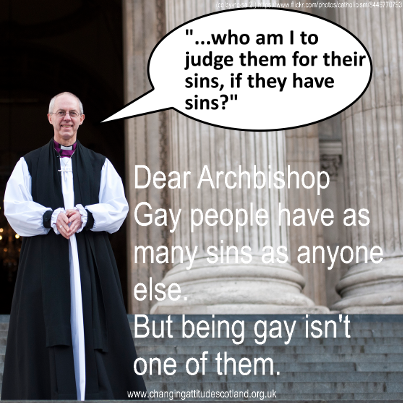
• The Archbishop, the gays and their sins

    Welby fbsize

    One of the things that we’ve learned about Archbishop Justin Welby in recent weeks is that he gets upset about what people write about him on social media.

    He wrote at some length about how what gets written online is upsetting and he’d just prefer to have personal contact with him rather than sounding off online.

    Love often says don’t tweet. Love often says don’t write. Love often says if you must rebuke, then do so in person and with touch – with an arm around the shoulder and tears in your eyes that can be seen by the person being rebuked.

    It is difficult not to have some sympathy for him and I say that as someone who has been really particularly critical of him in the past. It can’t have been much fun seeing my You Condemn It, Archbishop post being relentlessly copied, commented on and retweeted across the Anglican globe.

    And yet the trouble is, there’s no turning the social media clock back. Wanting a world where people don’t comment online about things they care about very deeply is wanting a fantasy world that has no chance of coming back into being.

    Is it possible for leaders and people in public life to do well when the whole internet seems bedeviled with naughty people who will retweet and repost every last mistake that people make?

    I think it is possible, but trying to stand above the fray and condemning people for writing about things you’ve said is hardly going to work nowadays.

    The Archbishop’s complaint about social media came just after someone published a blog post which appeared to suggest that one of the Archbishop’s closest advisors had given a briefing to a group of Anglicans which suggested that Lambeth was now not trying to avoid schism in the Anglican communion but trying to manage it – the expectation being that some parts of the Church of England (the most liberal and the most conservative) would be lost but that a coherent “middle” would survive. It was a deeply shocking position to claim to be true. So shocking that I didn’t believe it at first but have since heard others who were at the briefing confirm that this stuff was indeed said and repeat also that expectation is that there would be bargaining over which buildings to give away, within 10 years.

    That blog post disappeared fairly quickly but internet genies don’t jump back into bottles and the story was out there and really rather embarrassing to all concerned.

    No wonder the Archbishop posted something indicating his discomfort about social media.

    But the real question is whether the social media phenomenon is the problem or whether the archbishop’s problems lie with with the things that social media point towards.

    It must be terribly frustrating to have people pick up on your every utterance and make a big deal out of it.

    The trouble is, in public life, the words you say have a lot of power. Social media posts rebalance that power a little and we should be welcoming the fact that we are a community that cares enough to talk about things rather than trying to remake the Anglican world into one in which bishops speak and everyone else listens uncritically.

    I’ve no doubt that the Archbishop will be embarrassed by posts such as this one which highlight something he said this week. Asked about the usual topic – those pesky gays, a topic that he will be asked about in every interview he ever gives, he is reported to have said:

    I’m listening very, very closely to try to discern what the spirit of God is trying to tell us.

    I see my own selfishness and weakness and think who am I judge them for their sins, if they have sins.

    You can almost hear him dithering over the comma in that last sentence and wondering how this might sound on social media and adding a bit of theological nonsense.

    Of course gay people have sins. However if the first response you make when people ask you about gay people is to talk about sin, then you are going to sound pretty homophobic. And it doesn’t matter whether you like it or you don’t like it, people are going to call attention to it online.

    But is that to be too critical? What strategies could the Archbishop adopt that would help when he is asked about the Usual Topic?

    The most basic thing is to recognise that everything is a conversation these days.

    In fact the Archbishop did quite well in answering a question from a young Muslim who wanted to know whether he would try to convert him to Christianity.

    I am not going to put pressure on you, and I wouldn’t expect you to put pressure on me.

    He could have done far worse with that question than he did.

    Unfortunately, he answered the question on the Usual Topic by immediately talking about sin and then parroting the “sex outside marriage in the C of E is against the rules” line.

    It is a conversation, Archbishop.

    That means we want to talk about it, not be told what the rules are before the conversation gets going.
    It means we want to talk about it, not be told to lay off social media because it gives you the hump.
    It means you can have your say so too and people will listen respectfully and carefully to what you say, but only so long as you engage with people.

    It is a conversation, Archbishop. Everything is a conversation.

    When the first thing you say about gay people is about sin then you can’t expect the conversation to go well.

    It wasn’t helped that the second thing you said was along the lines of “some of my best friends are gay you know?”

    “Marriage is between one man and one woman for life and sexual activity should be confined to marriage, that’s in the Church of England’s laws” he said. “I’m equally aware I have a lot of gay friends and I know gay clergy and they are doing incredible work.”

    You say that stuff and you are going to get people observing that there’s a lot more archbishops who claim that gay people are their friends than gay people who claim archbishops are their friends.

    This could be going better. It could be going much better.

    And it is going to happen again. That question is going to be asked again and again and again.

    There are people out there who can help you find better answers.

    Guess where they are, Archbishop?

    Yes – all over social media.

18 responses to “To the synod office”

  1. Robin Avatar
    Robin

    > Would it be out of the question, Robin, for Ms Goldie to become the new Bishop of Glasgow and Galloway?

    As far as I know, it would be OK, since she’s baptised and over 30! And Glasgow & Galloway has had a Bishop Goldie before, so there’s precedent!

  2. kelvin Avatar

    Robin – we are in the process of removing the 30 year lower age limit for bishops this year. If Ms Goldie turns out to be younger than we think, she is still in with a shout.

    David – thanks for your post. It is similar to what’s been said to me in synod. To be honest, as someone whose formative years were mainly in a part of the country where the dominant industry was coal, the idea that the farming/rural economy has been particularly ill treated by either European or national government thinking has always seemed very puzzling.

    There are many things which bring town and country together. Clergy complain of the same degrees of isolation in town and country, for example. People also often complain about the ability of young people in the country to find affordable housing locally. However, to someone who has lived succesively in Perth, Bridge of Allan and the West End of Glasgow, that complaint again seems to unite rather than divide us.

    As for field sports, I feel less strongly about the sports themselves than I did when I was younger. However, I feel more strongly than ever that all of us, whatever sector of society we live in can only muddle along by a common respect for the law and it has sometimes been difficult for someone like me to perceive such a respect in those advocating certain field sports.

    I don’t think field sports are a human rights issue. And I don’t think that civil disobedience (ie lawbreaking) is an appropriate or proportionate response to the banning of hunting with hounds.

  3. Robin Avatar
    Robin

    > Robin – we are in the process of removing the 30 year lower age limit for bishops this year.

    Is this to remedy the understandable confusion potentially caused among electors by your being eminently ‘episcopabile’ while you still look as if you’re well under 30?

  4. kelvin Avatar

    I’m ridiculously flattered on all counts. But no – I’m 42.

    Lower age limits are being removed from ordination canons because of the risk of it being seen as age discrimination.

    (Well, actually, because it was clear age discrimination).

  5. Robin Avatar
    Robin

    > But no – I’m 42.

    So you *are* the answer to the riddle of the Universe!

    I’d have imagined there would have been an exemption for such things. An 18yo Bishop would be a bit ridiculous, to say nothing of the risk of being stuck with her/him if she/he proved a bad choice. However, I don’t expect it will make any practical difference. Even under the existing Canon, did we ever have a Bishop as young as 30? The youngest I can think of was my own mentor, Bishop George Sessford, who was 42 when he was consecrated . . .

  6. Robin Avatar
    Robin

    I meant to write,

    “being stuck with her/him for half a century if….”

  7. David Bayne Avatar
    David Bayne

    “Annabelle, our Bishop” has a certain something, don’t you think?

    The age restrictions on Ordination that we are in process of removing did have a point. They were introduced across most post-Reformation denominations (I’m not sure about the RCC) to prevent beardless youths being presented to (with!) prosperous and influential livings by well-connected parents. My favourite Scottish example is Alexander Stewart, the illegitimate son of James IV who was made Archbishop of St. Andrews in 1504 at the age of 14 – or, possibly, 11. The archdiocese didn’t have to cope with a half-century episcopate, though: he died fighting beside his father at Flodden.

    Being of a slightly earlier vintage than The Provost, it’s the moving of the upper limit that has me exercised. Combined with the hole in the pension fund, it hints at a return to “ad vitam aut culpam” By the time people are worried about me having done 50 years in CD, I’ll be 97………..

  8. Andrew Avatar
    Andrew

    I think that it is nearer to the mark to describe ‘The Scottish Field’ (or was when we lived in Bromley and it was the most exciting post of the month) as ‘Unionist’
    The Editor in the 1950’s lived about 2 miles away in South London so The Scottish Field kept us in touch with Jimmy Shand, John Buchan, The Edinburgh Tattoo and The Fortingall Yew Tree. And those sherry party photographs to commemorate Law Firm anniversaries. We couldn’t recognise anyone but they looked nicer than the people who came to our own parties. So we grew in ignorance monthly as we happily anticipated another 3 weeks in Pitlochry.
    However in 2009, Old SF’s appearing in Room 1 must herald the employment of a dentist in Forbes House, or a gentle reminder of ‘The Homecoming’. I believe they provide the ‘Peoples Friend’ at 121 George Street, but I could be wrong.

Leave a Reply

Your email address will not be published. Required fields are marked *

Previous Posts

  • Sermon – 26 September 2010

    Here’s what I said yesterday in the pulpit… There’s no getting away from it. Sooner or later we do have to think about hell. That’s the message from this morning’s gospel reading and I don’t think that there is any choice but to deal with it head on and allow ourselves the chance to ask…

  • Knowing Me, Knowing You (again!)

    Hey, remember the Knowing Me, Knowing You sessions that I ran a while ago? Well I’m doing another one this week. If you don’t remember what this is about, check out this description from an earlier one. These sessions are limited to 20 people in order that we can keep the conversation flowing. If you…

  • Consecration of new bishop in Kentucky

    The Diocese of Kentucky consecrates a new bishop today. The Diocese of Kentucky is one of Glasgow and Galloway’s Companion Dioceses. At about 4 pm UK time, the service will begin in Kentucky…. and, provided they can resolve their internet issues in Kentucky, on this blog: Now, ain’t that neat?

  • Home is the wanderer

    Ah, Glasgow. Here I am again. Today I arrived back in town after two weeks holiday. I’ve been to France, since you ask and I’ve had a lovely time. I was in the sud and so my body was warmed greatly by the sun. I tend not to tan a great deal, because I slap…