
• Listen up! Moocs are the future

    OK listen up. Moocs are the future.

    Now before we go any further, let’s get the usual responses out of the way. The usual responses are twofold:

    1. What’s a mooc?  (Most people)
    2. *rolls eyeballs* (lots of academics, including quite a few in my congregation)

    Firstly, a mooc is a term used for a new form of education that you engage in online. It stands for Massively Open Online Course. Such things have been around for the last couple of years and there’s a good wikipedia page on the concept.

    The basic idea is that you do a course online along with many thousands of other people all at once (massive) which you have easy/free (open) online (online!) access to. It is a way for someone to teach many people. Many, many people. I’ve just finished doing a mooc where a team of three people were attempting to teach 13000 students all around the world.

    But why the eyeball-rolling from clever people?

    Well, any teacher worth their salt is going to say, “Ah, but wait a minute? Hang on there… what do you mean…. that’s not a learning experience that is equivalent to what I can do in a classroom.”

    And you know what? It isn’t.

    However, it is here, it is now and it is going to develop in the future all the same.

    Now, are you thinking you’ve heard all this before – are you thinking this is just a glorified correspondence course? Sure you are. But this is a bit more than that. Typically in a mooc, you get video lectures or other content to download, maybe on a weekly basis. You work through that stuff and you get online quizzes and exercises that you do along the way. If the course is well designed, you get instant feedback on how you are doing and can go back and review any of the bits that you didn’t understand.

    But here’s the thing – it isn’t just you. It is social. There’s a whole bunch of people out there doing the same course as you. And you can get to interact with them on the forums. Indeed, some of the ways that the mooc is assessed may include interaction on the forums. (Cue eyeball rolling from academics who can’t work out that this is the equivalent of giving a mark for interaction in class discussions, which is a relatively common practise in some institutions).

    Then, when all is done, you may well have a final piece of work to submit and this will be marked. But hey, how do you mark 13000 pieces of work? Well, if it is not machine markable material (multiple-guess questions) then the mooc method is to get students to peer review. In the mooc I’ve just participated in, we were encouraged to produce a final video and to pass the course you had to, not only submit your own video, but assess three (or more) others.

    Then you get your certificate and there is much rejoicing.

    Now, here’s where the Eyeball Rollers have started to harumph loudly. “What use is a certificate when no-one qualified has seen the work? Isn’t this the dumb assessing the dumber?”

    Well, the truth is, such a certificate is worth precisely nothing in terms of the educative processes that we have been used to.

    But get this, moocs are not really about what the certificate is worth. The satisfaction comes from having learned something new. Getting the certificate is just icing on the beans. Yet getting that certificate is oddly fulfilling – it is part of the gamification of learning. You get a certificate, you want another. You unlock a level badge, you go  back to try to accomplish the next level.

    Anyway at the end of this post is my certificate from the mooc I recently completed. I don’t care what you think about its value – for me it represents a whole bunch of skills that I just learned. It is for a course that was really for school teachers on Blended Learning – that’s about how to mix learning that takes place in an online setting with more traditional face-to-face teaching. I took the course because I want to be able to offer some online courses at St Mary’s as well doing what we already do. It seemed sensible to do the course and also learn from completing the mooc itself.

    What does this mean for the church at large – well it means that education needs to get slicker. In the same way that new technology has meant that we need to up our game in religious circles in the way we communicate with people, so we need to do the same with how we teach. That scrappy stapled-together church magazine is a great means of communicating but it does so on two levels. On one level, it communicates to those who have always received it that things are carrying on just the same as ever and even lets them know whether they are on the coffee rota on Sunday. To the more casual reader, however, it probably communicates that you are not terribly professional, have low expectations which will carry forward into worship and that you are desperate for someone to join the coffee rota to try to replace the people who are dying off.

    It is the same with education. Sitting around a flipchart with half a dozen people is something that I continue to do. However, increasingly as I do it, I’m aware that the ways in which people learn are changing. Gamification (rewards – yes, sometimes silly little rewards) is here to stay. Blending of online and offline worlds is how people are doing everything from shopping to looking after their health so why shouldn’t that affect how we learn about Things That Matter in church circles? And yes, self directed learning is here to stay.

    There’s new technology on offer here. Who knows what we’re going to do with it?

    And here’s my certificate, which I’m terribly proud of, can you tell?
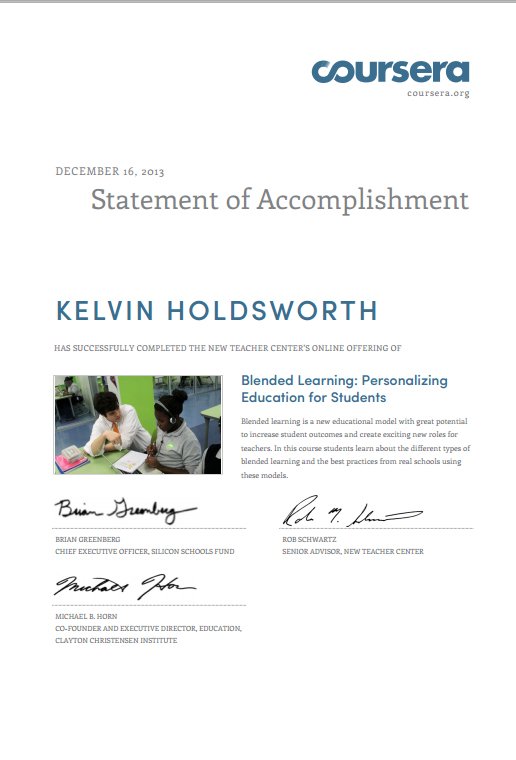
    Blended Learning

18 responses to “To the synod office”

  1. Robin Avatar
    Robin

    > Would it be out of the question, Robin, for Ms Goldie to become the new Bishop of Glasgow and Galloway?

    As far as I know, it would be OK, since she’s baptised and over 30! And Glasgow & Galloway has had a Bishop Goldie before, so there’s precedent!

  2. kelvin Avatar

    Robin – we are in the process of removing the 30 year lower age limit for bishops this year. If Ms Goldie turns out to be younger than we think, she is still in with a shout.

    David – thanks for your post. It is similar to what’s been said to me in synod. To be honest, as someone whose formative years were mainly in a part of the country where the dominant industry was coal, the idea that the farming/rural economy has been particularly ill treated by either European or national government thinking has always seemed very puzzling.

    There are many things which bring town and country together. Clergy complain of the same degrees of isolation in town and country, for example. People also often complain about the ability of young people in the country to find affordable housing locally. However, to someone who has lived succesively in Perth, Bridge of Allan and the West End of Glasgow, that complaint again seems to unite rather than divide us.

    As for field sports, I feel less strongly about the sports themselves than I did when I was younger. However, I feel more strongly than ever that all of us, whatever sector of society we live in can only muddle along by a common respect for the law and it has sometimes been difficult for someone like me to perceive such a respect in those advocating certain field sports.

    I don’t think field sports are a human rights issue. And I don’t think that civil disobedience (ie lawbreaking) is an appropriate or proportionate response to the banning of hunting with hounds.

  3. Robin Avatar
    Robin

    > Robin – we are in the process of removing the 30 year lower age limit for bishops this year.

    Is this to remedy the understandable confusion potentially caused among electors by your being eminently ‘episcopabile’ while you still look as if you’re well under 30?

  4. kelvin Avatar

    I’m ridiculously flattered on all counts. But no – I’m 42.

    Lower age limits are being removed from ordination canons because of the risk of it being seen as age discrimination.

    (Well, actually, because it was clear age discrimination).

  5. Robin Avatar
    Robin

    > But no – I’m 42.

    So you *are* the answer to the riddle of the Universe!

    I’d have imagined there would have been an exemption for such things. An 18yo Bishop would be a bit ridiculous, to say nothing of the risk of being stuck with her/him if she/he proved a bad choice. However, I don’t expect it will make any practical difference. Even under the existing Canon, did we ever have a Bishop as young as 30? The youngest I can think of was my own mentor, Bishop George Sessford, who was 42 when he was consecrated . . .

  6. Robin Avatar
    Robin

    I meant to write,

    “being stuck with her/him for half a century if….”

  7. David Bayne Avatar
    David Bayne

    “Annabelle, our Bishop” has a certain something, don’t you think?

    The age restrictions on Ordination that we are in process of removing did have a point. They were introduced across most post-Reformation denominations (I’m not sure about the RCC) to prevent beardless youths being presented to (with!) prosperous and influential livings by well-connected parents. My favourite Scottish example is Alexander Stewart, the illegitimate son of James IV who was made Archbishop of St. Andrews in 1504 at the age of 14 – or, possibly, 11. The archdiocese didn’t have to cope with a half-century episcopate, though: he died fighting beside his father at Flodden.

    Being of a slightly earlier vintage than The Provost, it’s the moving of the upper limit that has me exercised. Combined with the hole in the pension fund, it hints at a return to “ad vitam aut culpam” By the time people are worried about me having done 50 years in CD, I’ll be 97………..

  8. Andrew Avatar
    Andrew

    I think that it is nearer to the mark to describe ‘The Scottish Field’ (or was when we lived in Bromley and it was the most exciting post of the month) as ‘Unionist’
    The Editor in the 1950’s lived about 2 miles away in South London so The Scottish Field kept us in touch with Jimmy Shand, John Buchan, The Edinburgh Tattoo and The Fortingall Yew Tree. And those sherry party photographs to commemorate Law Firm anniversaries. We couldn’t recognise anyone but they looked nicer than the people who came to our own parties. So we grew in ignorance monthly as we happily anticipated another 3 weeks in Pitlochry.
    However in 2009, Old SF’s appearing in Room 1 must herald the employment of a dentist in Forbes House, or a gentle reminder of ‘The Homecoming’. I believe they provide the ‘Peoples Friend’ at 121 George Street, but I could be wrong.

Leave a Reply

Your email address will not be published. Required fields are marked *

Previous Posts

  • Book Review – Iona Dawn

    Edited by Neil Paynter (Wild Good Publications – www.ionabooks.com £7.99) Getting this book for your next Holy Week might be a wise move. The dramatic events of the days leading up to Easter Sunday are expressed here through biblical readings and the reflections of several well-known Iona Community members. This is a more devotional book…

  • Book Review – The Eye of the Storm

    The Eye of the Storm: Spiritual Resources for the Pursuit of Justice by Kenneth Leech This is an honest spirituality. Kenneth Leech knows that an authentic engagement with God will mean that everything changes. Here is a writer to knows that to separate spirituality from justice is to do great damage to Christian consciousness. A…

  • Book Review – Changing Rural Life

    This new book addresses a number of different themes facing rural life, which we are assured is changing in particular and distinctive ways. Drawing together essays by many contributors, the editors attempt to stimulate reflection on the rural economy, the environment and community issues. Of particular interest is a chapter by the Most Rev Bruce…

  • Book Review – Making Church Buildings Work

    The task of managing creaking church buildings is one which is mostly undertaken by volunteers in almost every community the length and breadth of the country. It is surprising therefore that so little has been written to aid those who take on this mammoth task. Those of us who do undertake such work now have…