
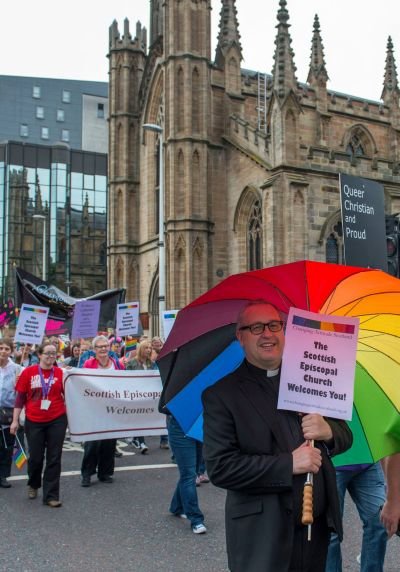
• 50 Years of Protest and Change

    As day turns to evening on the 28 June 2019, it is difficult not to think of a couple of relatively small-scale riots that took place 50 years ago and murmur a quiet prayer of thanksgiving for the rioters. I have little doubt that there was no way they could foresee the movement which was to spring from the events that took place in and around the Stonewall Inn in New York.

    Earlier this week I spent a lovely evening in the sun sitting outside the Royal Gourock Yacht Club eating a meal with friends. The sun was shining, the water was calm, boats were bobbing about and we were served good food. It could not have been further away from the rather downbeat drinking establishment that the Stonewall Inn had become all those years ago. However, as I sat eating my haddock and chips, one of the friends I was with said to me: “Do you know what I saw this week? I saw two young men walking down the street hand in hand. In Gourock! Imagine! How did that happen?”

    I looked at another friend who, like me, has been on a march or two in his time and said, “Well, it didn’t just happen. We made it happen”.

    But such is the luxury of being able to look back. No-one ever punched me in the nose, and I’d better remember that whilst thinking about what was started 50 years ago tonight.

    When the denizens of the Stonewall Inn were attacked by the police they seemed initially to simply have been fighting back rather than kick-starting a movement that would reach even down the Clyde on a balmy night in June 50 years later. They were not the A-Gays or the Power Lesbians of New York either. More the young, often homeless young people who had washed up in the big city for reasons with which gay people will instinctively be familiar. They were not welcome at home and they were not welcome most other places either. Lost LGBT youth still exist in major cities. The LGBT movement started by the Stonewall event hasn’t, sadly, stopped that completely.  But so very much has changed in those 50 years.

    There is so much to be thankful for. For those who, when set upon by a violent police force did high kicks and mocked the authorities mercilessly. For those who organised in the middle of chaos. For those who came up with slogans. For those who tended the wounded. For those who encouraged. For those who didn’t give in.

    Reading first hand accounts of the riots themselves, it is difficult for me not to hear echoes of the Magnificat, the riot itself a vesper prayer of those who knew that the world in which they were oppressed, needed to be toppled over. Reading of the corrupt world in which those who were attacked, I find myself cheering them on with a belated prayer that the mighty might be brought down from their seat with all the consequent glitter of the exaltation of the humble and meek.

    I celebrate and rejoice in all the activists then and since who have made this world a place where I can live in much more security than anything imaginable by the original rioters. And I am impatient for more.

    Thinking about the Stonewall Riots this particular week, it is impossible not to remember explicitly trans people and the current campaigns to change the law with regard to gender recognition. This process is going to take longer in Scotland than some had hoped for and there are many people directly affected who are feeling sad, cross and bereft right now. I’m someone who is sometimes puzzled by what trans rights to fight for – I’m very conscious that I don’t speak from that experience and the place of the church in those debates is very different from the discourse a few years ago over the marriage of same-sex couples. However I do see the most ghastly attacks (physical and in digital space) on trans people and recognise them as a kind of bullying and intimidation with which I am familiar.

    The conversation about how to reform the Gender Recognition Act will go on and it was clear from a gathering I was at within the Scottish Parliament building earlier this week that the genderqueer people who took leading roles in fighting back against oppression 50 years ago are still inspiring people today.

    The rights that have been won by the modern LGBT movement have been considerable. However, when those of us who have been active gather and talk at the moment, we often talk of the fragility we feel about those rights.

    And so much of what we have is partial anyway.

    I recently married a couple from Northern Ireland who were in a Civil Partnership. That meant that when they set off to come to get married they were in a Civil Partnership in Northern Ireland but at the moment I married them they became married in Scotland. Moreover, Scots Law says that at that moment, they became married from the date of their Civil Partnership. (As they travelled to come to Glasgow they were thus in one sense both married and not married simultaneously). And once they took the Easyjet flight home, as soon as they touched down they were in a part of the UK closer to here than Inverness, and all of a sudden they were no longer regarded as married in the jurisdiction in which they live.

    And I became aware this week of someone in the city too frightened to come to a Pride march as they could lose their job as a teacher in a state-funded Roman Catholic school in this city if they were seen to have done so and been reported to their bishop. (It happens to be the case that none of my friends in the Roman Catholic Church would think for a moment that such behaviour helps spread the good news of Jesus Christ – they seem as scandalised by it as I am). We won’t have inclusive education until such discrimination has been stopped in our local schools and it is a disgrace to the inclusive credentials of our local and Scottish governments that it hasn’t been tackled already.

    Such absurdities would never be tolerated by straight people. Nor should they be by us.

    The fight is far from over and there are plenty of us who are eager not only to secure the rights we have won but to fight for more.

    And notwithstanding the current fad for national populism, the borders of our countries will not ultimately inhibit or hold back the simple demand for equality that comes from those who don’t have it yet.

    The fight isn’t won yet.

    It won’t be over until the children of Kampala and Corstorphine grow up in institutions and households where prejudice against LGBT folk is unthinkable, never mind unrepeatable.

    It won’t be over until lesbians can take any bus in the world without being subject to the taunts and blows of putative patriarchs.

    It won’t be over until absurd aspersions cast against trans people are laughed at.

    It won’t be over until LGBT people are no longer running from home, from school or from life itself.

    It won’t be over until the boys holding hands in Gourock are unremarkable.

    But one day… one day it will be over.

    And until then, we march and work and dance and fight and laugh and pray.

    And I have no doubt, the whole company of heaven joins us.

10 responses to “Advertise, advertise, advertise!”

  1. Matt Hanson Avatar

    Good writing. Keep up the good work. I just added your RSS feed my Google News Reader..

    Matt Hanson

  2. Eamonn Avatar
    Eamonn

    How naff can you get? It was worth listening to a professional advertiser’s comments on the Lichfield advert on the Sunday programme on Radio 4.

  3. Gavin Drake Avatar

    Adverts that make people in the church feel comfortable are likely to be completely irrelevant to people outside the church. As the instigator and creator of the Lichfield football adverts campaign I stand by them – they did what we wanted them to do. We had a target and we achieved that target. The professional advertising chap on Radio Four was anti the adverts; but he was also anti the entire Christian message as a self-proclaimed militant atheist. His best effort? “Life” – which is a campaign he created for the Billy Graham missions 20 years ago. Hardly creative (now, 20 years on) nor fresh. His message was that the church should get rid of Jesus, God and all the “after life” stuff and concentrate on making people feel good now.

    One final thought, in this blog entry aren’t you demonstrating the Christian Christmas grumpetyness which you appear to be criticising in others?

  4. kelvin Avatar

    Thanks for your comments Gavin.

    You are quite right about my grumpityness though I was not particularly being critical of it in others. Indeed, being able to rely on other people’s grumpityness is one of the things which has ensured a lot of exposure for the CAN ads, for example, the Bad Hair Day campaign and the Meek, Mild As If one. It was the (mock?) outrage of the christian community that got those ads talked about.

    I’m a fan of what the CAN do, which I perhaps did not make clear in the above blog entry.

    I’d be interested to know what the target was and how achieving it was measured.

    I have to confess to feeling embarrassed by the Lichfield ad but then of course, it was not aimed at me.

    I also commented about past CAN campaigns here and here.

  5. Kennedy Avatar
    Kennedy

    Having listened to the CAN adverts, I am left asking what the message was and who was the target audience? If the intention was to familiarise the audience with the characters and motifs from the Christmas story then OK, but there is more that could be said in the time.

    You’ll permit me a small plug for the stuff that GRF produce.

    Have a listen:

    http://smallvoice.org.uk/wp-content/uploads/2008/09/01-ms-christianity.mp3

    Yes, this uses the style of the M&S ads but I think that it communicates something about the Christian message and in a form that a non-church person could relate to.

    The judges at the Jerusalem Awards seemed to like it as they awarded it the premier award in the ‘Shorts’ category at their awards ceremony last week.

    If you are looking for creative audio to use in churches or schools then have a look at http://www.audiopot.org.

    Kennedy

  6. kelvin Avatar

    Thanks Kennedy. I like the M and S Ad. Very clever. I always like hearing Albatross (the music underneath) because it reminds me of someone I knew a long time ago who used to play it (on large pipe organs) during communion.

    One of the drawbacks of the ads that I was speaking about above is that they all depend on knowing the Christian story. That is perhaps legitimate in a Back to Church Sunday as it is presumably aimed at folk who have gone away knowing something or other.

    The line about the penalty does kind of imply that substitutionary atonement is what we believe though.

    The Lichfield ad certainly got a lot of coverage and if that was the intention, it succeeded.

  7. Elizabeth Avatar
    Elizabeth

    I must admit I found the racing advert amusing. The football ones leave me cold. Aside from issue about inclusivity and dubious theology, I think living in Glasgow has made me very wary of any connection between religion and football.

  8. Coxy Avatar

    I think that the football one is excellent, as does my wife (and she can’t tell the difference between Liverpool and Arsenal – I guess they do both play in red though!). How is it not inclusive of men and women? As I see it there is good build up play from Mary and Joseph before Jesus scores…

  9. kelvin Avatar

    Hi Nick

    I’ve just rescued your comment from a spam filter – don’t know why it got swallowed.

    At St Mary’s we tend to avoid language like “men” where what is really meant is men and women, “mankind” when what is meant really is humanity etc

    This affects things like the language we use for hymns.

    We’d never sing, “Brothers, this Lord Jesus, shall return again” for example. In a mixed crowd it just seems rude.

    There is an ongoing degate about how far to go with this policy but by and large, language inclusive of men and women is the norm at St Mary’s and exclusive language tends to jar and be distractive when you’ve got used to more inclusive language in church. Thus the ad is something we couldn’t use because of the use of the word “man” meaning something other than just men.

  10. ryan Avatar
    ryan

    The term “banter”, as featured in the ad, should also be used by no-one anyway (and only partly because of Chewing the Fat). O the amount of people that have endured abuse and had it expained away as “just banter”.

    Wondering if “male” ads like this are ok if one also does female-centered advertising, or if the whole idea is hoary sexism. St.Silas does a Women 4 Women thing which I believe is popular. No Men 4 Men though.

    Hope I’m immune from the st.silasite ensnaring spam filter
    ;-).

Leave a Reply

Your email address will not be published. Required fields are marked *

Previous Posts

  • Madama Butterfly – Review

    Here’s a review of Madama Butterfly from Scottish Opera which I saw just before I was signed off sick. This also appears on the Opera Britannia blog. Rating: For their final show in an uncertain season, Scottish Opera return to form with an achingly beautiful revival of Sir David McVicar’s production of Madama Butterfly from…

  • Alternative Queen’s Speech

    Here is an Alternative Queen’s Speech – the things that I’d have liked to hear from the Queen in the House of Commons today and what I’d have asked Her Majesty to say if I were the Prime Minister. My Lords and Members of the House of Commons, my government will work in the year…

  • The Visitation and an Anniversary

    Today is the Feast of the Visitation. It also happens to be the anniversary of me coming to St Mary’s 8 years ago. Those who were around then will remember that my ministry started here with a hugely exciting service of induction and installation. I had to be made the Rector and I had to…

  • Off sick

    Have had an extraordinarily quiet time over the last couple of weeks, unable to really enjoy being on holiday as I was still trying to get over a bronchial infection which has gone on for weeks and weeks. Back to work for half a day yesterday showed me that I’m still a long way from…