
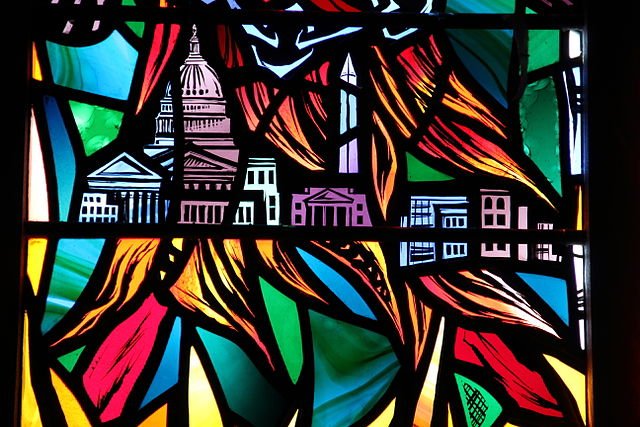
Just over four years ago, I was on sabbatical in the USA and one of the institutions that I visited was Washington National Cathedral in the US capital. It is an odd entity in many ways, carrying with it what feels very much like a load of assumptions about established religion in a land where religion is not established. There’s no doubting that the cathedral is there for America rather than simply for its city or its locality as that is what it was built for and determined in foundation documents. Yet the paradox is that America proudly believes in the separation of church and state in a way which might lead one to believe made a National cathedral an impossibility. As usual, religious people manage to hold the paradox together, believe 6 impossible things before breakfast and Washington National Cathedral has a place in the life of the United States that can’t really be explained with logic alone.
When I visited, the question that the cathedral faced was what happened if Obama were to lose the election. Not because the cathedral cared particularly about Obama winning but because his opponent was a Mormon. No-one knew what would happen. Would a Mormon president want a liturgical act at an Episcopal cathedral or not? And work was being done to try to find out. It is the nature of conservative institutions to work very hard to adapt to circumstances and all cathedrals are inherently conservative in that sense. That’s what often makes them places where radical things can happen.
There is currently a hoo-ha about whether the choir from Washington National Cathedral should sing at the inauguration of President Trump on Friday. The word has gone out that the choir will sing and there’s quite a lot of people who think that is inappropriate given the mores and peccadilloes of the incoming president.
I can see this one from both sides. It seems unsurprising to me that the cathedral would want the choir to accept the invitation. Otherwise, they are going to have to vet every incoming president’s agenda for suitability in the future and that is not a comfortable place to find oneself. It seems to me that one either accepts all the invitations or none of them. One cannot get into the business of picking and choosing or else one will forever be in the midst of conflict and forever be upsetting half the country.
However, I can also see it from the side of those who want something to protest about. Trump is a baffling figure to the liberal establishment at prayer. He is their worst nightmare. Why should the church turn out on parade for someone seen as an ogre? Are there no limits? Isn’t Trump so far removed from normality that normal presumptions no longer apply?
There’s a similar connected discussion about whether there should be a liturgical celebration for the new president in the National Cathedral and indeed about how or whether people are going to pray for the new president in US Episcopal churches across the country.
There’s a wee nugget of Scottish Episcopalian church history that our US daughter church might want to be aware of in trying to work their way through these dilemmas. However, before I get to that, I think it is worth noting that it can matter hugely whom one is praying for.
A significant part of my time of formation for priesthood was spent in Egypt living with the Coptic church and also with Anglicans in Cairo. In that environment I learnt about subtle and not so subtle forms of persecution and have never forgotten the response of one Coptic bishop when I asked him why a particular sectarian attack on Copts had taken place. He leaned back on his chair and stroked his not inconsiderable beard and said very sadly: “attacks take place because we do not love our Muslim brothers and sisters enough”. I’ve never forgotten those words from someone who himself could have been a target of violence. (They were spoken in the compound which was recently blown up with great loss of life just a few weeks ago).
The point is that at that time in most of the big churches in Cairo (Anglican and Coptic) people were very careful to pray for the then president Hosni Mubarak. The reason they were keen to pray for him was that there would generally be a couple of well dressed young men in the congregation to check that such loyal prayers were being uttered. The secret police were not really that secret. The government was always just checking up and people prayed with an implied threat over them at all times.
When I was in the USA – I was immediately intrigued by one aspect of the intercessions that is connected with praying for the powerful. Wherever I went I found that the intercessions contained prayers for the Archbishop of Canterbury. That is unremarkable in the USA but to a Scottish Episcopalian on tour it was a revelation. We tend to pray for our diocesan bishops and sometimes (but not that often) for the Primus, and almost never for the Archbishop of Canterbury. Indeed, not praying for the Archbishop of Canterbury is almost a part of who we are.
The prayers for the Archbishop in the USA illuminate the incredible hurt caused by Rowan Williams and his successor in snubbing the American church and persistently misunderstanding or misrepresenting its polity. “We prayed (and also often paid) for your ministry” you can feel the US Episcopalians wailing in their distress. We played the pipe for you and you refused to dance.
But back to the Scottish Episcopal Church – that church which blessed the US Episcopalians into being.
For controversy about prayers for the powerful are a big part of our history. At times in our history, the safety and wellbeing of those gathered in church was directly connected with which monarch was being prayed for in the prayers. I am not the first Episcopal priest in this city who needed to worry about safety and security for the congregation. Prayers for the House of Stewart could (and sometimes did) lead to violence.
Gradually it became the practise of Episcopalians in this part of the world to pray for the ruling House of Hanover. However, not all in the pews ever really got there.
American Episcopalians today might be interested in the historical records of Scottish Episcopalians in the pews faced with clergy who, rightly or wrongly, and for a whole range of reasons believed that they had to pray for the Hanoverian regime.
There are records of congregations going to divine worship and when the state prayers for the House of Hanover were read those in the pews simply and loudly slammed their prayerbooks shut or coughed loudly.
There’s even reports of people deliberately partaking of snuff in the pews at the contentious moment the better to affect a snuffling, coughing and sneezing fit.
Now, let us finish with a prayer from the wonderful US Book of Common Prayer.
O Lord our Governor, whose glory is in all the world:
We commend this nation to thy merciful care,
that, being guided by thy Providence, we may dwell secure in thy peace.
Grant to the President of the United States,
the Governor of this State (or Commonwealth),
and to all in authority,
wisdom and strength to know and to do thy will.
Fill them with the love of truth and righteousness,
and make them ever mindful of their calling to serve this people in thy fear;
through Jesus Christ our Lord,
who liveth and reigneth with thee and the Holy Spirit, one God, world without end.
Now, do I hear the people say Amen?
Or Aaaah-choooo?


Leave a Reply