
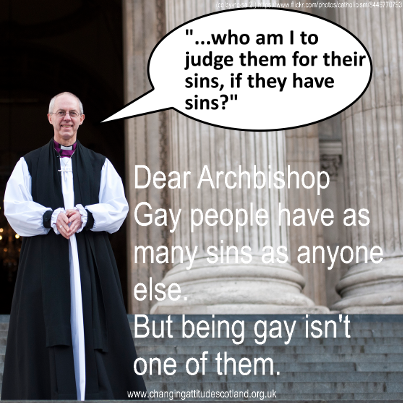
• The Archbishop, the gays and their sins

    Welby fbsize

    One of the things that we’ve learned about Archbishop Justin Welby in recent weeks is that he gets upset about what people write about him on social media.

    He wrote at some length about how what gets written online is upsetting and he’d just prefer to have personal contact with him rather than sounding off online.

    Love often says don’t tweet. Love often says don’t write. Love often says if you must rebuke, then do so in person and with touch – with an arm around the shoulder and tears in your eyes that can be seen by the person being rebuked.

    It is difficult not to have some sympathy for him and I say that as someone who has been really particularly critical of him in the past. It can’t have been much fun seeing my You Condemn It, Archbishop post being relentlessly copied, commented on and retweeted across the Anglican globe.

    And yet the trouble is, there’s no turning the social media clock back. Wanting a world where people don’t comment online about things they care about very deeply is wanting a fantasy world that has no chance of coming back into being.

    Is it possible for leaders and people in public life to do well when the whole internet seems bedeviled with naughty people who will retweet and repost every last mistake that people make?

    I think it is possible, but trying to stand above the fray and condemning people for writing about things you’ve said is hardly going to work nowadays.

    The Archbishop’s complaint about social media came just after someone published a blog post which appeared to suggest that one of the Archbishop’s closest advisors had given a briefing to a group of Anglicans which suggested that Lambeth was now not trying to avoid schism in the Anglican communion but trying to manage it – the expectation being that some parts of the Church of England (the most liberal and the most conservative) would be lost but that a coherent “middle” would survive. It was a deeply shocking position to claim to be true. So shocking that I didn’t believe it at first but have since heard others who were at the briefing confirm that this stuff was indeed said and repeat also that expectation is that there would be bargaining over which buildings to give away, within 10 years.

    That blog post disappeared fairly quickly but internet genies don’t jump back into bottles and the story was out there and really rather embarrassing to all concerned.

    No wonder the Archbishop posted something indicating his discomfort about social media.

    But the real question is whether the social media phenomenon is the problem or whether the archbishop’s problems lie with with the things that social media point towards.

    It must be terribly frustrating to have people pick up on your every utterance and make a big deal out of it.

    The trouble is, in public life, the words you say have a lot of power. Social media posts rebalance that power a little and we should be welcoming the fact that we are a community that cares enough to talk about things rather than trying to remake the Anglican world into one in which bishops speak and everyone else listens uncritically.

    I’ve no doubt that the Archbishop will be embarrassed by posts such as this one which highlight something he said this week. Asked about the usual topic – those pesky gays, a topic that he will be asked about in every interview he ever gives, he is reported to have said:

    I’m listening very, very closely to try to discern what the spirit of God is trying to tell us.

    I see my own selfishness and weakness and think who am I judge them for their sins, if they have sins.

    You can almost hear him dithering over the comma in that last sentence and wondering how this might sound on social media and adding a bit of theological nonsense.

    Of course gay people have sins. However if the first response you make when people ask you about gay people is to talk about sin, then you are going to sound pretty homophobic. And it doesn’t matter whether you like it or you don’t like it, people are going to call attention to it online.

    But is that to be too critical? What strategies could the Archbishop adopt that would help when he is asked about the Usual Topic?

    The most basic thing is to recognise that everything is a conversation these days.

    In fact the Archbishop did quite well in answering a question from a young Muslim who wanted to know whether he would try to convert him to Christianity.

    I am not going to put pressure on you, and I wouldn’t expect you to put pressure on me.

    He could have done far worse with that question than he did.

    Unfortunately, he answered the question on the Usual Topic by immediately talking about sin and then parroting the “sex outside marriage in the C of E is against the rules” line.

    It is a conversation, Archbishop.

    That means we want to talk about it, not be told what the rules are before the conversation gets going.
    It means we want to talk about it, not be told to lay off social media because it gives you the hump.
    It means you can have your say so too and people will listen respectfully and carefully to what you say, but only so long as you engage with people.

    It is a conversation, Archbishop. Everything is a conversation.

    When the first thing you say about gay people is about sin then you can’t expect the conversation to go well.

    It wasn’t helped that the second thing you said was along the lines of “some of my best friends are gay you know?”

    “Marriage is between one man and one woman for life and sexual activity should be confined to marriage, that’s in the Church of England’s laws” he said. “I’m equally aware I have a lot of gay friends and I know gay clergy and they are doing incredible work.”

    You say that stuff and you are going to get people observing that there’s a lot more archbishops who claim that gay people are their friends than gay people who claim archbishops are their friends.

    This could be going better. It could be going much better.

    And it is going to happen again. That question is going to be asked again and again and again.

    There are people out there who can help you find better answers.

    Guess where they are, Archbishop?

    Yes – all over social media.

10 responses to “Advertise, advertise, advertise!”

  1. Matt Hanson Avatar

    Good writing. Keep up the good work. I just added your RSS feed my Google News Reader..

    Matt Hanson

  2. Eamonn Avatar
    Eamonn

    How naff can you get? It was worth listening to a professional advertiser’s comments on the Lichfield advert on the Sunday programme on Radio 4.

  3. Gavin Drake Avatar

    Adverts that make people in the church feel comfortable are likely to be completely irrelevant to people outside the church. As the instigator and creator of the Lichfield football adverts campaign I stand by them – they did what we wanted them to do. We had a target and we achieved that target. The professional advertising chap on Radio Four was anti the adverts; but he was also anti the entire Christian message as a self-proclaimed militant atheist. His best effort? “Life” – which is a campaign he created for the Billy Graham missions 20 years ago. Hardly creative (now, 20 years on) nor fresh. His message was that the church should get rid of Jesus, God and all the “after life” stuff and concentrate on making people feel good now.

    One final thought, in this blog entry aren’t you demonstrating the Christian Christmas grumpetyness which you appear to be criticising in others?

  4. kelvin Avatar

    Thanks for your comments Gavin.

    You are quite right about my grumpityness though I was not particularly being critical of it in others. Indeed, being able to rely on other people’s grumpityness is one of the things which has ensured a lot of exposure for the CAN ads, for example, the Bad Hair Day campaign and the Meek, Mild As If one. It was the (mock?) outrage of the christian community that got those ads talked about.

    I’m a fan of what the CAN do, which I perhaps did not make clear in the above blog entry.

    I’d be interested to know what the target was and how achieving it was measured.

    I have to confess to feeling embarrassed by the Lichfield ad but then of course, it was not aimed at me.

    I also commented about past CAN campaigns here and here.

  5. Kennedy Avatar
    Kennedy

    Having listened to the CAN adverts, I am left asking what the message was and who was the target audience? If the intention was to familiarise the audience with the characters and motifs from the Christmas story then OK, but there is more that could be said in the time.

    You’ll permit me a small plug for the stuff that GRF produce.

    Have a listen:

    http://smallvoice.org.uk/wp-content/uploads/2008/09/01-ms-christianity.mp3

    Yes, this uses the style of the M&S ads but I think that it communicates something about the Christian message and in a form that a non-church person could relate to.

    The judges at the Jerusalem Awards seemed to like it as they awarded it the premier award in the ‘Shorts’ category at their awards ceremony last week.

    If you are looking for creative audio to use in churches or schools then have a look at http://www.audiopot.org.

    Kennedy

  6. kelvin Avatar

    Thanks Kennedy. I like the M and S Ad. Very clever. I always like hearing Albatross (the music underneath) because it reminds me of someone I knew a long time ago who used to play it (on large pipe organs) during communion.

    One of the drawbacks of the ads that I was speaking about above is that they all depend on knowing the Christian story. That is perhaps legitimate in a Back to Church Sunday as it is presumably aimed at folk who have gone away knowing something or other.

    The line about the penalty does kind of imply that substitutionary atonement is what we believe though.

    The Lichfield ad certainly got a lot of coverage and if that was the intention, it succeeded.

  7. Elizabeth Avatar
    Elizabeth

    I must admit I found the racing advert amusing. The football ones leave me cold. Aside from issue about inclusivity and dubious theology, I think living in Glasgow has made me very wary of any connection between religion and football.

  8. Coxy Avatar

    I think that the football one is excellent, as does my wife (and she can’t tell the difference between Liverpool and Arsenal – I guess they do both play in red though!). How is it not inclusive of men and women? As I see it there is good build up play from Mary and Joseph before Jesus scores…

  9. kelvin Avatar

    Hi Nick

    I’ve just rescued your comment from a spam filter – don’t know why it got swallowed.

    At St Mary’s we tend to avoid language like “men” where what is really meant is men and women, “mankind” when what is meant really is humanity etc

    This affects things like the language we use for hymns.

    We’d never sing, “Brothers, this Lord Jesus, shall return again” for example. In a mixed crowd it just seems rude.

    There is an ongoing degate about how far to go with this policy but by and large, language inclusive of men and women is the norm at St Mary’s and exclusive language tends to jar and be distractive when you’ve got used to more inclusive language in church. Thus the ad is something we couldn’t use because of the use of the word “man” meaning something other than just men.

  10. ryan Avatar
    ryan

    The term “banter”, as featured in the ad, should also be used by no-one anyway (and only partly because of Chewing the Fat). O the amount of people that have endured abuse and had it expained away as “just banter”.

    Wondering if “male” ads like this are ok if one also does female-centered advertising, or if the whole idea is hoary sexism. St.Silas does a Women 4 Women thing which I believe is popular. No Men 4 Men though.

    Hope I’m immune from the st.silasite ensnaring spam filter
    ;-).

Leave a Reply

Your email address will not be published. Required fields are marked *

Previous Posts

  • Sermon – 26 September 2010

    Here’s what I said yesterday in the pulpit… There’s no getting away from it. Sooner or later we do have to think about hell. That’s the message from this morning’s gospel reading and I don’t think that there is any choice but to deal with it head on and allow ourselves the chance to ask…

  • Knowing Me, Knowing You (again!)

    Hey, remember the Knowing Me, Knowing You sessions that I ran a while ago? Well I’m doing another one this week. If you don’t remember what this is about, check out this description from an earlier one. These sessions are limited to 20 people in order that we can keep the conversation flowing. If you…

  • Consecration of new bishop in Kentucky

    The Diocese of Kentucky consecrates a new bishop today. The Diocese of Kentucky is one of Glasgow and Galloway’s Companion Dioceses. At about 4 pm UK time, the service will begin in Kentucky…. and, provided they can resolve their internet issues in Kentucky, on this blog: Now, ain’t that neat?

  • Home is the wanderer

    Ah, Glasgow. Here I am again. Today I arrived back in town after two weeks holiday. I’ve been to France, since you ask and I’ve had a lovely time. I was in the sud and so my body was warmed greatly by the sun. I tend not to tan a great deal, because I slap…