
• Every Eucharist is a Virtual Eucharist

    Heaven

    Every Eucharist is a virtual Eucharist. Of course it is.

    We know this.

    We experience this.

    We forget this.

    Christianity – at least the bits of Christianity that are worth taking seriously – takes time and space so seriously that it knows that the particular cannot ever express the ultimate. Indeed, time and space are playthings in the hands of the religiously inspired.

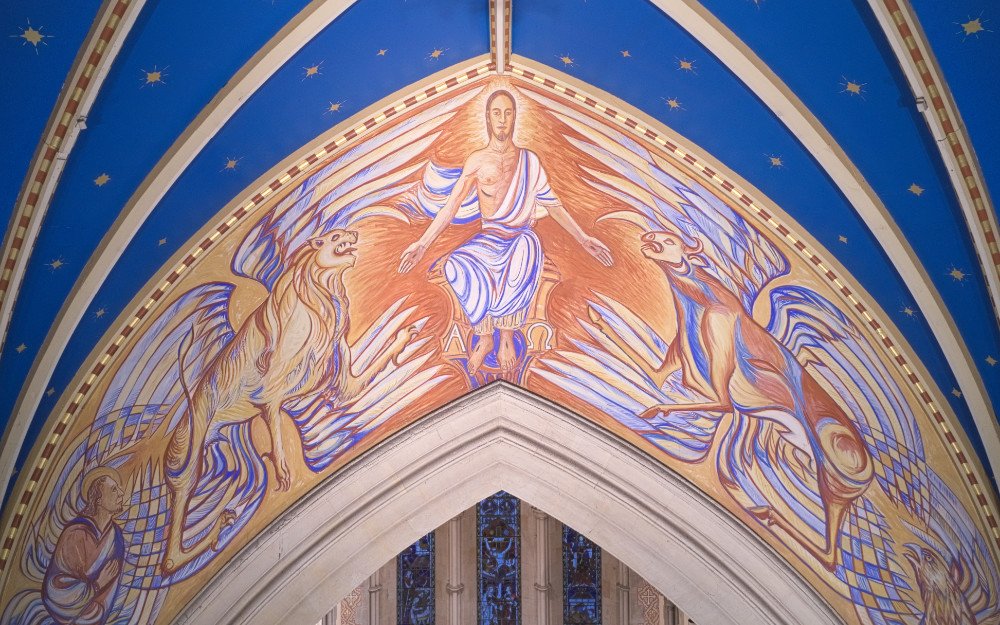
    Over the last few months it hasn’t been possible for my congregation to celebrate the Eucharist together in one space. But when we used to do that, we were never entirely in one space anyway. The very building itself is designed to transport people from the knowledge that they are a few yards from a busy thoroughfare in the Second City of Empire. Taking a few steps inside we find that we are in another place altogether. And in another empire, where the Emperor is servant of all and love is the essense of the law. The conceit that going into church takes you into a divine, heavenly realm is not an idea exclusive to the East. Coming into St Mary’s you are supposed to feel that you are stepping into heaven. It has been built to make you feel that. It has been decorated to make you feel that.  It does make people feel that.

    Whenever I take people into church I almost always hear them express a sense of wonder. We have the wow factor. It has been created by human skill to make you feel that the reality that you experience as you stand in the street is not the only reality that you can experience. It is a space that conveys that love, joy and peace might be possible and it does that without words. It is done with beauty and it takes people a few steps up the stairway to heaven.

    And it is the church playing with reality.

    That experience of going into a holy space and feeling part of something bigger is something common to religions that are divided on all kinds of doctrinal matters. It points to things that are best expressed through virtual reality and religious people are so used to virtual reality that they sometimes forget that it is all around them.

    When people come to the Eucharist in St Mary’s they are at once in Glasgow and simultaneously elsewhere. And elsewhere isn’t even singular either. At the Eucharist in Glasgow we are at one and the same time in an Upper Room in Jerusalem rather a long time ago and at the Wedding Feast of the Lamb at the ultimate consumation of all that is. The Last Supper and the Breakfast at the End of the Universe happen at the same table. At the same time.

    And as we gather at our table, we gather at every table and eat in communion with those who share in the same meal. Our fellowship with them isn’t prevented by circumstance. Our Eucharistic fellowship has never been prevented by circumstance or lack of physical proximity.

    We couldn’t keep the Triduum in Holy Week without virtual reality.

    Without virtual reality it would just be a way of making feet smell less.

    Without virtual reality it would just be a bonfire that would die.

    Christ is the celebrant at every Eucharist no matter which particular celebrant is standing there. Virtual reality becomes interwoven with the reality of the lives that we bring to the table and we are formed and changed and made new. It is how God’s love is expressed.

    This is virtual reality. Every Eucharist is a Virtual Eucharist. Cyberspace is one of the most powerful metaphors for prayer that human beings may ever develop.

    Our bodies are bound by physics.

    God’s love in this world isn’t.

    This is why religious buildings are important. It is also why they are not important.

    Every Eucharist is a Virtual Eucharist.

    Every Eucharist always was a Virtual Eucharist.

    Of course it was.

14 responses to “Liturgical sadness”

  1. Robin Avatar
    Robin

    Has anyone else been following the series in ‘The Tablet’ taking the Latin Sunday Collects from the Roman Missal (Ordinary Form), printing alongside them the official English translations and then commenting on the Collects?

    The effect the series has on me is not what was intended. I spend much of my time being puzzled and irritated by the looseness of the translations from the Latin – words and phrases left out, new ideas included, and sometimes translations which are at best a paraphrase.

    The point of mentioning this is that what I’ve seen of the new English translation of the Roman Mass is undoubtedly more faithful to the Latin, which is, after all, the definitive form.

    This will be important to some and, I expect, an irrelevance to others. However, an ecumenical gesture we could make (pause for breathtakingly unpopular suggestion!) would be to incorporate the new relevant parts of the new translation in our own Liturgy. That really *would* show ecumenical goodwill.

  2. David |Dah • veed| Avatar
    David |Dah • veed|

    “…the Latin, which is, after all, the definitive form.”

    That is certainly debatable. I fail to see that the purpose of the liturgical reforms of the 70s and 80s which resulted in many new liturgical books for most major denominations and prayer books for Anglicans, was to get us all back to the Latin Mass.

    Rome has pretty much cut the rest of us “free” so to speak, as irredeemable for all the heresies of women’s ordination and now GLBT ordinations and same sex blessings, and I am fine with that. I would not go anywhere near the Tiber, but I share Kelvin’s sense of loss of something we pew sitters shared around the world.

  3. Robin Avatar
    Robin

    Just to clarify, when I wrote “…the Latin, which is, after all, the definitive form” I meant that it was the definitive form for Roman Catholics.

  4. Ritualist Robert Avatar
    Ritualist Robert

    Vicky wrote: “… it is unlikely new conversion areas such as China would find Latin accessible.”

    A Roman friend of mine who probably would know said to me the other day that the Catholics in China use the Latin mass because they missed out on the reforms of Vatican II. Does anybody know if this is true?

    I went recently to a Latin mass here in Sydney with the same friend and most of the servers and the priest were from Vietnam … and a good deal of the back-to-the-future seminarians one sees at the papist cathedral seem to be Korean … so I am not sure that the formality of the Latin mass, or a more formal English one will put off Asian converts.

    It’s a pity that the ecumenical implications of this translation exercise haven’t been pondered a bit more.

Leave a Reply

Your email address will not be published. Required fields are marked *

Previous Posts

  • New Year Predictions 2015

    Here are my New Year Predictions for 2015   Those who voted YES in the Scottish Referendum will continue to behave as though they won. This may be unhelpful. Those who voted NO in the Scottish Referendum will continue to behave as thought he referendum never happened. This may be unhelpful. There will, I fear,…

  • Review of Last Year’s Predictions

    Well, clearly it behoves me to consider last year’s New Year Predictions and see how I did. Remember those people who used to say, “But what is a blog…?” Well this year you are going to be hearing them say, “But what is a mooc…?” Well, I think I got that partially right. Lots of…

  • Review of the year on the blog

    Well, everyone else is doing it so I might as well look back over the last year and pick out a few highlights from the blog. I began the year by declaring that The Archbishop of Canterbury is not a Pope and defended him from other people making demands that he rebuke the Nigerian Church.…

  • Ditching the sermon – a dialogue for Holy Innocents

    This morning I decided to ditch the sermon in favour of a dialogue with Bishop Gregor. It has been a difficult Christmas in Glasgow with a major tragedy in the centre of the city as people were doing their last minute Christmas shopping. Bishop Gregor was himself there in the square just after the incident…