
Do we make history or does it make us?
Scottish Opera’s co-production of Nixon in China is a timely and intelligent piece that asks questions about things that many in the audience will remember yet provides no easy answers. This is not a simple morality tale, nor a love story, nor a tragedy. It is an opportunity for every audience member to reflect on the swirling currents of modern political life. It is a piece that is at once about how strange the past seems to be and how even stranger, the present.
The dominant theme in John Fulljames’s production is looking back. The whole story is told as a retrospective study of documents within an archive storage facility. Everything is either memory or historical record.
This is an innovative staging making clever use of video throughout. Some of this is simply projected pictures. More interestingly though, much is seen in the form of layers of documents laid down under a digital vizualiser on a desk on the stage.
The bold scoring of the arrival of the plane in China (Landing of the Spirit of ’76) is matched with a particularly fabulous kaleidoscope of projected images on stage.
Joana Caneiro’s conducting shows some restraint throughout the evening. Both orchestra and singers seem a little underpowered. There was no trouble with balance between the pit and the stage but as the action and the theatre heated up, the sound of the fans on the large digital projector in the auditorium were more of a distraction than they should have been.
None of this took away from the sheer excitement of the score. This is a phenomenal musical work. The retrospective mood on the stage perfectly matches the retrospective mood of much of the music, referencing, Wagner, Stravinsky, dance tunes and so forth. This is a production which also emphasises that though radical in some ways, the piece is fundamentally rooted in an operatic tradition. The various set pieces between the six characters, the three female secretaries singing in a semi-chorus, the quotes from other musical works and librettist Alice Goodman’s teasing playfulness with rhyming couplets all emphasise that this is a piece that refreshes a tradition that we already know well.
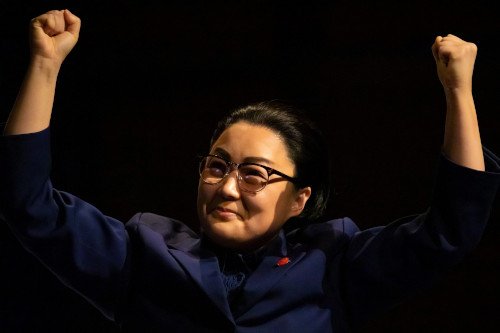
The singing honours have to be awarded to the two female principals. The arrival of Hye-Youn Lee as Madame Mao in the second act was brilliantly exciting. The role demands an agile coloratura soprano and Hye-Youn Lee did not disappoint. Julia Sporsén’s portrayal of Pat Nixon was also astonishing and she completely dominated Act II. Indeed, there was the creeping realisation that there’s an ambiguity in the title of the work. Which Nixon are we celebrating coming to China – Richard or Pat? John Fulljames missed a trick in not bringing Ms Sporsén on last to receive the audience’s appreciation at the end of the evening to make the point that the piece is largely about Pat Nixon rather than her tricky husband. This was particularly seen throughout the revolutionary ballet when the action was entirely focused on Pat. Throughout everything her voice and hair were coiffed to perfection. She looked and sounded impeccable.
Amongst the men, Eric Greene’s Richard Nixon was interesting and even vulnerable and Nicholas Lester’s final valediction as Chou En-lai the Premier of China moving, elegiac and world-weary.
As the final archive box was put away with its characters in it, one felt thankful that this work had been brought out of storage by those intelligent enough to make it compelling and interesting. In a world still functionally unable to make sense of the relationship between power and the people this was a production that seemed necessary. I came out at the end of the evening feeling that I understood the world better than I did before. I also came out feeling that the world was also more perplexing than it seemed earlier in the evening.
Both things can be true.
Rating: 

This review was published first by Scene Alba.


Leave a Reply