
The first time that I encountered ChatGPT was three years ago when I was staying in a seminary in the USA. It was a place dedicated to teaching theology and particularly to training Episcopal clergy.
The ChatGPT preview release was let loose on the world on 30 November 2022, so I must have discovered it very early on. AI has moved on significantly since then but at the time one could use it to render a piece of text in the voice of someone well-known. The entertainment at mealtimes was to give it a well-known piece of the Bible such as Psalm 23 and get it to rewrite the text in the voice of a well-known American politician.
The Lord is my shepherd — a truly incredible shepherd, by the way, the best. Nobody shepherds like He does!
I’m not going to want; I’ve got everything I need. Believe me!
This seemed very entertaining to the students though I suspect that the joke may not be quite so entertaining these days.
ChatGPT seemed an incredible plaything. A novelty. A curiosity. A wonderful new internet gewgaw.
Three years on and a lot of development later, AI has changed a lot even if people haven’t yet moved on quite so much and many are still using it primarily as a novelty. You can still ask ChatGPT to translate bits of the Bible into the voice of someone else. It still seems remarkable to many that a machine can write anything at all.
The primary thing that people think of when they think of text-based AI is still the creation of written material in response to some kind of prompt though there are vastly more interesting things that one can do with AI than you could back in the olden days of December 2022.
There have been a number of surveys released this year which focus on the use of AI by preachers and I thought that it might be interesting to mull over a few questions in order to think about the ethics of using AI in sermon generation.
The obvious question is perhaps the least interesting though I’m not 100% sure that it has a clear answer.
Is it ethical to preach a sermon generated by AI rather than something that you’ve thought up yourself?
I think many people might initially answer this question in the negative and be fairly sure that this isn’t OK. However, I find myself remembering being trained by clerics when I was first ordained and clearly remember being told – “If you find you don’t have a sermon of your own, then preach someone else’s”. In the intervening years, the internet has come of age and that has complicated this question. There are sites dedicated to providing sermons for particular Sundays. I sometimes read a few sermons by other people on a particular text before settling myself down to write one of my own. I suspect most people would think that was absolutely fine ethically – indeed it falls well within the learning and study that clerics are all supposed to pursue.
Would I lift an idea from someone else’s sermon?
Yes, absolutely.
You get to know the preachers who inspire you. I would pay particular tribute to the preaching of Fr Grant Gallup who, when he was alive preached audacious sermons. I think it is a positive good to catch hold of things that inspire you and let them inform your own thinking.
But would I lift a paragraph from someone else’s sermon?
No, I don’t think I would, though I have come across people who do. (And I’ve known people do it with things I’ve written).
I remember once assessing someone for a job and looking at some of the sermons that he had been preaching. Something didn’t seem quite right about them. A little clever googling revealed that he was simply lifting sermons wholesale from one particular preacher from the other side of the world and preaching them as though they were his own. “And that reminds me of something that happened to me this week…” falls a little flat when you know that the same thing happened word for word to someone else three years ago in the lectionary cycle.
I never outed him as stealing ideas from someone else. But there was no chance of him getting the job.
I’m not convinced that it is ethical to preach someone else’s words verbatim in a sermon.
AI raises whole new questions beyond that though.
It is more or less ethical to lift a paragraph from a sermon that no human being ever wrote?
I think that’s a complicated question and is made even more complicated for me by my knowing that some AI engines have been trained on my own sermons.
Indeed, one of my tests when looking at a new AI tool is sometimes to ask it to write a sermon in the voice and style of Kelvin Holdsworth on the Bible passages for a particular set of Bible readings. This test, which I have to acknowledge I’m rather pleased with myself for devising certainly sorts out the AI sheep from the AI goats.
I did it recently with one engine and it produced this paragraph:
“It reminds me of the week before my mother-in-law comes to visit. You know the drill. It doesn’t matter if the house is generally tidy; you go into a state of panic. You’re not just cleaning the surfaces; you’re clearing the cupboards and organising the spice rack. Why? Because you’re trying to create a perfect space for a very important guest. You want the place to look like your best self, a version of reality that lasts exactly as long as the visit.”
Now there’s no risk in my stealing anything from this at all. It doesn’t sound like my spoken style and anyone who has ever shared an office with me knows that tidiness isn’t necessarily next to provostness. The really exciting thing, I thought, was the appearance of a mother-in-law. I rather like the idea that in some alternative cyberspace I’m tidy, happily married and have a well-organised spice rack.
Here, in the real world alas, things are different.
However, I asked another AI engine to come up with a sermon in my style and the more I read, the more I realised that it had been trained on my own sermons, most of which have been freely available online for the last 25 years or so. Here’s a fragment that I asked it to generate for a sermon in my voice for Midnight Mass.
“And so we come here at midnight—a time for secrets, hushed voices, and the honest acknowledgement that the world is not always as we wish it to be. Midnight is truthful. It exposes our longings. It meets us without the polite veneer we put on during the day. Midnight Mass is the Church daring to say: God meets us in the dark.”
It isn’t better than me and the middle sentences are a bit vapid. But there’s an idea in there at the end that I could have come up with and could have preached. And maybe, who knows yet, maybe I will.
So it is ethical to preach a sermon that is generated from an AI engine that has been trained on one’s own voice?
That’s a really complicated question and worth a good deal of pondering. And it is a very different question from those facing authors who make a living from their work.
As I try to think about the ethics of where the words come from there will always be people who tell me that nothing ethical comes from AI because of the world’s resources of power and water that are consumed in their production. I get it. But people have frequently taken to social media to make that point to me without acknowledging the irony of doing so. We are living beyond our means environmentally in so many areas of life. Yes, AI contributes negatively to this. But I don’t think that fact is going to put it back in its box.
At the moment I’ve never read a sermon from an AI engine that I think is better than any that I could have written. However, I suspect that in a year’s time I won’t be able to make that claim.
So, is it AI generated sermons from me from now on?
No actually. But primarily because I enjoy the writing. Wrestling with the ideas, thinking about the scripture and pondering where the world is at gives me life and I suspect that ultimately those listening to sermons can tell whether there’s life and spirit in them. And being a preacher who does grapple with the text is part of who I think I am and part of what I think the church has formed me to do.
Are there easy ethical answers to AI related questions for preachers? I don’t think so. And I think that’s what makes those questions so very interesting.
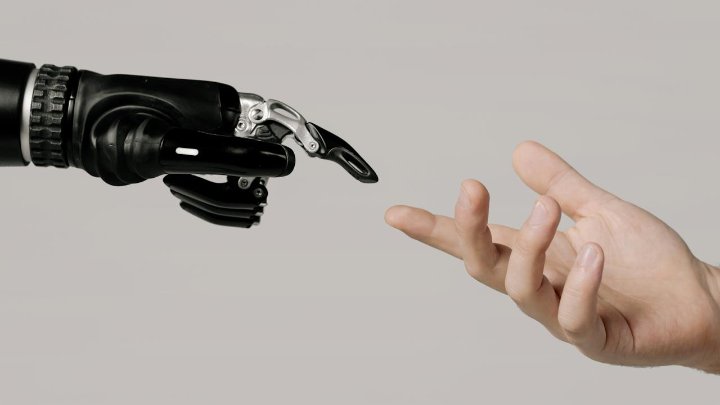
Photo by cottonbro studio: https://www.pexels.com/photo/hand-of-a-person-and-a-bionic-hand-6153343/
37 responses to “Keeping the faith”
It was an inspiring recitation. Following the English translation in the service sheet provided added insight to the life of Mary. All the more so as the cathedral is dedicated to St Mary. You are reminded of Mary every time you walk into the building with the Gwyneth Leech mural over the High Altar.
Kelvin is quite right. The very self-righteous defenders of the Bible (including the ones who trolled a brave young Muslim woman, for days, with the most vile language, and those who did not reprimand them) totally ignored the Biblical instructions for raising concerns with a brother in faith (Matthew 18:15; 2 Tim 23). Very practical instruction too! As anyone who has ever lived in community can verify. Could all these obsessive men *please* stop trying to divide our communities in Glasgow. We will not be divided. At the first sign of trouble we rush out to embrace one another. These abusers have much to repent of, even if *just* standing by while others throw stones.
I HATE it when the wrong tune is picked for a hymn … it is simply an abomination before God.
However, helping people to think about how we share hospitality, welcome and learn from each other is the WAY of God! Blessings on you Kelvin.
Some reasons why this time was different:
1. The other quaran recitations you mentioned happened at Nine Lessons and Carols, or special ecuminical and interfaith events. While 9L&C was originally a modified Evensong, nowadays it’s usually considered a seasonal community musical recitial with a religious tinge, so having a Muslim from the community recite something from their faith would seem natural enough. Civic and interfaith services will likewise naturally include representatives of every faith in the community. By contrast the Eucharist is the central act of Christian worship and people expect to hear ONLY Christian doctrine proclaimed in the Holy Eucharist. In other words, this was the wrong venue for showing hospitality to Muslim neighbors. You did not intend to practice syncretism, but I think the outcome was syncretic despite your good intentions.
2. Post Brexit (and post Trump) British Muslims are now seen as alien invaders rather than fellow members of the community.
3. Because hostility to Muslims is now fashionable, the Express and rest of the gutter press decided that this was a story worth reporting. Since conservative Americans often read the online editions of the British gutter press, the story then went global.
4. Because you are gay and out, your every action is scrutinized for any possible hint of heresy by GAFCON and Co.
Of all these reasons, only reason #1 is a legitimate criticism, but I hope you do think about criticism #1 as well as defending yourself from other, illegitimate criticisms.
Thank you for your comment Whit J – all the more because it is a thoughtful criticism.
I’ve plenty to reflect on about the how and the when we do things like that and I do hear loudly and clearly that many people think this was an inappropriate context. Though of course, I’d be bound to say that some are saying that the Eucharist is precisely the place indeed there are some saying that is what it is for.
I’m not going to get into a back and forth with all the comments on this post and I’m deliberately not letting through things that have already been said but be assured that I’ve heard the criticism and will reflect on it not simply now but over coming months. (I’ve learned a lot about where God is this week that will take a long time to process). I’m grateful for the way you’ve made your point.
I think there is a good deal in what Whit J says, although I am not sure the effect actually was syncretic. I think one does perhaps have to be a regular worshipper at St Mary’s to understand how totally orthodox the worship there is, and how much Jesus is the focus of worship – how utterly unlikely it is that anyone there would make the mistake of thinking he was not revered by the congregation as a whole as very God from very God. It would be impossible for them not to realise that all the clergy there rejoice in this belief. The congregation saw the words of the Qu’ran in an English translation which portrayed that book’s far-from-easy-to-follow account of Islam’s view of the conception of Jesus, in which there was nothing offensive, and heard a very beautiful voice singing in a strange and glorious language. These were clearly indicated to be the beliefs of another faith. We certainly neither saw or heard or understood any insult to the person of Christ. I am sure none was intended, either. Whereas, and this bears repeating, I am totally sure that many of those commenting (not of course by any means all of them, and nobody whose comments are published here) simply wish harm to relationships between the great faiths in Glasgow.
I have spent my whole adult life in dialogue with people of other religious traditions, it has been deeply rewarding. However I feel that what happened at this service was profoundly wrong. When we are truly ourselves we allow other people to be profoundly themselves. The truth of Christianity is not compatible with any other religion. To avoid that incompatibility is to avoid reality. Worship of Jesus is the fountain of our faith the Qu’ran is opposed to that. I love Jesus and therefore cannot conceive of reading the Qu’ran in an act of worship – no problem doing so in other contexts but not in worship. I am profoundly disturbed that you cannot see this Kelvin.
There are so many things aren’t there, not just around this issue which we hold dear in faith and which we can’t see from another perspective?
I can hear and see that people are upset by this and clearly there are many people not upset by it too. And obviously, at least I hope obviously, I love Jesus too.
The trouble with religious questions and the questions that religious people have I think is that so often that our love for our faith can make it impossible to comprehend others who also claim to love the same faith but who take different views about things. We can hear them claim that love but be intellectually unable to process it because it leads them to different conclusions.
I’ve found the same thing to be true in the sexuality debates very frequently though I perceive that to be changing sometimes now. Similarly with other identity issues and some political issues. Israel/Palestine conversations for example often seem to be conducted (when they are conducted at all) by people who seem to behave like ships passing in the night.
I happen to have views about Church Schools which are pretty intransigent and negative. You are one of the few people, no the only person, who ever made me really think there might be a point of view about them other than mine which might have an integrity I could respect. And I’m very grateful for that.
Kelvin, thank you for your reply. I have enormous respect for you. I have no doubt that church schools can be argued against from perfectly respectable positions. Worship of Jesus is simply a different order, it cannot include a reading from the Qu’ran. Worship is one thing, study, dialogue, relationship something else.
I am really grateful to Richard for the phrase “When we are truly ourselves we allow other people to be profoundly themselves” which reflects my experience of interfacing with sincere people of other faiths. Is a Christian Eucharist a place this should happen? I can understand some Christians feeling it is not, but as long as everything was clearly labelled as what it was and the integrity of the liturgy was intact, I can also understand some feeling it is.
Brother Kelvin,
Although I do not agree with allowing the Koran to be read in our Christian churches, I truly appreciated your firm and resolute stand for the deity of Jesus. He is our great God and Savior and I love Him very much. Blessings from Tennessee.
Just as a perhaps amusing point of reference, the 1982 hymnal of the Episcopal church in the USA has “Brightest and best of the STARS” (caps mine) “of the morning,” apparently so as to avoid offending any daughters who might be present, and the two tunes included are “Morning Star” by James Proctor Harding (1850-1911) and “Star in the East” from The Southern Harmony (1835). The Harding tune was also in the 1940 Hymnal, wherein the word “sons” was still used.
I am not clear as to whether the hospitality at St Mary’s anticipates infinite extension of parallel lines between Islam and the Church in Glasgow. Are you planning some opportunities for Glasgow Muslims to understand the Christian faith and prepare for Baptism and the glorious liberty of regeneration by the Holy Spirit? (In whichever order; no axe about that!) As you move around the Glasgow community and meet more Christians of Islamic background, why not invite such to participate in groups for new Muslim enquirers? The testimony of an ex-Muslim can express vibrantly “How I know He lives” (as your SA brethren would sing). You might find not only new hearts from a divine work of grace among your Muslim neighbours but in other neighbours too. Amen. Inshallah!
There are a small number of people in St Mary’s who are converts from Islam to Christianity just as there are a small number of people in local mosques who are converts from Christianity to Islam.
St Mary’s regularly puts on events and courses for people discovering and exploring Christianity. Most living religions do the same thing.