
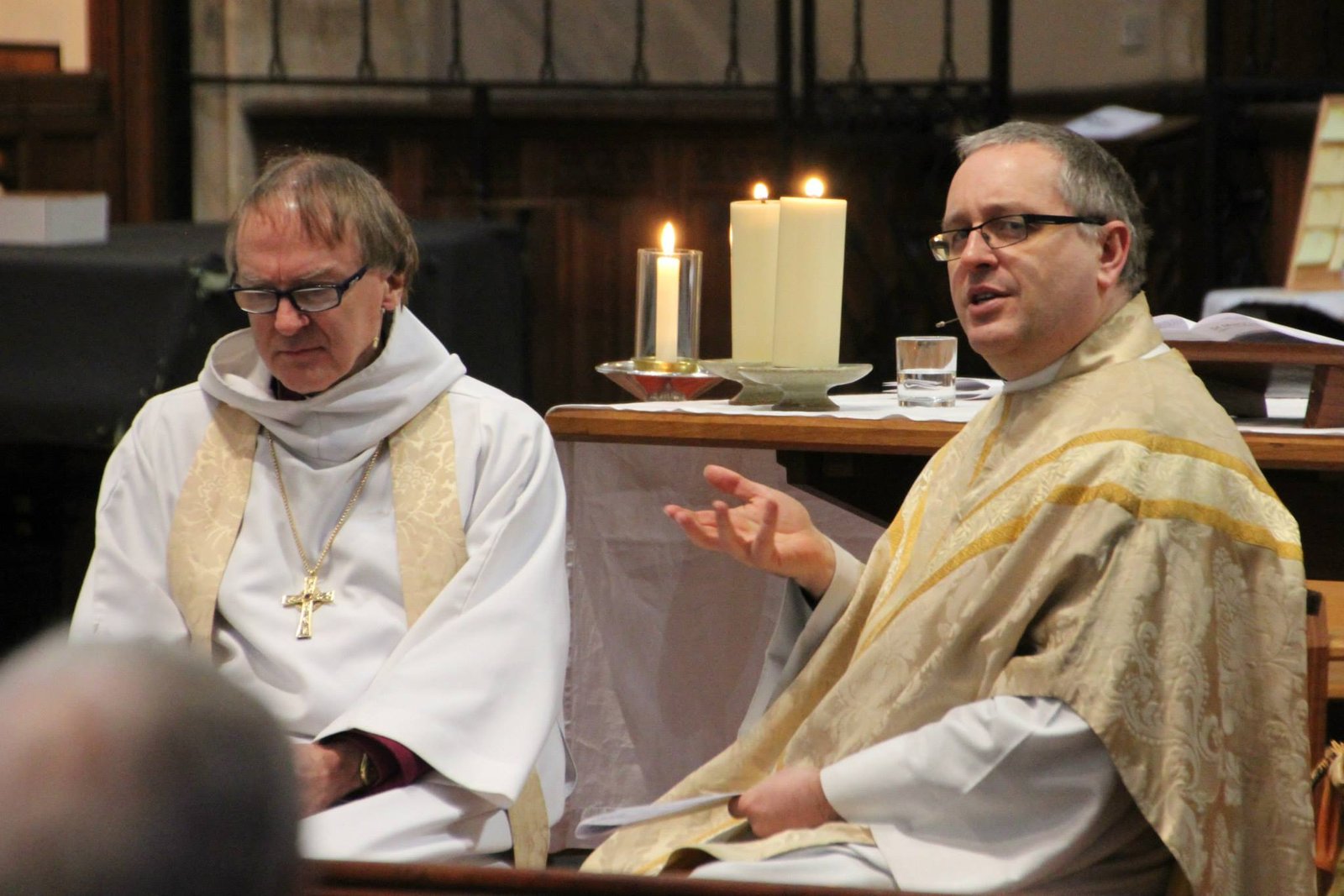
• Christmas Day 2014 – Sermon

    Come with me to Bethlehem. Come and see the babe in the manger. Come and worship and adore the Lord of Heaven and Earth with the shepherds at the manger.

    But don’t come with me to Bethlehem of Judea. Not yet anyway.

    Come with me instead in your mind to the city of Venice where I had part of my main holiday this year.

    I stepped off the train and walked out of the station and gasped at the scene in front of me. The grand canale, the vaporetto water busses. The astonishing modern Canalettoesque scene. A city completely without roads and cars.

    And I quickly got used to it and started to enjoy finding my way about down the little alleys and along the byways along the canals.

    Now, some of you will have been to Venice yourself. You’ll know that walking about can be a bit of a struggle.

    It is crowded and busy. The pathways are narrow and crowded. And it is insanely pretty so you just want to stop and gaze at everything.

    And everyone is feeling the heat and everyone needs to pause for breath sometimes.

    And one of the hazards are the bridges that you have to use to get over the canels. Every hundred and fifty yards or so you go up steps and over the bridge and down steps.

    And that adds to the weariness.

    And this year there is an added hazard on the bridges of Venice. Not just people sitting on their suitcases having an ice-cream and getting in everyone’s way. Not just people stopping to admire the view. No, there’s something new.

    Someone has come up with one of those bright ideas which seems like such a good idea until you see it in practise.

    Someone has come up with a pole a couple of feet long, upon which you can mount your phone or camera to allow you to take photographs of yourself with a background view behind you.

    And there’s nothing so pretty as the Venetian canals and so people stand on those bridges waving these dangerous sticks about trying to get the perfect picture of themselves, a canal and the whole of St Mark’s Basilica in the frame of a small smartphone.

    Yes – this is the year of the selfie and tourist spots like Venice are falling victim to the selfie pole menace. For sometimes you could barely get across a bridge without being poked or prodded by one of these infernal poles.

    Well, Venice is lovely. I completely fell in love with it. But oh, it can hard work.

    And so it was one day I found myself going along the alleyways in the heat, up and down the bridges and through the crowds. And I was hot and tired. And I needed a rest.

    Well the only thing to do in Venice when you need a rest is to slip into a church. Cool marble and shade from the sun was what I needed and so I pushed open the door of one of the many churches and found my way inside.

    And immediately I realised that I was in one of the churches that has significant pieces of art. I was hot and bothered so I don’t remember whether it was a San Maggiore or a San Benedissimus or what it was. And I’d seen so much art that I’d long since stopped being able to remember which was a Giotto and which was a Tintoretto.

    But I knew what was featured in the large painting in this particular church. It was at once completely familiar.

    The adoration of the shepherds in Bethlehem.

    Instantly recognisable. Somehow the image of the poor shepherds worshipping at the manger had appealed to some Venetian dignitary with enough money to commission art big enough to fill a wall.

    And in the picture were the holy family – Joseph, Mary and the babe.

    And in front of the picture, with their backs turned away, looking towards me was another family. Guiseppe, Maria and a rather hot and bothered babe.

    And the parents stood there in front of the great piece of art smiling.

    The family stood there grinning but with their backs to the great painting.

    For as they stood, the father was holding one of those selfie poles to ensure that they could get a picture of what mattered to them that day.

    There they were. This modern hot and bothered family putting themselves into the scene with the holy and beloved family. Putting themselves into Bethlehem.

    Come with me to Bethlehem.

    Come with me to Bethlehem and put yourself in the scene.

    For if the shepherds are invited then so are you.

    The invitation to the shepherds are a clue that God was setting up an open, inclusive and welcoming stable.

    For shepherds were not smart but scruffy. They were not respectable but rapscallions. They were not gentry but general riff raff.

    But the word came to the shepherds that something was going on. God had come into their neck of the woods and they had better pick themselves up and rush down and see what it was all about. The invitation to the shepherds implies that anyone is welcome.

    Come with me to Bethlehem and put yourself into the scene. For you are invited too.

    You are invited to know that God has come into your world.

    You are invited to know that God has come close to you.

    You are invited to know that God is near to you.

    And in Glasgow this week we need to know that God is near us, that God loves us and that God is right beside us – no matter what.

    All those selfie photographs in Venice and no doubt every other tourist spot speak of the desire to put ourselves into the picture.

    But we are already made in the image and likeness of God.

    A God who chose to put his own self into the picture; who opted to enter into our frame of reference.

    God came into the world long ago so that I could tell you right now that God is here in this city today.

    For the word of God in scripture, for the word of God in Glasgow, for the word of God within us.

    Thanks be to God.

16 responses to “St Andrew's Day 2008”

  1. Christina Avatar
    Christina

    On a related theme, was there not a year recently when we had to move the assumption because it fell on Ash Wednesday? I don’t remember Christmas being delayed, but of course, can’t comment on the delay of the second coming.

  2. Christina Avatar
    Christina

    And I know I meant “annunciation” before you point it out to me.

  3. Rob Murray Brown Avatar
    Rob Murray Brown

    Is there a reason that the two celebrations cant be held on the same day? Do you really think that Christ would object to sharing a day with one of his disciples. I think not!

  4. kelvin Avatar

    I think that it is more about giving the church the full opportunity to concentrate on both.

    The themes that we remember at Christ the King (ie how Jesus undermines all our expectations of monarchy and power) don’t fit terribly well with theme we think about on St Andrew’s Day (thinking about missions and spreading faith in the world and also praying for Scotland). Advent 1 is something else altogether and also does not make a good fit.

    I quite like the way the calendar works as it is a good reminder to us that being God’s people is something that happens daily, not weekly.

  5. Rob Murray Brown Avatar
    Rob Murray Brown

    Im feel sure that your congregation would manage to digest more than one message on any particular day. The fact is that St Andrews Day is on the 30 November each year – every 7 or so years this will fall on a Sunday. I cant remember it ever being moved before and see no reason to start in 2009.

  6. Kelvin Avatar
    Kelvin

    St Andrews Day is on 1 December this year in the Scottish Episcopal Calendar as it is every year when 30 November falls on a Sunday.

    It is the way the Ecclesiastical calendar works.

    To quote fully from the published Calendar:

    Each Holy and Saint’s Day listed in the Calendar has been assigned a number which indicates its category.
    It is intended that feasts in categories 1 – 4 (below) should be kept by the whole Church. Days in categories 5 and
    6 may be kept according to diocesan or local discretion. Commemorations not included in this Calendar may be
    observed with the approval of the Bishop.
    When two celebrations fall on the same day, the following table indicates which takes precedence.
    1 Maundy Thursday, Good Friday, Holy Saturday;
    Easter Day (and the weekdays following);
    Pentecost;
    Ash Wednesday; Monday, Tuesday, Wednesday in Holy Week; Ascension Day;
    Christmas Day ; Epiphany;
    Sundays of Advent, Lent and Easter.
    2 Feasts of The Lord (Naming, Presentation, Annunciation, Transfiguration);
    Trinity Sunday; All Saints’ Day;
    Dedication and Patronal Festivals;
    Eves of Christmas and Pentecost;
    First Sunday after Christmas;
    First Sunday after Epiphany (the Baptism of the Lord).
    3 Sundays after Christmas (except Christmas 1);
    Sundays after Epiphany (except Epiphany 1);
    Sundays after Pentecost (except Pentecost 1);
    Weekdays in Lent.
    4 Feasts of the Apostles and Evangelists;
    Saint Mary the Virgin, the Visit to Elizabeth;
    Joseph, John the Baptist (Birth, Beheading);
    Mary Magdalene; Michael and All Angels;
    Stephen, the Holy Innocents;
    Kentigern, Patrick, Columba, Ninian, Margaret of Scotland.
    5 All Souls’ Day; Holy Cross Day;
    Conception and Birth of Mary, Mother of the Lord;
    Thanksgiving for the Institution of the Holy Communion (Corpus Christi);
    Thanksgiving for Harvest.
    6 Other commemorations.
    Notes:
    (i) Epiphany may be kept on the Sunday following 1 January, and the Ascension on the Seventh Sunday of
    Easter.
    (ii) Feasts in Category 2, falling on a weekday, may be kept on the nearest Sunday, except Sundays in
    Categories 1 and 2.
    (iii) Feasts in Category 4, falling on a day of higher category (other than a weekday in Lent), should be
    transferred (in chronological order) to the next available weekday.
    (iv) Where feasts in Category 4 fall on a Sunday (other than a Sunday in Categories 1 and 2), they may, if local
    circumstances require, be kept on that day.
    (v) The weekdays of Advent and Easter may be given special weighting.
    (vi) When days in Category 6 coincide with a day of higher category, they should be omitted that year.
    (vii) Thanksgiving for the Institution of Holy Communion is particularly associated with the Thursday after
    Trinity Sunday.
    (viii) Thanksgiving for the Harvest may take place on any appropriate Sunday.

    The full thing can be found within this zip file:
    http://www.scotland.anglican.org/media/liturgy/liturgy/calendar_and_lectionary_pdf.zip

Leave a Reply

Your email address will not be published. Required fields are marked *

Previous Posts

  • Child Protection

    Lexie Plumtree speaks. As usual, the synod is awed by her name. Committee on Child Protection will do some work on victims. Helping congregations to help those who are victims of abuse. New legislation is on course to come into place at end of this year. Vetting and barring scheme will come in. Will mean…

  • Amendment

    The Synod amends the motion to ask Diocesan Synods to consider the motion as well as the Standing Committee. It is the first division 73 in favour, 35 against. it doesn’t get more exciting

  • Patricia Peatie

    Says that Standing Committee is asked to consider the recommendations. Says next year’s General Synod will receive a progress report. Standing committee asked dioceses to think about skills on committees.

  • Elaine Cameron sums up

    Please that synod is interested in Gender language Purpose of Audit was partly to open up conversations and she is pleased it has done so.