
• Ten Key Skills for Priestly Ministry

    There are doubtless parts of the world where someone in my position would not need the skills that I have. If one were the Dean of a Swedish Cathedral or one of the glories of the Church of England, perhaps it would be the case that you could just hire Someone To Do It For You. However, I’ve found that I’ve had to learn a lot by myself. Here are 10 key skills that I’ve tried to teach myself.

    Working as a priest in Scotland in a part of Christendom which is, shall we say, financially challenged, I find these skills to be essential for building a congregation and helping it to grow.

    None of them are things which I was taught during my formation for ministry by the church.

    1 – Being able to resize pictures and put text on them

    Oh, I know you were expecting me to say that the number one skill that a priest needs is to be able to parse a Hebrew sentence or to be able to recite the reasons that the Council of Nicaea was called but no, there are other things that you need in order to be able to attract folk to the lovely mysteries these days and being able to manipulate pictures is right up there.

    The truth is, we are becoming an ever visual culture and being the mistress of how and where your message appears visually is a fundamental skill.

    I could teach you this in an afternoon.

    I use gimp to manipulate images. It is free as in beer, speech and salvation.

    This is what I’m talking about:
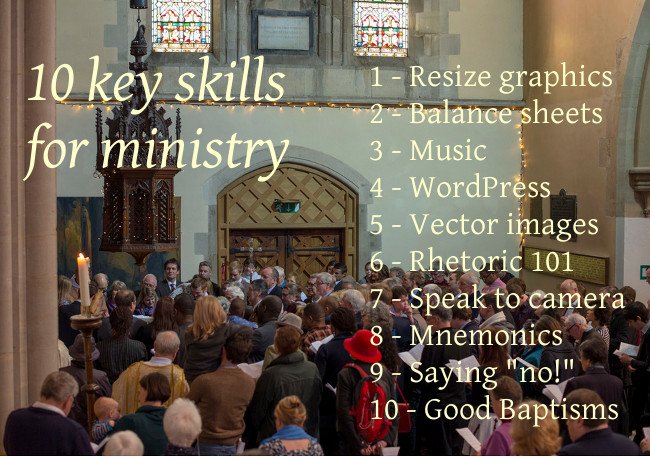
    key-skills

    See how your eye shot to that on the page?

    2 – Being able to read a balance sheet

    Yes, lots of people are frightened of numbers. I’m in the lucky position of having a maths and computer degree and that gives me a head start. However, the maths I learned didn’t tell me much about how to deal with financial information. That experience does give me a head start in trying to get my head around annual statistics, but money is something else.

    I don’t think I’m particularly skilled in this area, but I know the basics. Enough anyway to have requested a copy of the church accounts when I was interviewing for this post and enough to have asked the bishop at the time whether he knew that the cathedral basically had no money. And I know enough to be able to read the diocesan accounts now and realise that St Mary’s is contributing more than the poorest 30 or so congregations in the diocese. (And I note that each congregation having one vote at Diocesan Synod feels like a very expensive delight from where I’m standing).

    3 – Being able to read music and sing

    It is impossible to underestimate how much it can improve matters in any congregation if the priest has some musical common sense and a few basic skills. I think that one of the basics about growing a congregation is that you can’t make any progress unless the congregation like singing what they are invited to sing. The theology doesn’t matter that much. (Trust me on this one, there are strong musical traditions with astonishingly bonkers theologies that have helped very different churches to expand). The musical style doesn’t seem to matter that much. If your congregation enjoy belting something out, your congregation is more likely to grow than if they feel uncertain, grumpy or sad when they sing. Almost no-one talks about this. I don’t know why.

    Everyone can sing a bit better than they do. Everyone should try to do so.

    For the kingdom.

    4 – Being able to set up a WordPress blog

    Think what Gutenberg managed to do for the Christian faith by making ideas available to those who were desperate to receive them.

    Now think what you could do with power that Gutenberg could not have imagined.

    We are all publishing outfits these days.

    Go on, go the extra mile and learn enough about search engine optimisation to make sure your stuff appears high up in google when people are searching for things. Go on, go on, go on.

    Basic skills mean basic growth. Of anything.

    5 – Basic Vector Image manipulation

    Yes, I know there’s a lot of technical stuff about images going on here. I took two days away from regular work a couple of years ago in order to improve my vector image skills and it has paid off hugely. The badge ministry at St Mary’s is a direct consequence of this, establishing ethos for the congregation, proclaiming our values to those coming into the building and raising no small amount of money and fun.

    Vector image skills means being able to do very basic design work like centering things, putting circles around things, tiling things, using fonts appropriately in larger images.

    By the way, you do know that when everyone in Christendom uses an appropriate font for the task in hand then God’s reign of Justice and Joy will be at hand, don’t you?

    Become a fontamentalist.

    Here in St Mary’s we use heavenly Gentium and we spurn the way of Comic Sans, which leads to the nether parts of hell.

    I use inkscape for my vector image work. It is free. Have a go.

    6 – Rhetoric 101

    There’s no-one in the priestly game who doesn’t need to get up on their hind legs from time to time and persuade people of something. That means either having a natural gift of the gab or working at it to get better. Actually, those who have a natural gift probably work that bit harder because they know it matters.

    Speaking clearly is one thing. Knowing when to apply an appropriate bit of assonance, alliteration and anticip———-ation doesn’t just ease the pain for you of speaking in public but it makes life much easier on your audience.

    By the by, you might be interested to know that I had 35 minutes of teaching about how to preach a sermon during all of my training. It wasn’t a 35 minutes that was a particularly good 35 minutes either.

    7 – Speaking to camera

    I think everyone in ministry these days needs to be able to speak to camera about something that matters without hesitation, repetition or deviation. Video killed the radio star but video is the future of the pulpit hopeful.

    And whilst we are at it, learn a few video editing skills too.

    Not for your sake but for all for Jesus.

    He’s worth it.

    8 – Learn some mnemonic tricks
    Everyone forgets names. Everyone can get better at learning how to remember them.

    Rehearse names you need to remember. Write down names you need to remember. Ask people whose names you have forgotten how they think you should remember them. Use your most outrageous visual imagination in order to trick your mind into remembering people. It is one of the reasons God gave you an ability to imagine the absurd.

    9 – Cultivating the ability to say “no” nicely.

    I’m quite good at saying “no” but we can all learn to try saying so a bit more nicely. For all of us in ministry need to know when to say no. It is a basic skill to be able to decline The Latest Mission Plan (We call them LMPs in the trade), Unwelcome Ecumenical Initiatives (UEIs, obviously), Invitations to Raise Money From Charities who are certain that you need to work for three months to alleviate the plight of Abandoned Gay Puppies in South America etc (sadpuppycamp.com). They all distract from the matter at hand.

    So… No. No. No.

    Nicely if you can. But no anyway.

    10 – Liturgical Skills: Good Baptisms

    There’s no greater liturgical skill than baptising someone without making them wail. My top tip here is don’t turn them upside down and make sure they can still see someone they like.

56 responses to “Six things I have learned about anti-semitism and the church”

  1. Jacqui Norman Avatar
    Jacqui Norman

    Dear Kevin,
    I am sure that some Jews would be offended, and this is very sad on every level. Just as it would be sad for Christians to object to non Christians celebrating Christmas or Resurrection Day.
    In your piece you said yourself, that some Jewish people invite Christian people to join them for the meals. This demonstrates that the offence to Gentiles celebrating with their Jewish brothers and sisters is not universal in the faith.
    Blessings.

    1. Kelvin Avatar

      No Jacqui. It is considered a blessing in Judaism to include others in the ritual of passover. This does not justify Christians copying it without Jews being present, appropriating the ceremony to make it something entirely Christian and in doing so causing offence. It is not the same in any way as Christians objecting or not to non-Christians celebrating Christmas.

      If you wish to follow the line of saying that Christian Passovers are not offensive to all Jewish people, then can I ask what proportion of Jewish people you think it is legitimate for Christians to be offensive to? How many is OK?

      1. Jacqui Norman Avatar
        Jacqui Norman

        Of course one would not wish to offend anybody.
        I feel we must graciously agree to disagree, I see no difference to the Christmas/Resurrection Day comparison… We disagree on this one point from your piece.
        God bless you.

        1. Kelvin Avatar

          > We disagree on this one point from your piece.

          So what you’re saying is that anti-semitic things that other people do are wrong but things that you do can’t be anti-semitic because you do them with good intent in your heart?

          Isn’t that what the problem is?

          1. Jacqui Norman Avatar
            Jacqui Norman

            WOW what a leap!
            No, of course it is not what I am saying… It is the opposite!
            Your opinion is that Christians should not engage with the Old Testament. Mine is that it is divisive NOT to. As you said Jesus is Jewish, we are his body …
            I have never had a conversation with a Jew who has expressed your opinion about this matter.
            I asked you politely about this aspect of your opinion, and you have made a personal attack at me(whom you do not know) and called me an anti Semite when nothing could be further from the truth. Now, that kind of thing IS where the problem lies.
            Blessings to you.

          2. Kelvin Avatar

            Don’t be ridiculous, Jacqui. My opinion is not that Christians should not engage with the Old Testament.

            If you can’t post things truthfully then I’ll not allow further comment.

      2. Martin Reynolds Avatar
        Martin Reynolds

        I would ask the opposite question.
        How many need to be offended?
        Just one?

        This argument seems to be in the mode of
        “Christians shouldn’t practice yoga.” school of thought.

        1. Kelvin Avatar

          There’s a difference isn’t there? Most people wanting to stop Christians practicing yoga think that they should take that view because it will harm Christian souls rather because it will harm Hindu feelings.

          1. Martin Reynolds Avatar
            Martin Reynolds

            It depends which Hindu you talk to.

          2. Kelvin Avatar

            Can you point me to an argument coming from someone in the Hindu community who believes that Christians and non-Hindus should refrain from practising yoga? I’m genuinely interested.

        2. Martin Reynolds Avatar
          Martin Reynolds

          I will try and point you in the right direction.

  2. Alexander Hamilton Avatar
    Alexander Hamilton

    Wel now that was a jolly good read. Thank you to all contributers, some thought provoking matters raised, with of course no conclusion, and properly so. So much is a matter of personal belief and practise, no matter how bedecked and caparisoned the chuch one attends. I find myself sayng, ‘What would Jesus say?’ when watching the next best thing to pantomime at some services.

    1. Jacqui Norman Avatar
      Jacqui Norman

      Amen

  3. Jacqui Norman Avatar
    Jacqui Norman

    Ps, In my opinion, the fact that “Passover is not important to most Christians ” is due to a lack of good teaching on the subject. It is not possible to fully appreciate the work of Jesus, (who in you picture, notably does not have the “Jewish nose” – very much enforcing your point that people do not appreciate that Jesus was (is!) a Jew, and with which I wholeheartedly agree with you) without first understanding the Old Testament story in its fullness.

    I would also like to emphasise that this is the only one of your points with which I disagree 🙂

  4. Jacqui Norman Avatar
    Jacqui Norman

    From the homepage:

    Disclaimer
    The views published here are my own and do not necessarily represent the views of St Mary’s Catheral nor the Scottish Episcopal Church.

    Nor do they represent what I’ll think forever.

    I change my mind sometimes – especially when persuaded of something by someone in debate.

    Try me and see.

    Maybe that should read “Try me and get called ridiculous ”

    Very sad.

    1. Kelvin Avatar

      Jacqui – this is my blog space. You don’t get to post untruthful things about me on it.

      Whether you like that or not doesn’t really matter to me it is the way it is.

      No further comments from you.

  5. Dion Smythe Avatar
    Dion Smythe

    Christian “seders” are comparable to Jewish [re]appropriation of the Eurcharistic texts and reciting them [with some notable omissions] at Kiddush after the Sabbath morning service….

    1. Meg Rosenfeld Avatar
      Meg Rosenfeld

      As a Christian who once visited a conservative synagogue where they did this, I was surprised and pleased to find this activity that was so much like ours, taking place. It seemed home-like. My daughter, then a teen-ager, had the same reaction. We were both thinking “Now I see where this part of our ritual comes from.” After all, Jesus (a Jew) was probably following very familiar tradition when he, as we say, instituted the Eucharist; he just said some new and startling things.

      1. Dion Smythe Avatar
        Dion Smythe

        Meg, I think you’ll find that what you witnesses at a conservative Jewish synagogue was the standard Kiddush after the Sabbath morning service — blessings over wine and bread and then the sharing of the same. What I was suggesting was that these Christian “Seders” would be comparable to Jewish congregations celebrating Christian Eucharists but with the important words left out [or indeed maybe even not] rather than the comparison between Christian “Seders” and Jews [or other non Christians] celebrating or marking the celebrations of Christmas or Easter, but not going so far as to have a parody of the Christian Eucharist.

        1. Meg Rosenfeld Avatar
          Meg Rosenfeld

          Hmm. since I’ve never seen the sort of thing you’re describing, I can’t really make an intelligent comment. It’s difficult to think of a literal parody of a Christian ritual (except maybe in the case of a group of kids “playing church”) other than the secular Santa-centered goings-on which seem to be increasingly taking over the holy day commonly known as Christmas . . .

  6. Meg Rosenfeld Avatar
    Meg Rosenfeld

    Back to St. John, sometimes I can’t help wondering what Jesus would say if he heard some of John’s more convoluted pronouncements. What’s the Aramaic for “Huh?”

  7. James Byron Avatar
    James Byron

    Regarding offensiveness: surely Christianity’s central claim, that Jesus of Nazareth was God in human form, is deeply offensive to Judaism.

    Further, offense isn’t a knockdown argument. It just means that someone strongly objects to something. Many evangelicals find gay relationships offensive; many Calvinists find Arminianism offensive, and so on. Such feelings say nothing for the merits of the view.

    The key question isn’t whether X is offensive, but whether the objections are reasonable and compelling enough to justify ending it.

    1. Dennis Avatar
      Dennis

      Once again, we have a problem with most of western society having forgotten the difference between disagreeing with and being offended by. Offensiveness is most certainly not just when someone strongly objects to something. Calvinists don’t or shouldn’t find Armenianism offensive, though they disagree with it. It is merely a competing theory that divides evangelicals. But a play or novel that presented John Calvin as pimp who ran a brothel on the side and committed sex crimes with little boys would be offensive because it would be a false characterization meant to belittle and demean. So-called Christian seders are more like the sex-crime pimp John Calvin example than the disgreement with non-predestinationist types example – and would therefore be offensive.

  8. Bernard Randall Avatar
    Bernard Randall

    At the risk of re-opening a can of worms, it seems to me a mistake to suggest that passover is not important to Christians. The death of the firstborn Son, the crossing of the people through the waters etc – the whole Exodus narrative – are deeply part of Christian theology. It’s an inescapable background to much in the New Testament (Sermon on the Mount as reflecting Moses on Sinai, or Jesus (in John’s Gospel) being crucified at the same time as the Passover lambs are sacrificed, anyone?).
    So to take just a few liturgical examples, in “Common Worship” material for Easter season, the introduction to confessional starts “Christ our Passover lamb has been sacrificed for us …”; the Eucharistic prefaces say “he is the true paschal lamb” or “in the joy of this Passover”; and the invitation to Communion is “Alleluia. Christ our Passover is sacrificed for us. Therefore let us keep the feast. Alleluia.”
    Fine, that’s Church of England, not everyone will be saying those particular words, but the theology is front and centre.
    To this extent the passover story belongs just as much to Christianity as to Rabbinic Judaism. But the passover story in the Bible is not the same as the Passover religious observance/festival of modern Judaism.
    Indeed I thoroughly object to Christians celebrating a Seder meal, because it isn’t what Jesus did – both because the Seder as we have it is a later development, and because the Last Supper quite likely wasn’t a Passover meal. A “Christian Seder” doesn’t connect us to anything historically, while we have the Eucharist (and Maundy foot washing) to connect theologically to what Jesus did at the Last Supper.
    I don’t think that being offensive alone is a reason not do something with another more positive purpose, but in the case of a “Christian Seder” the offense is caused to no good purpose and so the case against is fatal. It ought not to be done.

Leave a Reply

Your email address will not be published. Required fields are marked *

Previous Posts

  • New Provosting

    There’s a new provosting tonight in Oban and I’m carefully packing the Cope of Glory. There’s certainly a sense of purpose and excitement about the Diocese of Argyll and The Isles these days. [Trivia point – the definite article in the name of the diocese is capitalised for the Episcopal diocese of Argyll and The…

  • Tuesday Update

    Tuesday: Useful comment article by Colette Douglas Home in today’s Herald, on the Roman Catholic Church’s position on #equalmarriage: http://www.heraldscotland.com/comment/columnists/core-message-of-christianity-is-one-of-love-and-forbearance.18704767 Includes good key quotes from Sunday’s sermon and this: [Kelvin Holdsworth] welcomed gay Christians to the service and discovered, not surprisingly, that his congregation had increased. A senior Catholic source reportedly accused him of “incendiary…

  • New article in Herald

    There’s a new article in the Herald newspaper today reporting on yesterday’s sermon and service at St Mary’s. It is prominently placed, with a nice big pic of me in the pulpit on the front page. I’d probably have preferred a different headline (they are never written by the reporters themselves) but the article is…

  • Sermon preached on 26 August 2012

    Here’s what I said this morning: Jesus said, This is the bread that came down from heaven, not like that which your ancestors ate, and they died. But whoever eats this bread will live forever. In the name of the Father and of the Son and of the Holy Spirit. I was trying to think…