
• Every Eucharist is a Virtual Eucharist

    Heaven

    Every Eucharist is a virtual Eucharist. Of course it is.

    We know this.

    We experience this.

    We forget this.

    Christianity – at least the bits of Christianity that are worth taking seriously – takes time and space so seriously that it knows that the particular cannot ever express the ultimate. Indeed, time and space are playthings in the hands of the religiously inspired.

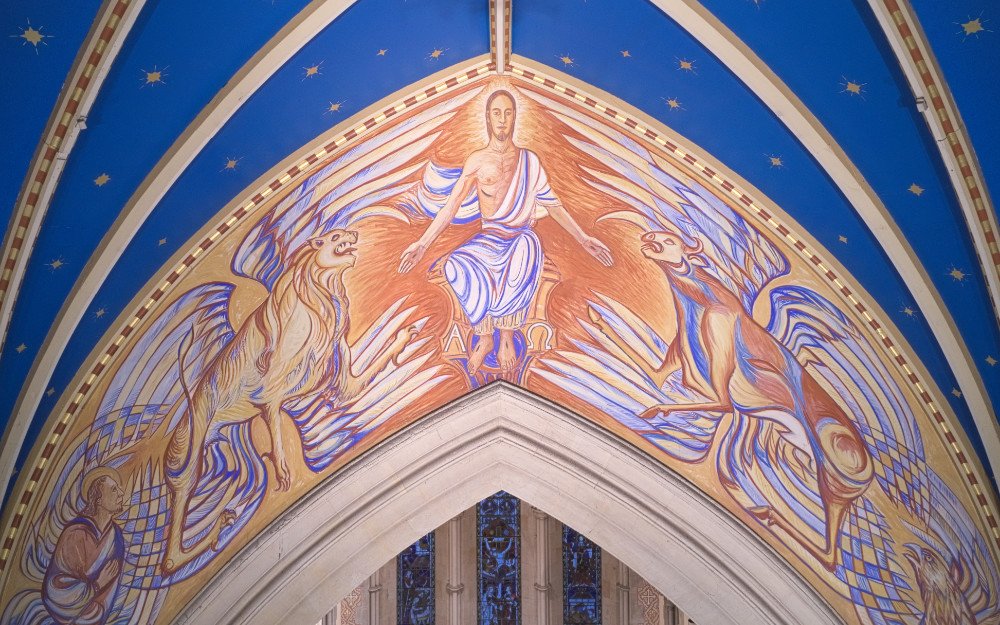
    Over the last few months it hasn’t been possible for my congregation to celebrate the Eucharist together in one space. But when we used to do that, we were never entirely in one space anyway. The very building itself is designed to transport people from the knowledge that they are a few yards from a busy thoroughfare in the Second City of Empire. Taking a few steps inside we find that we are in another place altogether. And in another empire, where the Emperor is servant of all and love is the essense of the law. The conceit that going into church takes you into a divine, heavenly realm is not an idea exclusive to the East. Coming into St Mary’s you are supposed to feel that you are stepping into heaven. It has been built to make you feel that. It has been decorated to make you feel that.  It does make people feel that.

    Whenever I take people into church I almost always hear them express a sense of wonder. We have the wow factor. It has been created by human skill to make you feel that the reality that you experience as you stand in the street is not the only reality that you can experience. It is a space that conveys that love, joy and peace might be possible and it does that without words. It is done with beauty and it takes people a few steps up the stairway to heaven.

    And it is the church playing with reality.

    That experience of going into a holy space and feeling part of something bigger is something common to religions that are divided on all kinds of doctrinal matters. It points to things that are best expressed through virtual reality and religious people are so used to virtual reality that they sometimes forget that it is all around them.

    When people come to the Eucharist in St Mary’s they are at once in Glasgow and simultaneously elsewhere. And elsewhere isn’t even singular either. At the Eucharist in Glasgow we are at one and the same time in an Upper Room in Jerusalem rather a long time ago and at the Wedding Feast of the Lamb at the ultimate consumation of all that is. The Last Supper and the Breakfast at the End of the Universe happen at the same table. At the same time.

    And as we gather at our table, we gather at every table and eat in communion with those who share in the same meal. Our fellowship with them isn’t prevented by circumstance. Our Eucharistic fellowship has never been prevented by circumstance or lack of physical proximity.

    We couldn’t keep the Triduum in Holy Week without virtual reality.

    Without virtual reality it would just be a way of making feet smell less.

    Without virtual reality it would just be a bonfire that would die.

    Christ is the celebrant at every Eucharist no matter which particular celebrant is standing there. Virtual reality becomes interwoven with the reality of the lives that we bring to the table and we are formed and changed and made new. It is how God’s love is expressed.

    This is virtual reality. Every Eucharist is a Virtual Eucharist. Cyberspace is one of the most powerful metaphors for prayer that human beings may ever develop.

    Our bodies are bound by physics.

    God’s love in this world isn’t.

    This is why religious buildings are important. It is also why they are not important.

    Every Eucharist is a Virtual Eucharist.

    Every Eucharist always was a Virtual Eucharist.

    Of course it was.

6 responses to “The Scottish Episcopal Church and the "Listening Process"”

  1. Brian (from Australia) Avatar

    The Scottish and Australian churches have in common that most of their efforts (commendable in themselves) have been directed to talking through theological documents about gays and lesbians rather than listening to gay and lesbian people themselves. The Australian statement acknowledges, moreover, that attempts by some dioceses and parishes to conduct ‘listening’ have more often than not resulted in acrimonious arguments between opinionated participants.

  2. kennedy Avatar
    kennedy

    I don’t know who wrote it but according to the ACNS, +Idris approved it.

    http://www.anglicancommunion.org/acns/articles/42/50/acns4270.cfm

    says
    Each of the summaries has been compiled in cooperation with the Primate of that Province. “The summaries have drawn upon public statements and further research,” said the Listening Process facilitator Canon Phil Groves of the Anglican Communion Office. “Each Primate has approved the final text.”

    Each Province has submitted reports, statements and papers. In addition, Groves has taken time to speak with Primates and their representatives from each of the Provinces in order to produce these summaries. The Primates asked for the summaries to be “made more fully available across the Communion for study and reflection.”

  3. Roddy Avatar
    Roddy

    I get a bit confused as to what the process of ‘listening’, in any sphere of modern life, means. What it so often seems to mean is, “We don’t really want to get involved or change, but we’d like to appear as if we care, even though we don’t.”

    I find the whole concept of being listened to a wee bit patronising, as it has overtones of being regarded as a bit of a nuisance but given a short period of attention to keep you quiet.

    I’m not gay but the whole debate about gays and lesbians in the Anglican Communion appears to be about control of a rather large minority in the church more than anything religious or spiritual. A much more daring approach for the SEC would have been to say the subject is a matter of disinterest to the Church; that is the argument of someone’s sexuality is now of minimal relevance to church life for either gays or straights and that there are better and more important things to do.

    Or have I got this hopelessly wrong?

  4. kennedy Avatar
    kennedy

    Roddy said:
    ‘that is the argument of someone’s sexuality is now of minimal relevance to church life for either gays or straights and that there are better and more important things to do.’

    I think, and I hope, that that is what the American Episcopal Church is starting to say.

    Kennedy

  5. vicky Avatar
    vicky

    I’m with Roddy on this one…it almost seems as if the Anglican Communion has become a one issue Church…and that issue is sexuality. it would be nice to have this level of debate going on about the beatitudes rather than sexual-attitudes………..

  6. steg Avatar
    steg

    I’m not a church goer, but was brought up one and can’t understand why the church – or anyone for that matter – gets so wound up about homosexuality. Dorothy L Sayers had it right when she wrote:

    ‘As I grow older and older, And totter toward the tomb, I find that I care less and less, Who goes to bed with whom.’

Leave a Reply

Your email address will not be published. Required fields are marked *

Previous Posts

  • Generous Episcopacy: The Rt Rev Michael Hare Duke RIP

    I gather from a twitter correspondent that the Rt Rev Michael Hare Duke has died. Bishop Michael was the bishop with whom I first tested my vocation. Having been a bishop since 1969, he saw and influenced the entire modern story of the Scottish Episcopal Church. Where to begin with memories? The time I sat…

  • The Peace and Unity and Order of the Church

    One of the things that I’ve occasionally raised in blog posts is the question of whose responsibility it is to promote the unity of the church. I think this was focused for me particularly at the consecration of the Bishop of St Andrews, Dunkeld and Dunblane just over 9 years ago when the preacher preached…

  • New Statement from College of Bishops

    There’s a new statement from the College of Bishops today about same-sex marriage. It can, and should, be read in full – see here: College of Bishops Guidance re Marriage 2014 I’m appalled by its contents and in particular appalled at the way the Bishops of the Scottish Episcopal Church are treating gay clergy and…