
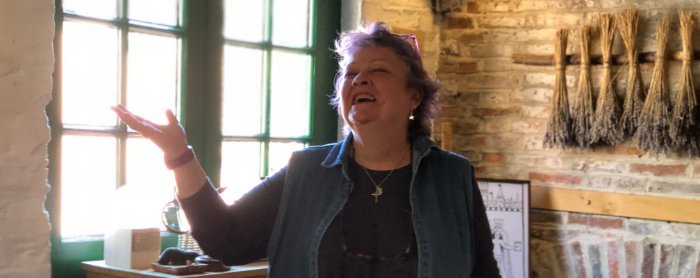
• Ruth Innes RIP

    Mother Ruth

    This week the funeral will take place of an extraordinary priest, the Rev Canon Ruth Innes of the Diocese of Edinburgh.

    Ruth served various congregations in that diocese – St Fillan’s, Buckstone, Christ Church, Falkirk, St Mark’s, Portobello and St Peter’s (formerly St Mildred’s) in Linlithgow along with St Columba’s, Bathgate.

    Ruth never worked in large churches. Each of these places had their own vulnerabilities. But to her, each of her charges were for the time she was with them, My Little Flock. She was defensive of those she cared for too. Not so much a mother hen as a mother lion.

    People will remember her as pastoral, caring and imaginative. Some will also remember her with that double-edged description – that she was colourful.

    Ruth’s outrageous sense of humour and extravagant love could make some nervous of her. However, Ruth was not merely colourful in the sense of being slightly quirky – she wasn’t slightly anything. Her personality lit up the world and made it far more vibrant.

    Despite working as a rector only in relatively small congregations, Ruth was widely known throughout Scotland and beyond. She cultivated her friendships and they lasted many years. Some of these came from the Cursillo movement, some from people she met on conferences and some from friends she holidayed with. Ruth put her friendships to work too in her pursuit of justice. She was a founding member of Changing Attitude Scotland and a key person in the early years of the movement to enable same-sex couples to get married in church. She turned up as a priest in a clerical collar to Pride marches long before it was fashionable to do so.

    She cared about the poor. She cared about her family, including her two sons.  She cared about the sick. She cared about the dying. She cared about the homeless and spoke, to the considerable surprise of many who heard her, of her own experience of homelessness.

    My guess is that when others were making decisions about whether Ruth should be ordained she was described as coming from a “non-traditional background for a priest”. Most clergy don’t have years of experience as a cocktail waitress to draw on after all. Ruth did and she knew much about how people tick as a result. She also brought a sense of fun and good humour to every room she entered.

    Ruth was an adult convert to Christianity having been captured by the beauty, peace and joy she found in the church of St Michael and All Saints in Edinburgh one day when she wandered in. These things turned her life around completely.

    In recent months, Ruth knew she was dying and was brave and honest throughout. She had been present at the deathbeds of many in her care. She knew the consolations of religion without ever being sentimental about them. She knew that God loved her very much and she loved God greatly in return.

    Spirituality is a personal matter. For Ruth it included a love for religious tat. In life, she gathered many icons, statues and rosaries. Some were exquisite. Some were exquisitely camp. None gave her more joy than the pectoral crucifix which also operated as a cigarette lighter – the flame appearing as if by magic above the head of the crucified Lord. She loved all these things but as death approached, she started to let them go. Visiting friends would get to choose from the tat collection but nothing could be removed without one first hearing about the story of where the object came from and what it represented.

    Most treasured of the things she gave me was an icon that Ruth always described as Ugly Mary. Having noticed it in a monastery shop, she realised that no-one else would take home such an ugly icon of Our Lady and that thus it fell to her to rescue her and love her. “Why should Mary always be pretty, anyway?”

    There is a tendency when someone dies to represent them as either a saint or an angel. Ruth was neither of these. She was something much more – a human being fully alive. Devout, fully alive and full of fun.

    May she rest in peace.

    And rise in purple.


    [Many thanks to Kimberly Bohan for the picture]

6 responses to “Here or there?”

  1. Gary Avatar

    Up there. High altar. No doubt.

  2. Tom Allen Avatar

    I am very much with Richard Giles on this one – there should liturgically only be one main altar – ideally this is achieved by romoving the former High altar and dedicating that space to some other purpose – where that is not possible as in historic cathedrals then it should be left dormant (covered in a simple cloth perhaps) and only the altar which is being used for worship should be dressed since this is in fact THE altar.

    Despite all the reservations about removing former altars in the end it solves long-term problems, and provides a single visual focus for Eucharistic worship. At times when a high altar is needed then the new altar can moved there.

    This kind of fuzziness illustrates that our liturgical practice has become dominated by hertiage criteria.

    I am about to replace our main altar with something moveable and aesthetically more appropriate, but am facing a Registrars ruling that the current altar (and former eastward facing number more recently provided with wheels and moved to the chancel!) must be burnt, and that the wood frontal cannot be used for a screen.

    Dont’ we get ourselves tied up in knots!
    Tom

  3. Stewart Avatar

    A thought came to my mind this afternoon. At the Creed we all face east. This results in the choir turning their back on the Nave Altar and in most cases put the High Altar in their sight.

    Considering Tom’s comments, another thought thinking about some English Cathedrals which have multiple altars around the building, it is not usually possible to see more than one at a time. Some have a chapel behind the High Altar – behind a screen.

    Turning back to St Mary’s – all the action at the 10:30 service is centred and focused around the Nave Altar. However there is still the High Altar, the Pheobe Traquair Reredos and Gwyneth Leach mural of Our Lady at the East End. To my mind their presence enhances the worship around the Nave Altar and does not detract from it.

  4. Andrew Avatar
    Andrew

    The Altar is a table, where we commemorate a meal together. Clearly (to my mind) we should all be sitting round it, as we do (more or less) at present. The table reminds me that Jesus instituted the Last Supper when he was among us (HERE), not somewhere else (THERE).

    I very much hope that the Altar in St. Mary’s can be left where it is.

  5. kelvin Avatar
    kelvin

    It seems to me curious that the practice that I inherited was to light and dress the high altar whilst using the nave altar. It makes no sense, except perhaps to highlight St Mary’s puzzling parallel worlds of deep conservatism mingled with radical liberalism.

    Whist tending to agree with Andrew’s sentiments, it is worth remembering that the nave altar could hardly be said to have stayed in one place these last 20 years.

  6. Elizabeth Avatar
    Elizabeth

    Here. Both. Loving the paradox.

    But maybe I only say that beccause the only church I’ve regularly worshiped in where there are clearly two visible altars is St Mary’s and that’s what I’m used to. I’ve never found it distracting that the high altar is dressed and lit, even though the nave altar is where the action is, so to speak. But then, would I notice if the high altar wasn’t dressed and lit? Probably not.

    I do love the nave altar, peripatetic as it is!

Leave a Reply

Your email address will not be published. Required fields are marked *

Previous Posts

  • Don’t worry – it just religion. It won’t bother you.

    Preached on 20 September 2015   In the name of the Father and of the Son and of the Holy Spirit. “Don’t worry,” she said. “Don’t worry, its just a religious thing. It won’t bother you.” I’d just arrived in the village. And she said, ““Don’t worry, its just a religious thing. It won’t bother…

  • Dear Straight People – Greenbelt Talk 2015

    Here’s the talk I recently gave at Greenbelt. In the course of what I was saying, I threw these badges out into the crowd. The spectre of homophobia stalks the church. It is, in the language that Jesus would have understood, one of the principalities, one of the very powers of darkness. It is a…

  • Why government assassinations are wrong

    Earlier this week we had the revelation that British military forces had targeted two citizens of this country in Syria and killed them using a remotely controlled drone. I’m aware of some concerns being expressed by the usual suspects – ie lefty guardian-reading knit your own sandals people who can be relied upon to object…

  • The Hegemony Asserts Itself

    Every day, the straight heterosexist hegemony manages to find new ways to assert its dominance over all who do not share its presumptions. Today, hangers on the back of an hotel room door. Every day something different.