
• Every Eucharist is a Virtual Eucharist

    Heaven

    Every Eucharist is a virtual Eucharist. Of course it is.

    We know this.

    We experience this.

    We forget this.

    Christianity – at least the bits of Christianity that are worth taking seriously – takes time and space so seriously that it knows that the particular cannot ever express the ultimate. Indeed, time and space are playthings in the hands of the religiously inspired.

    Over the last few months it hasn’t been possible for my congregation to celebrate the Eucharist together in one space. But when we used to do that, we were never entirely in one space anyway. The very building itself is designed to transport people from the knowledge that they are a few yards from a busy thoroughfare in the Second City of Empire. Taking a few steps inside we find that we are in another place altogether. And in another empire, where the Emperor is servant of all and love is the essense of the law. The conceit that going into church takes you into a divine, heavenly realm is not an idea exclusive to the East. Coming into St Mary’s you are supposed to feel that you are stepping into heaven. It has been built to make you feel that. It has been decorated to make you feel that.  It does make people feel that.

    Whenever I take people into church I almost always hear them express a sense of wonder. We have the wow factor. It has been created by human skill to make you feel that the reality that you experience as you stand in the street is not the only reality that you can experience. It is a space that conveys that love, joy and peace might be possible and it does that without words. It is done with beauty and it takes people a few steps up the stairway to heaven.

    And it is the church playing with reality.

    That experience of going into a holy space and feeling part of something bigger is something common to religions that are divided on all kinds of doctrinal matters. It points to things that are best expressed through virtual reality and religious people are so used to virtual reality that they sometimes forget that it is all around them.

    When people come to the Eucharist in St Mary’s they are at once in Glasgow and simultaneously elsewhere. And elsewhere isn’t even singular either. At the Eucharist in Glasgow we are at one and the same time in an Upper Room in Jerusalem rather a long time ago and at the Wedding Feast of the Lamb at the ultimate consumation of all that is. The Last Supper and the Breakfast at the End of the Universe happen at the same table. At the same time.

    And as we gather at our table, we gather at every table and eat in communion with those who share in the same meal. Our fellowship with them isn’t prevented by circumstance. Our Eucharistic fellowship has never been prevented by circumstance or lack of physical proximity.

    We couldn’t keep the Triduum in Holy Week without virtual reality.

    Without virtual reality it would just be a way of making feet smell less.

    Without virtual reality it would just be a bonfire that would die.

    Christ is the celebrant at every Eucharist no matter which particular celebrant is standing there. Virtual reality becomes interwoven with the reality of the lives that we bring to the table and we are formed and changed and made new. It is how God’s love is expressed.

    This is virtual reality. Every Eucharist is a Virtual Eucharist. Cyberspace is one of the most powerful metaphors for prayer that human beings may ever develop.

    Our bodies are bound by physics.

    God’s love in this world isn’t.

    This is why religious buildings are important. It is also why they are not important.

    Every Eucharist is a Virtual Eucharist.

    Every Eucharist always was a Virtual Eucharist.

    Of course it was.

6 responses to “Here or there?”

  1. Gary Avatar

    Up there. High altar. No doubt.

  2. Tom Allen Avatar

    I am very much with Richard Giles on this one – there should liturgically only be one main altar – ideally this is achieved by romoving the former High altar and dedicating that space to some other purpose – where that is not possible as in historic cathedrals then it should be left dormant (covered in a simple cloth perhaps) and only the altar which is being used for worship should be dressed since this is in fact THE altar.

    Despite all the reservations about removing former altars in the end it solves long-term problems, and provides a single visual focus for Eucharistic worship. At times when a high altar is needed then the new altar can moved there.

    This kind of fuzziness illustrates that our liturgical practice has become dominated by hertiage criteria.

    I am about to replace our main altar with something moveable and aesthetically more appropriate, but am facing a Registrars ruling that the current altar (and former eastward facing number more recently provided with wheels and moved to the chancel!) must be burnt, and that the wood frontal cannot be used for a screen.

    Dont’ we get ourselves tied up in knots!
    Tom

  3. Stewart Avatar

    A thought came to my mind this afternoon. At the Creed we all face east. This results in the choir turning their back on the Nave Altar and in most cases put the High Altar in their sight.

    Considering Tom’s comments, another thought thinking about some English Cathedrals which have multiple altars around the building, it is not usually possible to see more than one at a time. Some have a chapel behind the High Altar – behind a screen.

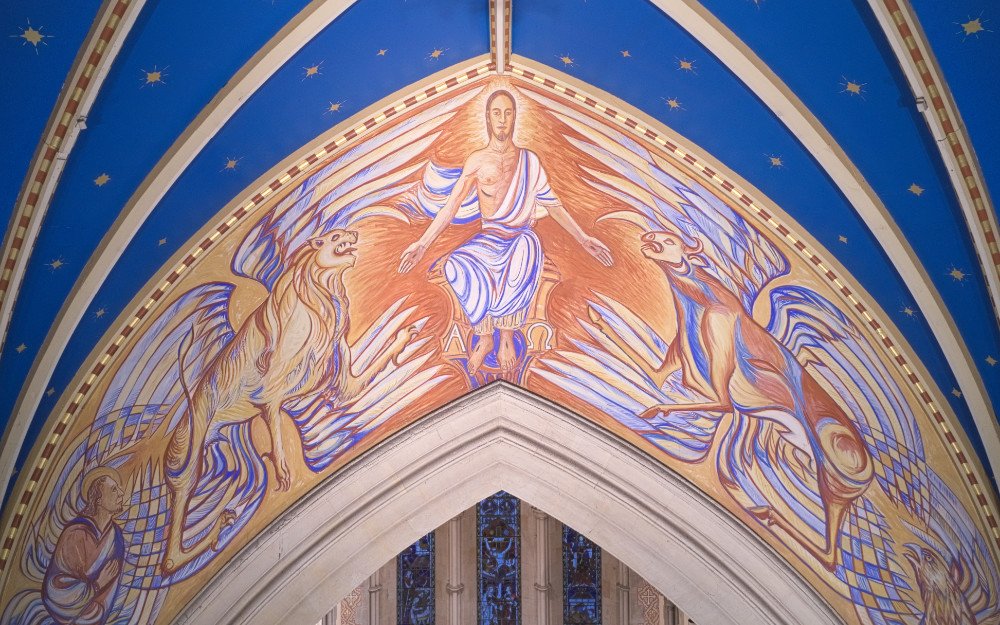
    Turning back to St Mary’s – all the action at the 10:30 service is centred and focused around the Nave Altar. However there is still the High Altar, the Pheobe Traquair Reredos and Gwyneth Leach mural of Our Lady at the East End. To my mind their presence enhances the worship around the Nave Altar and does not detract from it.

  4. Andrew Avatar
    Andrew

    The Altar is a table, where we commemorate a meal together. Clearly (to my mind) we should all be sitting round it, as we do (more or less) at present. The table reminds me that Jesus instituted the Last Supper when he was among us (HERE), not somewhere else (THERE).

    I very much hope that the Altar in St. Mary’s can be left where it is.

  5. kelvin Avatar
    kelvin

    It seems to me curious that the practice that I inherited was to light and dress the high altar whilst using the nave altar. It makes no sense, except perhaps to highlight St Mary’s puzzling parallel worlds of deep conservatism mingled with radical liberalism.

    Whist tending to agree with Andrew’s sentiments, it is worth remembering that the nave altar could hardly be said to have stayed in one place these last 20 years.

  6. Elizabeth Avatar
    Elizabeth

    Here. Both. Loving the paradox.

    But maybe I only say that beccause the only church I’ve regularly worshiped in where there are clearly two visible altars is St Mary’s and that’s what I’m used to. I’ve never found it distracting that the high altar is dressed and lit, even though the nave altar is where the action is, so to speak. But then, would I notice if the high altar wasn’t dressed and lit? Probably not.

    I do love the nave altar, peripatetic as it is!

Leave a Reply

Your email address will not be published. Required fields are marked *

Previous Posts

  • New Year Predictions 2015

    Here are my New Year Predictions for 2015   Those who voted YES in the Scottish Referendum will continue to behave as though they won. This may be unhelpful. Those who voted NO in the Scottish Referendum will continue to behave as thought he referendum never happened. This may be unhelpful. There will, I fear,…

  • Review of Last Year’s Predictions

    Well, clearly it behoves me to consider last year’s New Year Predictions and see how I did. Remember those people who used to say, “But what is a blog…?” Well this year you are going to be hearing them say, “But what is a mooc…?” Well, I think I got that partially right. Lots of…

  • Review of the year on the blog

    Well, everyone else is doing it so I might as well look back over the last year and pick out a few highlights from the blog. I began the year by declaring that The Archbishop of Canterbury is not a Pope and defended him from other people making demands that he rebuke the Nigerian Church.…

  • Ditching the sermon – a dialogue for Holy Innocents

    This morning I decided to ditch the sermon in favour of a dialogue with Bishop Gregor. It has been a difficult Christmas in Glasgow with a major tragedy in the centre of the city as people were doing their last minute Christmas shopping. Bishop Gregor was himself there in the square just after the incident…