
• Listen up! Moocs are the future

    OK listen up. Moocs are the future.

    Now before we go any further, let’s get the usual responses out of the way. The usual responses are twofold:

    1. What’s a mooc?  (Most people)
    2. *rolls eyeballs* (lots of academics, including quite a few in my congregation)

    Firstly, a mooc is a term used for a new form of education that you engage in online. It stands for Massively Open Online Course. Such things have been around for the last couple of years and there’s a good wikipedia page on the concept.

    The basic idea is that you do a course online along with many thousands of other people all at once (massive) which you have easy/free (open) online (online!) access to. It is a way for someone to teach many people. Many, many people. I’ve just finished doing a mooc where a team of three people were attempting to teach 13000 students all around the world.

    But why the eyeball-rolling from clever people?

    Well, any teacher worth their salt is going to say, “Ah, but wait a minute? Hang on there… what do you mean…. that’s not a learning experience that is equivalent to what I can do in a classroom.”

    And you know what? It isn’t.

    However, it is here, it is now and it is going to develop in the future all the same.

    Now, are you thinking you’ve heard all this before – are you thinking this is just a glorified correspondence course? Sure you are. But this is a bit more than that. Typically in a mooc, you get video lectures or other content to download, maybe on a weekly basis. You work through that stuff and you get online quizzes and exercises that you do along the way. If the course is well designed, you get instant feedback on how you are doing and can go back and review any of the bits that you didn’t understand.

    But here’s the thing – it isn’t just you. It is social. There’s a whole bunch of people out there doing the same course as you. And you can get to interact with them on the forums. Indeed, some of the ways that the mooc is assessed may include interaction on the forums. (Cue eyeball rolling from academics who can’t work out that this is the equivalent of giving a mark for interaction in class discussions, which is a relatively common practise in some institutions).

    Then, when all is done, you may well have a final piece of work to submit and this will be marked. But hey, how do you mark 13000 pieces of work? Well, if it is not machine markable material (multiple-guess questions) then the mooc method is to get students to peer review. In the mooc I’ve just participated in, we were encouraged to produce a final video and to pass the course you had to, not only submit your own video, but assess three (or more) others.

    Then you get your certificate and there is much rejoicing.

    Now, here’s where the Eyeball Rollers have started to harumph loudly. “What use is a certificate when no-one qualified has seen the work? Isn’t this the dumb assessing the dumber?”

    Well, the truth is, such a certificate is worth precisely nothing in terms of the educative processes that we have been used to.

    But get this, moocs are not really about what the certificate is worth. The satisfaction comes from having learned something new. Getting the certificate is just icing on the beans. Yet getting that certificate is oddly fulfilling – it is part of the gamification of learning. You get a certificate, you want another. You unlock a level badge, you go  back to try to accomplish the next level.

    Anyway at the end of this post is my certificate from the mooc I recently completed. I don’t care what you think about its value – for me it represents a whole bunch of skills that I just learned. It is for a course that was really for school teachers on Blended Learning – that’s about how to mix learning that takes place in an online setting with more traditional face-to-face teaching. I took the course because I want to be able to offer some online courses at St Mary’s as well doing what we already do. It seemed sensible to do the course and also learn from completing the mooc itself.

    What does this mean for the church at large – well it means that education needs to get slicker. In the same way that new technology has meant that we need to up our game in religious circles in the way we communicate with people, so we need to do the same with how we teach. That scrappy stapled-together church magazine is a great means of communicating but it does so on two levels. On one level, it communicates to those who have always received it that things are carrying on just the same as ever and even lets them know whether they are on the coffee rota on Sunday. To the more casual reader, however, it probably communicates that you are not terribly professional, have low expectations which will carry forward into worship and that you are desperate for someone to join the coffee rota to try to replace the people who are dying off.

    It is the same with education. Sitting around a flipchart with half a dozen people is something that I continue to do. However, increasingly as I do it, I’m aware that the ways in which people learn are changing. Gamification (rewards – yes, sometimes silly little rewards) is here to stay. Blending of online and offline worlds is how people are doing everything from shopping to looking after their health so why shouldn’t that affect how we learn about Things That Matter in church circles? And yes, self directed learning is here to stay.

    There’s new technology on offer here. Who knows what we’re going to do with it?

    And here’s my certificate, which I’m terribly proud of, can you tell?
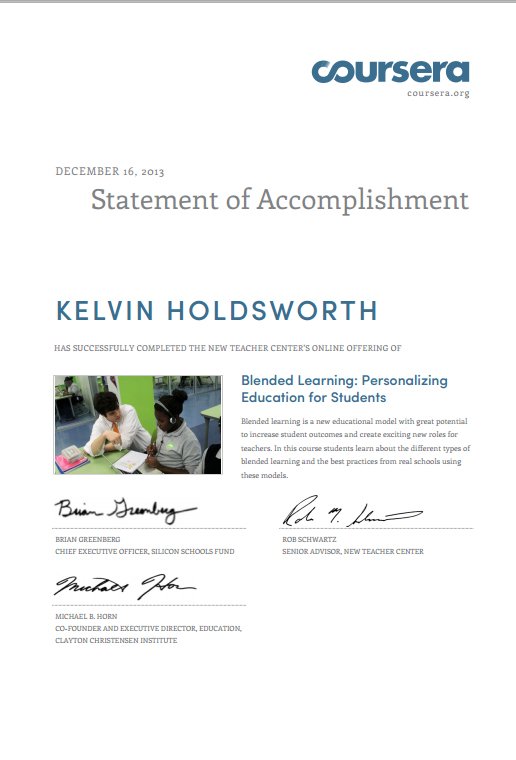
    Blended Learning

10 responses to “Blogging”

  1. Lisa Avatar

    First, let me argue that Bishop Paul Marshall — who wrote that letter you cite — is not one of the great liberals of the Episcopal Church in the U.S. He is widely respected and regarded as a moderate. What he wrote in that letter is a frustration that many of us share: Why can the Archbishop meet privately with the most extreme conservatives of the Episcopal Church in the U.S., but consistently refuses to meet with our bishops assembled? I think that is a fair and valid question. I would urge folks to read Bishop Marshall’s whole letter and not just Ruth Gledhill’s biased “gloss” on it.

    I agree the overall tenor of dialogue on U.S. Episcopalians’ blogs is worrisome. But I do not believe it’s the “liberals” that have gone out of bounds. If you want to read true venom, go to Virtue Online or StandFirm.

  2. David Avatar

    It would be great to have a meet up and blether!

  3. kelvin Avatar
    kelvin

    Thanks for the comments

    Lisa – it was precisely standfirm and virtueonline that I had in mind.

    You’re presuming that I don’t have sympathy for Paul Marshall. I have a great deal of sympathy for his position. I think he is angry. And I think he is right to be angry. I deliberately linked directly to his piece rather than Ruth Gledhill’s stuff about it, which people can find for themselves.

    Perhaps if I had written “Those of us with strong liberal convictions…” my own position would have been clearer.

  4. Tim Avatar

    Sociability good. (And arguably good for online interactions too – there are several notable folks whose adventures I read, whom I could happily put in a room together with a football and lock the door 😉

  5. Frank Avatar
    Frank

    There comes a time to toss convention and start communicating. I have a tea party in mind.

    cheers

  6. Raspberry Rabbit Avatar

    Kelvin, I think the whole blogging machine on the right in the U.S. has been set up for a good long while now. They’ve become proficient at it – the ‘blog storm’ if you like which sees itself quite self consciously as ‘generating’ public opinion for particular ends. The amount of support which ‘social conservatives’ will lend to religious conservatives as ‘deserving cousins’ allows those involved in the present TEC dispute access to an immense network.

    I agree with the first comment about Bishop Marshall being middle of the road and not particularly liberal.

  7. Raspberry Rabbit Avatar

    Oh and with respect to SEC bloggers. A meeting might be a good idea

  8. Dennis Avatar
    Dennis

    Kevin: Just discovered your blog through MadPriest’s blog. I’ll add you to my regular visits.

    It is exciting for me, an American far away from the Episcopal Church of Scotland, since I was confirmed at St Mary’s Glasgow back on Pentecost Sunday in 1988 – your church is where I became an Episcopalian – Fr John Turner was the chaplain at GU. Fr Malcolm was provost.

    How exciting. Glad to find your blog.

    Dennis

    The world of political blogs in the US isn’t really that bad. The most important blog in the US for political progressives is DailyKos (www.dailykos.com) – I’m over there quite a lot – worth watching – it has a lot of voice and influence in the US Democratic party for supporting and raising money for underdog candidates last year who happened to win.

  9. Dennis Avatar
    Dennis

    make that Kelvin, not Kevin. sorry about that!

  10. Lisa Avatar

    I’ve corresponded privately with Kelvin about this, but let me make a few comments here in public.

    I usually have to do my reading and writing on “things Anglican” after a full day at work. I regret to say that means I am sometimes too tired, and I miss the nuances. Which clearly happened in my public reply here. I apologize for that, and I apologize for making unwarranted assumptions about Kelvin’s stance.

    One of the things I am realizing is that we in the Anglican Communion really do not understand enough about each other’s cultures and ethos. Over here in the U.S., we are very much hoping that the churches in the U.K. (and a few other provinces) will allow us to “work out our salvation with fear and trembling,” as St. Paul urged. I fear that our colonial past [of which most U.S. Episcopalians repent most sincerely] is working against us. We do not want to “export” our positions to others in the Communion; we don’t want to tell others they must do as we have done. We simply want the space in which to walk the path that seems right to us — and that path already has a 30-year history of prayerful discernment, both about the place of women in ordained ministry and about the place of gay men and lesbians in the Church and ordination.

    Unfortunately, in the larger U.S. culture now, both “liberal” and “moderate” are anathema. A very scary conservativism (verging on — dare I use the term? — fascism) is taking hold.

    When folks say the Episcopal Church is “bowing to popular culture,” they could not possibly be more wrong. “Popular culture” now in the U.S. is strongly capitalist, imperialist, nationalist, sexist, and anti-gay. Our church is “bucking” that tide, and we are paying a great price for what we truly believe to be a Spirit-led, prophetic witness.

    It remains to be seen whether others in the Anglican Communion will trust us to continue in this time of discernment.

    These are very, very hard times for all of us. And I hate how the positions are being polarized.

    At our church’s General Convention [Do you call it a synod?], several people spoke about how the “diverse center” had spoken. I hope and pray that the “diverse center” will find their voices in Tanzania.

Leave a Reply

Your email address will not be published. Required fields are marked *

Previous Posts

  • Book Review – Iona Dawn

    Edited by Neil Paynter (Wild Good Publications – www.ionabooks.com £7.99) Getting this book for your next Holy Week might be a wise move. The dramatic events of the days leading up to Easter Sunday are expressed here through biblical readings and the reflections of several well-known Iona Community members. This is a more devotional book…

  • Book Review – The Eye of the Storm

    The Eye of the Storm: Spiritual Resources for the Pursuit of Justice by Kenneth Leech This is an honest spirituality. Kenneth Leech knows that an authentic engagement with God will mean that everything changes. Here is a writer to knows that to separate spirituality from justice is to do great damage to Christian consciousness. A…

  • Book Review – Changing Rural Life

    This new book addresses a number of different themes facing rural life, which we are assured is changing in particular and distinctive ways. Drawing together essays by many contributors, the editors attempt to stimulate reflection on the rural economy, the environment and community issues. Of particular interest is a chapter by the Most Rev Bruce…

  • Book Review – Making Church Buildings Work

    The task of managing creaking church buildings is one which is mostly undertaken by volunteers in almost every community the length and breadth of the country. It is surprising therefore that so little has been written to aid those who take on this mammoth task. Those of us who do undertake such work now have…