
• Every Eucharist is a Virtual Eucharist

    Heaven

    Every Eucharist is a virtual Eucharist. Of course it is.

    We know this.

    We experience this.

    We forget this.

    Christianity – at least the bits of Christianity that are worth taking seriously – takes time and space so seriously that it knows that the particular cannot ever express the ultimate. Indeed, time and space are playthings in the hands of the religiously inspired.

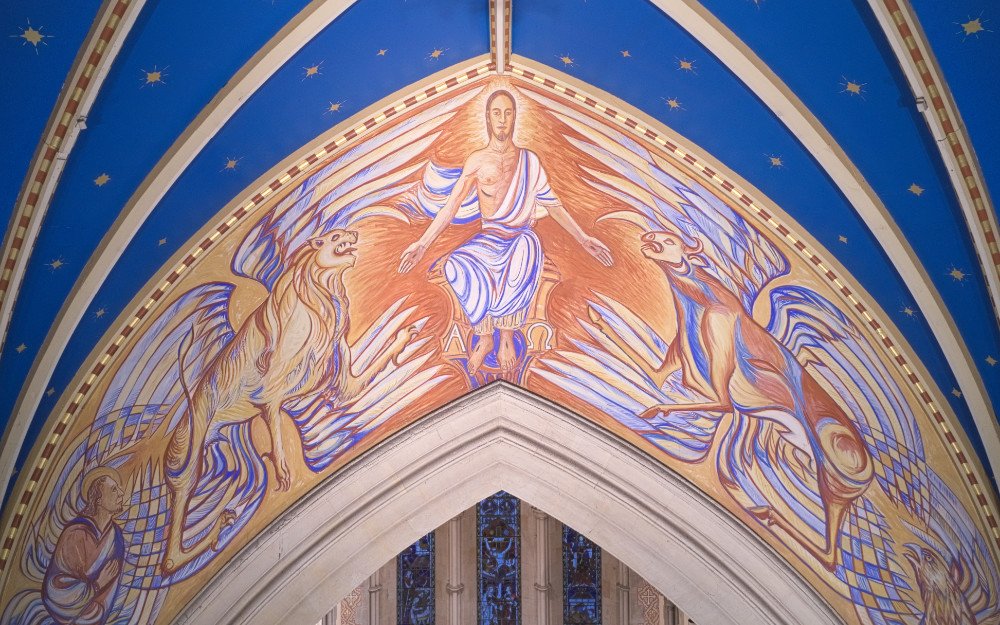
    Over the last few months it hasn’t been possible for my congregation to celebrate the Eucharist together in one space. But when we used to do that, we were never entirely in one space anyway. The very building itself is designed to transport people from the knowledge that they are a few yards from a busy thoroughfare in the Second City of Empire. Taking a few steps inside we find that we are in another place altogether. And in another empire, where the Emperor is servant of all and love is the essense of the law. The conceit that going into church takes you into a divine, heavenly realm is not an idea exclusive to the East. Coming into St Mary’s you are supposed to feel that you are stepping into heaven. It has been built to make you feel that. It has been decorated to make you feel that.  It does make people feel that.

    Whenever I take people into church I almost always hear them express a sense of wonder. We have the wow factor. It has been created by human skill to make you feel that the reality that you experience as you stand in the street is not the only reality that you can experience. It is a space that conveys that love, joy and peace might be possible and it does that without words. It is done with beauty and it takes people a few steps up the stairway to heaven.

    And it is the church playing with reality.

    That experience of going into a holy space and feeling part of something bigger is something common to religions that are divided on all kinds of doctrinal matters. It points to things that are best expressed through virtual reality and religious people are so used to virtual reality that they sometimes forget that it is all around them.

    When people come to the Eucharist in St Mary’s they are at once in Glasgow and simultaneously elsewhere. And elsewhere isn’t even singular either. At the Eucharist in Glasgow we are at one and the same time in an Upper Room in Jerusalem rather a long time ago and at the Wedding Feast of the Lamb at the ultimate consumation of all that is. The Last Supper and the Breakfast at the End of the Universe happen at the same table. At the same time.

    And as we gather at our table, we gather at every table and eat in communion with those who share in the same meal. Our fellowship with them isn’t prevented by circumstance. Our Eucharistic fellowship has never been prevented by circumstance or lack of physical proximity.

    We couldn’t keep the Triduum in Holy Week without virtual reality.

    Without virtual reality it would just be a way of making feet smell less.

    Without virtual reality it would just be a bonfire that would die.

    Christ is the celebrant at every Eucharist no matter which particular celebrant is standing there. Virtual reality becomes interwoven with the reality of the lives that we bring to the table and we are formed and changed and made new. It is how God’s love is expressed.

    This is virtual reality. Every Eucharist is a Virtual Eucharist. Cyberspace is one of the most powerful metaphors for prayer that human beings may ever develop.

    Our bodies are bound by physics.

    God’s love in this world isn’t.

    This is why religious buildings are important. It is also why they are not important.

    Every Eucharist is a Virtual Eucharist.

    Every Eucharist always was a Virtual Eucharist.

    Of course it was.

10 responses to “Blogging”

  1. Lisa Avatar

    First, let me argue that Bishop Paul Marshall — who wrote that letter you cite — is not one of the great liberals of the Episcopal Church in the U.S. He is widely respected and regarded as a moderate. What he wrote in that letter is a frustration that many of us share: Why can the Archbishop meet privately with the most extreme conservatives of the Episcopal Church in the U.S., but consistently refuses to meet with our bishops assembled? I think that is a fair and valid question. I would urge folks to read Bishop Marshall’s whole letter and not just Ruth Gledhill’s biased “gloss” on it.

    I agree the overall tenor of dialogue on U.S. Episcopalians’ blogs is worrisome. But I do not believe it’s the “liberals” that have gone out of bounds. If you want to read true venom, go to Virtue Online or StandFirm.

  2. David Avatar

    It would be great to have a meet up and blether!

  3. kelvin Avatar
    kelvin

    Thanks for the comments

    Lisa – it was precisely standfirm and virtueonline that I had in mind.

    You’re presuming that I don’t have sympathy for Paul Marshall. I have a great deal of sympathy for his position. I think he is angry. And I think he is right to be angry. I deliberately linked directly to his piece rather than Ruth Gledhill’s stuff about it, which people can find for themselves.

    Perhaps if I had written “Those of us with strong liberal convictions…” my own position would have been clearer.

  4. Tim Avatar

    Sociability good. (And arguably good for online interactions too – there are several notable folks whose adventures I read, whom I could happily put in a room together with a football and lock the door 😉

  5. Frank Avatar
    Frank

    There comes a time to toss convention and start communicating. I have a tea party in mind.

    cheers

  6. Raspberry Rabbit Avatar

    Kelvin, I think the whole blogging machine on the right in the U.S. has been set up for a good long while now. They’ve become proficient at it – the ‘blog storm’ if you like which sees itself quite self consciously as ‘generating’ public opinion for particular ends. The amount of support which ‘social conservatives’ will lend to religious conservatives as ‘deserving cousins’ allows those involved in the present TEC dispute access to an immense network.

    I agree with the first comment about Bishop Marshall being middle of the road and not particularly liberal.

  7. Raspberry Rabbit Avatar

    Oh and with respect to SEC bloggers. A meeting might be a good idea

  8. Dennis Avatar
    Dennis

    Kevin: Just discovered your blog through MadPriest’s blog. I’ll add you to my regular visits.

    It is exciting for me, an American far away from the Episcopal Church of Scotland, since I was confirmed at St Mary’s Glasgow back on Pentecost Sunday in 1988 – your church is where I became an Episcopalian – Fr John Turner was the chaplain at GU. Fr Malcolm was provost.

    How exciting. Glad to find your blog.

    Dennis

    The world of political blogs in the US isn’t really that bad. The most important blog in the US for political progressives is DailyKos (www.dailykos.com) – I’m over there quite a lot – worth watching – it has a lot of voice and influence in the US Democratic party for supporting and raising money for underdog candidates last year who happened to win.

  9. Dennis Avatar
    Dennis

    make that Kelvin, not Kevin. sorry about that!

  10. Lisa Avatar

    I’ve corresponded privately with Kelvin about this, but let me make a few comments here in public.

    I usually have to do my reading and writing on “things Anglican” after a full day at work. I regret to say that means I am sometimes too tired, and I miss the nuances. Which clearly happened in my public reply here. I apologize for that, and I apologize for making unwarranted assumptions about Kelvin’s stance.

    One of the things I am realizing is that we in the Anglican Communion really do not understand enough about each other’s cultures and ethos. Over here in the U.S., we are very much hoping that the churches in the U.K. (and a few other provinces) will allow us to “work out our salvation with fear and trembling,” as St. Paul urged. I fear that our colonial past [of which most U.S. Episcopalians repent most sincerely] is working against us. We do not want to “export” our positions to others in the Communion; we don’t want to tell others they must do as we have done. We simply want the space in which to walk the path that seems right to us — and that path already has a 30-year history of prayerful discernment, both about the place of women in ordained ministry and about the place of gay men and lesbians in the Church and ordination.

    Unfortunately, in the larger U.S. culture now, both “liberal” and “moderate” are anathema. A very scary conservativism (verging on — dare I use the term? — fascism) is taking hold.

    When folks say the Episcopal Church is “bowing to popular culture,” they could not possibly be more wrong. “Popular culture” now in the U.S. is strongly capitalist, imperialist, nationalist, sexist, and anti-gay. Our church is “bucking” that tide, and we are paying a great price for what we truly believe to be a Spirit-led, prophetic witness.

    It remains to be seen whether others in the Anglican Communion will trust us to continue in this time of discernment.

    These are very, very hard times for all of us. And I hate how the positions are being polarized.

    At our church’s General Convention [Do you call it a synod?], several people spoke about how the “diverse center” had spoken. I hope and pray that the “diverse center” will find their voices in Tanzania.

Leave a Reply

Your email address will not be published. Required fields are marked *

Previous Posts

  • New Year Predictions 2015

    Here are my New Year Predictions for 2015   Those who voted YES in the Scottish Referendum will continue to behave as though they won. This may be unhelpful. Those who voted NO in the Scottish Referendum will continue to behave as thought he referendum never happened. This may be unhelpful. There will, I fear,…

  • Review of Last Year’s Predictions

    Well, clearly it behoves me to consider last year’s New Year Predictions and see how I did. Remember those people who used to say, “But what is a blog…?” Well this year you are going to be hearing them say, “But what is a mooc…?” Well, I think I got that partially right. Lots of…

  • Review of the year on the blog

    Well, everyone else is doing it so I might as well look back over the last year and pick out a few highlights from the blog. I began the year by declaring that The Archbishop of Canterbury is not a Pope and defended him from other people making demands that he rebuke the Nigerian Church.…

  • Ditching the sermon – a dialogue for Holy Innocents

    This morning I decided to ditch the sermon in favour of a dialogue with Bishop Gregor. It has been a difficult Christmas in Glasgow with a major tragedy in the centre of the city as people were doing their last minute Christmas shopping. Bishop Gregor was himself there in the square just after the incident…