
Just over a week ago there was something called the Scottish Church Census. Churches all over Scotland were asked to count how many people were present and to account for the gender diversity, ethnic diversity, age profile etc of the congregation.
Those organising the census helpfully provided a brief form which people could use to tick the various categories in order to make an accurate return. Though this was helpful, I quickly realised that we couldn’t use the form that was supplied as using it was not going to be inclusive of everyone in the congregation. The first question on the form asked people to indicate whether they were male or female and I was aware that for at least one person in the congregation, that was not going to be a helpful question.
I was aware that there was someone in the congregation who does not identify themselves in a way that would allow them to tick either box with any conviction, seeing gender as something rather more complex for themselves.
Once you start to notice this, you realise that the world is full of forms that require one to identify oneself as either male or female, very many of them forms for which gendered information is completely and utterly irrelevant.
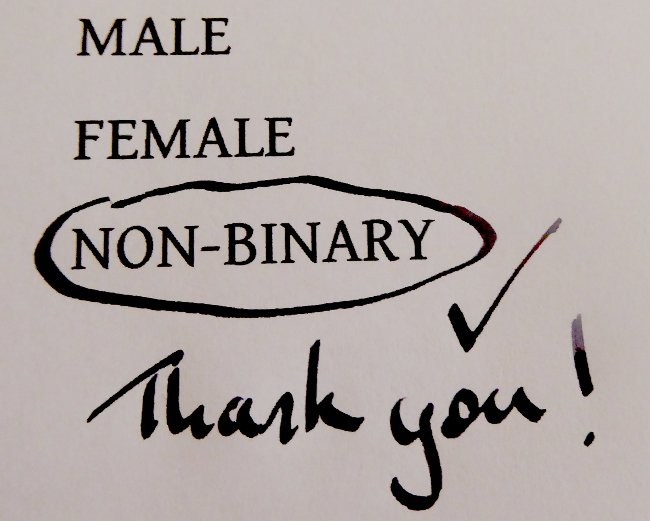
Anyway, we ended up producing our own local version of the Scottish Church Census form with a third box. The options were now male, female and non-binary.
When all the forms were gathered up and counted, it turned out that three people had ticked the non-binary box, one of them circling the words and writing “thank you” next to them.
Thus I found out simply by asking the question, that there were three times as many people in the congregation that day than I would have estimated who would describe themselves as not male nor female but in some way non-binary.
We’re going to hear quite a lot more about this in the coming years I think. In Scotland there’s going to be a consultation about allowing people to legally be regarded as being of a non-binary gender, the law neither regarding them as male or female. It is a change which should go ahead I think though one suspects that a great number of people have never thought it through.
The three people describing themselves as non-binary in St Mary’s that Sunday were towards the younger end of the (very mixed) age profile that we have. This suggests to me that this way of identifying oneself is likely to become more common as time goes on and may be very helpful.
Gender does push people’s buttons a lot and we don’t all agree. There’s a pernicious law being pursued in some parts of the USA trying to ensure that people use the “correct” toilets according to the gender they were assigned at birth. This is problematic for those who have transitioned from one gender to another, those who were born intersex and those for whom gender is simply more complex and who would regard themselves as non-binary.
(We have both gendered and non-gendered toilet facilities at St Mary’s Cathedral. At home I only have a non-gendered toilet, like most people).
But here’s the thing. Christians worship a non-binary God, don’t we?
Haven’t we come (rejoicing) through the days of feminists calling upon us to recognise that there is a female aspect to the divine which makes all talk of God as purely male to be inadequate?
Haven’t we come to a point of recognising that God is beyond gender?
When the government comes to the point of asking us all what we think of introducing a non-binary gender category, won’t the churches joyfully embrace it and support it because this reflects the God we know and in whose image and likeness we are made?
Might the non-binary gender category that is increasingly going to become an option for people be a helpful way in which we might reflect on the nature of God?
In congregations like my own, I suspect that will be the case very quickly but maybe for the whole church this shift in the way we regard gender may help us in the way we look at God.
I wrote last week about the fact that anyone who insists on God being a male authority figure or even daddy is readily challenged by simply reading the bible where God is seen more by attributes that go way beyond gender. When we address God these days in my own congregation we are more likely (far more likely) to address God as “Eternal God” or “Loving God” than we are to talk of “Father God”. This is partly because not everyone has a good model of fatherhood in their own experience but far more it is because this simply isn’t the God whom the bible has introduced us to. Jesus used fatherhood as a metaphor for God but that has to be seen in the context of a book which speaks of God as a flower – the Rose of Sharon, a carnivorous wild animal – the Lion of Judah or weapon – sharper than a two edged sword, along with dozens of other complex rich and sometimes perplexing images.
We worship a God who is beyond gender even though our tradition has sometimes embraced images of God which are highly gendered – sometimes I think, to distinguish the faith from other highly female gendered images of divinity with which Christianity was competing. (I’ve seen an effigy of Artemis of Ephesus and can honestly say I wouldn’t like to meet her during a dark night of the soul).
Christian people are not in the business of dealing with a Mr God.
And Christian people need to wise up fairly quickly to the questions about gender which are coming our way.
Dear God who is beyond gender,
give us a greater dose
of your holy spirit of common sense
in dealing with gender
than we have seemed to the world to posses
over your gift of sexuality.
Amen


Leave a Reply