
• A Scottish Kalendar

    Once upon a time, many years ago, by which we mean up until the 1990s, the Scottish Episcopal Church used to publish an annual Kalendar which listed, for every day of the year, a set of bible readings for devotional reading, what saint’s day might happen to fall on that day and the liturgical colour for the day.

    It was immensely useful but was immensely difficult for someone to compile.

    At some point a decision was made to stop publishing it and instead to publish a comprehensive lectionary which listed all the possible combinations of bible readings that you could ever encounter along with a guide to the lectionary that was produced each year. The lectionary and guide are available on the Scottish Episcopal Church webpage here: http://www.scotland.anglican.org/who-we-are/publications/liturgies/calendar-and-lectionary/

    The trouble is, people find the lectionary very difficult to use. You can’t just open it up and see what bible readings you might read on any one day as you need to know which year you are in (1 or 2 for daily readings, A, B or C for the Sunday readings in church). You need to know whether you want readings for Daily Prayer or for a Eucharist. And you need to check in the guide which form of Daily Prayer you should be using that week if you are doing that and you need to check whether it is a feast day which might alter what you are doing and the way in which it might change what you are supposed to be doing.

    In short, checking the readings became something  that you needed to learn how to do rather than something you could just read from the Kalendar for every day of the year. And I think this has had quite an impact. It was much easier to give people copies of the Kalendar by way of supplying daily bible readings than it is to tell people to download the lectionary and guide and teach them how to use it.

    At the time that this change happened, I lamented somewhat.

    However, I also thought about it. For it seemed to me that this was a task that a half-decent computer programmer could get a computer to do.

    Reader, I am that computer programmer, albeit only one who is half-decent.

    Anyway, I started to write some routines to calculate the Kalendar about 19 years ago thinking it wouldn’t take me long to complete.

    Every year before Advent Sunday I’ve tinkered with it and had a go at producing a Kalendar. Each year I’ve failed dismally and got on with my life and muttered into my decaffeinated tea about why this is such a difficult task.

    In the mean time, other offerings have appeared, notably, that outstanding digital calendar that Gareth Saunders produces each year and distributes at no cost on http://www.seccalendar.co.uk/ Gareth’s offering gives you all you might want in a form that can be uploaded into a digital calendar, for example, a google calendar. It thus means that you have the readings at hand wherever you have a digital calendar.

    However, I’ve always hankered after something physical – something that you could leave lying around in the oratory in the cathedral where we gather for daily prayer that would have all the readings in a format that was easy to use. Something that you could leave by the bed or in the holy corner at home which gave you the same readings for use easily and practically when at home.

    I’ve always rather regretted the fact that the church didn’t produce this as it seems to me to be the most obvious way of getting people to read the bible every day. People love lists of daily bible readings. Many people just don’t know where to start with the bible without such suggestions.

    Anyway, this year was no different to any other year in that I had a tinker with the program I started to write 19 years ago. It was not particularly easy as I had chosen to write in an unpleasant computer language called Visual Basic for Applications simply because I had the lectionary tables available in Access. (Everything is a database problem as we know from our Computer Science degrees, right?). The trouble is, I’ve never learned Visual Basic and had to keep looking up the syntax just about every line I wrote.

    I reached the usual muttering into my tea stage early this year, about a week before Advent Sunday. I retired to bed in a very grumpy mood. And I slept. And as I slept, I must have dreamed. For on waking, I immediately went and found a piece of paper and wrote out an algorithm for solving the problem – for putting all the right readings and all the right saints’ days on all the right days of the year.

    And lo – I’ve managed to produce a new Kalendar in a similar format to that which was produced all those years ago.

    Thus, this week looks like this:
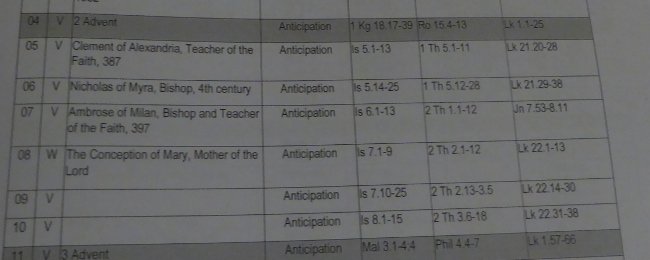
    And there’s even an easy explanation of how it works like this:

    Now, having produced it for myself, as an intellectual exercise if nothing else, it being the first time I’ve really used my programming skills since graduating in 1989, what to do with it?

    It seemed to me that this might be something that people in St Mary’s would like, not least those who have just completed the Vice Provost’s challenge to read the bible in a year.

    I printed some copies off and sold them on the Sunday morning and they went like hotcakes.

    Bishop Gregor has suggested that I should make them more widely available and, having checked with the chair of the Liturgy Committee that I wasn’t stepping on any toes by doing so, am now able to do so.

    Copies are available from me in church for the sum of £3 or are available to purchase on this website here:

    http://thurible.net/product/scottish-kalendar-2017/

    There’s a hefty discount for anyone wanting to buy in bulk for a bible study group maybe or for a church stall.

    For those wondering, the spelling Kalendar is a traditional spelling for a calendar kept by the church.

    This one runs from Advent Sunday 2016 until the end of 2017.

    I’d be happy to answer any other questions about this here. At this stage, I’m not going to be publishing a pdf – this is only available in physical form.

11 responses to “We should be wary of declaring martyrs”

  1. Eamonn Avatar

    Agree totally. I find myself in a comparable position vis-à-vis the mass canonisations of the ‘martyrs’ of the Spanish Civil War, which assume that all those worthy of commemoration were on the same side.

  2. Michael Russell Avatar

    Anyone killed for professing their faith is a martyr. ISIS is an equal opportunity martyring machine. The various faith communities targeted, including Islamic ones, should build common ground to dismember ISIS. I simply fail to see the point in quibbling about who is a real martyr and who is not.

    1. Kelvin Avatar

      Is it your view that someone is a martyr for Christianity because they cannot recite a verse from the Qur’an?

      It seems to me that whilst some men and women of violence are being claimed to be martyrs if they should be shot by law enforcement agencies whilst pursuing paths of terror that there’s a huge amount to be gained by determining who is a martyr and who isn’t.

      1. Bro David Avatar
        Bro David

        Not being able to explain a quranic verse was merely a way of discerning if someone was not Muslim. However, is it not just as great a presumption to think they weren’t martyrs, as to think that they were.

        The early church seemed to accept that all who were crucified or sent to the lions for their Christianity were martyrs. Perhaps not all did so as a statement of faith, but were nominal Christians caught up with the rest. But the church didn’t seem obliged to footnote who didn’t qualify.

        I’m not sure that I understand why your are hesitant. It seems a quibble. I don’t think anyone is leaning toward canonization here, just speaking of them as a whole.

  3. Jo Avatar
    Jo

    The SEC still keeps the feast of Charles, King and Martyr. I don’t think we get to be too narrow in defining who is or isn’t a martyr.

    1. Kelvin Avatar

      Actually, Jo – that’s not quite right. The SEC keeps the commemoration of “Charles I, King, 1649”

      There’s no mention of him being a martyr in the calendar (and the current calendar superseded and replaced the one in the prayer book). There are plenty of people who are named as martyrs such as Agnes the week before Charles or indeed “Charles Mackenzie of Central Africa, Bishop, Missionary, Martyr, 1862” the very day after Charles.

      It would appear that rather careful thought was given to whether to describe Charles as a martyr and though he is included in the calendar (not least for founding one of our dioceses) any notion of martyrdom is absent.

      1. Jo Avatar
        Jo

        Thanks for the correction, I hadn’t realised there was that detail of difference between the SEC and CofE.

  4. Father David Avatar
    Father David

    Of course, King Charles was a Martyr and is commemorated as such on January 31st each year. The trouble is that Anglicans have no real mechanism for declaring people to be saints or martyrs. Having referred to two recent horrific incidents on the African continent where Christians were slaughtered simply for being Christians, I wonder what the Provost of Glasgow thinks about the Ugandan Martyrs of the 19th century and would you personally regard them to be martyrs? As you know 23 Anglicans and 22 Roman Catholics were killed by the Kabaka for refusing to submit to King Mwanga’s corporal intimacies. The Roman Catholics were beatified in 1920 and canonised in 1964 but what of our Anglican Ugandan brothers – where they equally to be regarded as martyrs, or would you deny them that honorific title?

    1. Kelvin Avatar

      The Scottish Episcopal Calendar is again very clear: “Charles Lwanga and his companions, 1886, Janani Luwum, Bishop, 1977, Martyrs of Uganda”

      I have no idea why anyone would say that the SEC has no means of declaring someone to be a martyr. Not only do we have such a mechanism, we use it.

  5. Father David Avatar
    Father David

    It would be interesting to know how this mechanism works in the SEC in deciding who is eligible to join the noble army of martyrs? Bishop Edward King of Lincoln is widely regarded as a saint South of the Border. I think it was Archbishop Lang who was asked how it was decided that Bishop King had reached sainthood status and the answer was that he was given a Collect, Epistle and Gospel to commemorate his saint’s day – 8th March, the day of his Heavenly Birthday.

  6. Harry Campbell Avatar
    Harry Campbell

    “We strongly condemn such atrocities, whether they are Ethiopians are not,” the Ethiopian communications minister Redwan Hussein told AFP.
    http://www.theguardian.com/world/2015/apr/19/isis-video-purports-to-show-massacre-of-two-groups-of-ethiopian-christians

    What a shame the Archbishop couldn’t have said something similarly inclusive about the victims of the Kenyan massacre, and all such massacres, without caring about what their religion affiliation may or may not have been.

Leave a Reply

Your email address will not be published. Required fields are marked *

Previous Posts

  • Postcard to Rowan

    Dear Rowan, wondered whether it had occurred to you that if you give an interview in one country, these days, it will probably be picked up in another country. Take this interview that you’ve given to the Telegraph this weekend. Did you have any regrets? Oh yes, not going to the USA to deal with…

  • Deaconings and Priestings

    I’m sadly unable to be in St Mary’s this weekend for one of the most significant moments in the year – five people are being ordained at a special service on Saturday afternoon. These are moments that people remember for the whole of their lives. My exuberant good wishes to all those being ordained. Some…

  • Installation/Institution

    For the next three months, I’m on sabbatical from St Mary’s, enjoying the freedom that Bishop Gregor and the congregation have given me to think and reflect and grow. The last formal thing that I did as Provost of St Mary’s before sabbatical time started was to go to the start of a new ministry…