
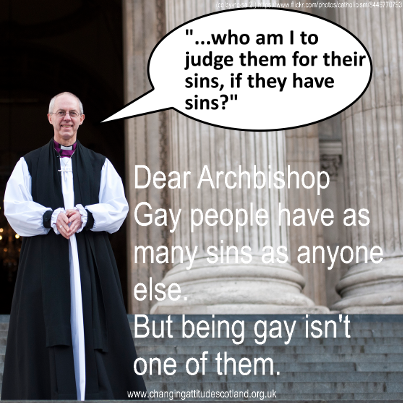
• The Archbishop, the gays and their sins

    Welby fbsize

    One of the things that we’ve learned about Archbishop Justin Welby in recent weeks is that he gets upset about what people write about him on social media.

    He wrote at some length about how what gets written online is upsetting and he’d just prefer to have personal contact with him rather than sounding off online.

    Love often says don’t tweet. Love often says don’t write. Love often says if you must rebuke, then do so in person and with touch – with an arm around the shoulder and tears in your eyes that can be seen by the person being rebuked.

    It is difficult not to have some sympathy for him and I say that as someone who has been really particularly critical of him in the past. It can’t have been much fun seeing my You Condemn It, Archbishop post being relentlessly copied, commented on and retweeted across the Anglican globe.

    And yet the trouble is, there’s no turning the social media clock back. Wanting a world where people don’t comment online about things they care about very deeply is wanting a fantasy world that has no chance of coming back into being.

    Is it possible for leaders and people in public life to do well when the whole internet seems bedeviled with naughty people who will retweet and repost every last mistake that people make?

    I think it is possible, but trying to stand above the fray and condemning people for writing about things you’ve said is hardly going to work nowadays.

    The Archbishop’s complaint about social media came just after someone published a blog post which appeared to suggest that one of the Archbishop’s closest advisors had given a briefing to a group of Anglicans which suggested that Lambeth was now not trying to avoid schism in the Anglican communion but trying to manage it – the expectation being that some parts of the Church of England (the most liberal and the most conservative) would be lost but that a coherent “middle” would survive. It was a deeply shocking position to claim to be true. So shocking that I didn’t believe it at first but have since heard others who were at the briefing confirm that this stuff was indeed said and repeat also that expectation is that there would be bargaining over which buildings to give away, within 10 years.

    That blog post disappeared fairly quickly but internet genies don’t jump back into bottles and the story was out there and really rather embarrassing to all concerned.

    No wonder the Archbishop posted something indicating his discomfort about social media.

    But the real question is whether the social media phenomenon is the problem or whether the archbishop’s problems lie with with the things that social media point towards.

    It must be terribly frustrating to have people pick up on your every utterance and make a big deal out of it.

    The trouble is, in public life, the words you say have a lot of power. Social media posts rebalance that power a little and we should be welcoming the fact that we are a community that cares enough to talk about things rather than trying to remake the Anglican world into one in which bishops speak and everyone else listens uncritically.

    I’ve no doubt that the Archbishop will be embarrassed by posts such as this one which highlight something he said this week. Asked about the usual topic – those pesky gays, a topic that he will be asked about in every interview he ever gives, he is reported to have said:

    I’m listening very, very closely to try to discern what the spirit of God is trying to tell us.

    I see my own selfishness and weakness and think who am I judge them for their sins, if they have sins.

    You can almost hear him dithering over the comma in that last sentence and wondering how this might sound on social media and adding a bit of theological nonsense.

    Of course gay people have sins. However if the first response you make when people ask you about gay people is to talk about sin, then you are going to sound pretty homophobic. And it doesn’t matter whether you like it or you don’t like it, people are going to call attention to it online.

    But is that to be too critical? What strategies could the Archbishop adopt that would help when he is asked about the Usual Topic?

    The most basic thing is to recognise that everything is a conversation these days.

    In fact the Archbishop did quite well in answering a question from a young Muslim who wanted to know whether he would try to convert him to Christianity.

    I am not going to put pressure on you, and I wouldn’t expect you to put pressure on me.

    He could have done far worse with that question than he did.

    Unfortunately, he answered the question on the Usual Topic by immediately talking about sin and then parroting the “sex outside marriage in the C of E is against the rules” line.

    It is a conversation, Archbishop.

    That means we want to talk about it, not be told what the rules are before the conversation gets going.
    It means we want to talk about it, not be told to lay off social media because it gives you the hump.
    It means you can have your say so too and people will listen respectfully and carefully to what you say, but only so long as you engage with people.

    It is a conversation, Archbishop. Everything is a conversation.

    When the first thing you say about gay people is about sin then you can’t expect the conversation to go well.

    It wasn’t helped that the second thing you said was along the lines of “some of my best friends are gay you know?”

    “Marriage is between one man and one woman for life and sexual activity should be confined to marriage, that’s in the Church of England’s laws” he said. “I’m equally aware I have a lot of gay friends and I know gay clergy and they are doing incredible work.”

    You say that stuff and you are going to get people observing that there’s a lot more archbishops who claim that gay people are their friends than gay people who claim archbishops are their friends.

    This could be going better. It could be going much better.

    And it is going to happen again. That question is going to be asked again and again and again.

    There are people out there who can help you find better answers.

    Guess where they are, Archbishop?

    Yes – all over social media.

11 responses to “We should be wary of declaring martyrs”

  1. Eamonn Avatar

    Agree totally. I find myself in a comparable position vis-à-vis the mass canonisations of the ‘martyrs’ of the Spanish Civil War, which assume that all those worthy of commemoration were on the same side.

  2. Michael Russell Avatar

    Anyone killed for professing their faith is a martyr. ISIS is an equal opportunity martyring machine. The various faith communities targeted, including Islamic ones, should build common ground to dismember ISIS. I simply fail to see the point in quibbling about who is a real martyr and who is not.

    1. Kelvin Avatar

      Is it your view that someone is a martyr for Christianity because they cannot recite a verse from the Qur’an?

      It seems to me that whilst some men and women of violence are being claimed to be martyrs if they should be shot by law enforcement agencies whilst pursuing paths of terror that there’s a huge amount to be gained by determining who is a martyr and who isn’t.

      1. Bro David Avatar
        Bro David

        Not being able to explain a quranic verse was merely a way of discerning if someone was not Muslim. However, is it not just as great a presumption to think they weren’t martyrs, as to think that they were.

        The early church seemed to accept that all who were crucified or sent to the lions for their Christianity were martyrs. Perhaps not all did so as a statement of faith, but were nominal Christians caught up with the rest. But the church didn’t seem obliged to footnote who didn’t qualify.

        I’m not sure that I understand why your are hesitant. It seems a quibble. I don’t think anyone is leaning toward canonization here, just speaking of them as a whole.

  3. Jo Avatar
    Jo

    The SEC still keeps the feast of Charles, King and Martyr. I don’t think we get to be too narrow in defining who is or isn’t a martyr.

    1. Kelvin Avatar

      Actually, Jo – that’s not quite right. The SEC keeps the commemoration of “Charles I, King, 1649”

      There’s no mention of him being a martyr in the calendar (and the current calendar superseded and replaced the one in the prayer book). There are plenty of people who are named as martyrs such as Agnes the week before Charles or indeed “Charles Mackenzie of Central Africa, Bishop, Missionary, Martyr, 1862” the very day after Charles.

      It would appear that rather careful thought was given to whether to describe Charles as a martyr and though he is included in the calendar (not least for founding one of our dioceses) any notion of martyrdom is absent.

      1. Jo Avatar
        Jo

        Thanks for the correction, I hadn’t realised there was that detail of difference between the SEC and CofE.

  4. Father David Avatar
    Father David

    Of course, King Charles was a Martyr and is commemorated as such on January 31st each year. The trouble is that Anglicans have no real mechanism for declaring people to be saints or martyrs. Having referred to two recent horrific incidents on the African continent where Christians were slaughtered simply for being Christians, I wonder what the Provost of Glasgow thinks about the Ugandan Martyrs of the 19th century and would you personally regard them to be martyrs? As you know 23 Anglicans and 22 Roman Catholics were killed by the Kabaka for refusing to submit to King Mwanga’s corporal intimacies. The Roman Catholics were beatified in 1920 and canonised in 1964 but what of our Anglican Ugandan brothers – where they equally to be regarded as martyrs, or would you deny them that honorific title?

    1. Kelvin Avatar

      The Scottish Episcopal Calendar is again very clear: “Charles Lwanga and his companions, 1886, Janani Luwum, Bishop, 1977, Martyrs of Uganda”

      I have no idea why anyone would say that the SEC has no means of declaring someone to be a martyr. Not only do we have such a mechanism, we use it.

  5. Father David Avatar
    Father David

    It would be interesting to know how this mechanism works in the SEC in deciding who is eligible to join the noble army of martyrs? Bishop Edward King of Lincoln is widely regarded as a saint South of the Border. I think it was Archbishop Lang who was asked how it was decided that Bishop King had reached sainthood status and the answer was that he was given a Collect, Epistle and Gospel to commemorate his saint’s day – 8th March, the day of his Heavenly Birthday.

  6. Harry Campbell Avatar
    Harry Campbell

    “We strongly condemn such atrocities, whether they are Ethiopians are not,” the Ethiopian communications minister Redwan Hussein told AFP.
    http://www.theguardian.com/world/2015/apr/19/isis-video-purports-to-show-massacre-of-two-groups-of-ethiopian-christians

    What a shame the Archbishop couldn’t have said something similarly inclusive about the victims of the Kenyan massacre, and all such massacres, without caring about what their religion affiliation may or may not have been.

Leave a Reply

Your email address will not be published. Required fields are marked *

Previous Posts

  • Sermon – 26 September 2010

    Here’s what I said yesterday in the pulpit… There’s no getting away from it. Sooner or later we do have to think about hell. That’s the message from this morning’s gospel reading and I don’t think that there is any choice but to deal with it head on and allow ourselves the chance to ask…

  • Knowing Me, Knowing You (again!)

    Hey, remember the Knowing Me, Knowing You sessions that I ran a while ago? Well I’m doing another one this week. If you don’t remember what this is about, check out this description from an earlier one. These sessions are limited to 20 people in order that we can keep the conversation flowing. If you…

  • Consecration of new bishop in Kentucky

    The Diocese of Kentucky consecrates a new bishop today. The Diocese of Kentucky is one of Glasgow and Galloway’s Companion Dioceses. At about 4 pm UK time, the service will begin in Kentucky…. and, provided they can resolve their internet issues in Kentucky, on this blog: Now, ain’t that neat?

  • Home is the wanderer

    Ah, Glasgow. Here I am again. Today I arrived back in town after two weeks holiday. I’ve been to France, since you ask and I’ve had a lovely time. I was in the sud and so my body was warmed greatly by the sun. I tend not to tan a great deal, because I slap…