
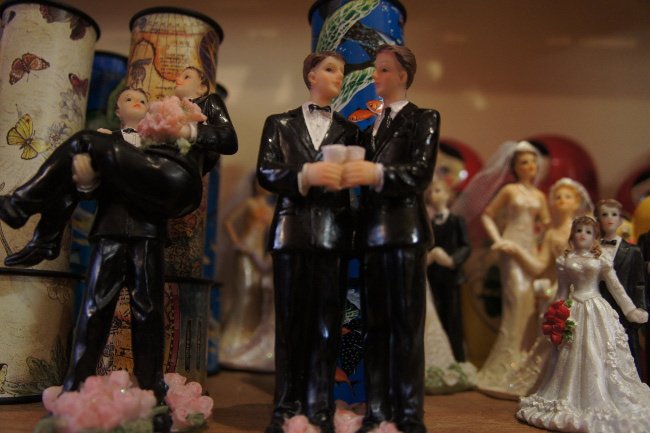
• Same-sex Marriage Date for Scotland – 31 December 2014

    SONY DSC

    Exciting news this morning – we have a date for the first same-sex marriages in Scotland. The date is within this year – just. The first day on which most couples will be able to get married will be 31 December 2014, the day known in Scotland as Hogmanay. There’s going to be some parties north of the border that night, I can tell you.

    The law will actually change in mid-December, as expected but the Scottish Government has delayed its proposal to increase the notice period to 28 days. Thus, same-sex marriage becomes legal on 16 December 2014. If a couple have been married in another jurisdiction (eg England) then they will be regarded in Scotland as being in a Civil Partnership until midnight on 15 December and regarded as a married couple on 16 December. Couples can give notice to marry on that day and a couple of weeks later can get married on 31 December 2014.

    From 16 December 2014 a couple in extenuating circumstances will be able to apply to be able to get married more quickly – this usually applies if one partner is near to death. It is entirely possible that such a couple may be the first to be married but the big celebrations will come right at the turn of the year.

    From 16 December, trans people can get gender recognition without having to be divorced.

    Couples who have entered a Civil Partnership will be able to apply to a Registrar to convert that to a marriage from 16 December 2014 and it will be free to do so for the first year. (You pay for the marriage certificate just like anyone else but there is no processing fee). Alternatively, couples may pay the usual fees for a marriage ceremony. Couples will be able to be married in a Register Office or by religious or humanist celebrants in certain circumstances.

    Couples will be able to be married in the Scottish Episcopal Church with the permission of the House of Bishops, the House of Clergy and the House of Laity meeting in General Synod.

    Any couple who has entered into a Civil Partnership who converts it to a marriage is welcome if they wish to bring the certificate to St Mary’s where it can be laid on the altar at a Eucharist in thanksgiving for the partnership and for this change in the law.

    Civil Partnerships will continue to be available to same-sex couples (but not to straight couples) and I am more than willing to go on blessing such couples.

    I’m also willing to bless all couples who have married by a Registrar, using the Service of Benediction that I drew people’s attention to earlier.

    Here’s the prayer I will be using to bless couples in church:
    God the Father,
    God the Son,
    God the Holy Spirit,
    bless, preserve and keep you;
    the Lord look upon you with favour and mercy
    and so fill you with all spiritual benediction and grace,
    that you may so live together in this life
    that in the world to come you may have life everlasting.
    Amen

    Straight couples marrying who wish to express solidarity with gay couples who wish to get married in Scottish Episcopal Churches should get married in a Register Office and come to church for the Benediction of their marriage just like anyone else wanting to get married.

    I’ve yet to decide whether or not to continue to perform legal marriages for straight couples in church after 31 December 2014.

    Congratulations are in order not only to those who will be getting married soon but also to all those campaigners who worked to change the law, to parliamentarians who voted for it and civil servants who have been working on it. The brilliant campaigning of the Equality Network has been a powerful force in bringing about change. And inevitably, my mind turns in awe to the members of St Mary’s Cathedral, particularly those belonging to the LGBT group who went out collecting signatures to bring in petition to the Scottish Parliament long before the big campaigns got going.

    We changed the world.


    Picture Credit – Peter Kolkman Copyright – Creative Commons Some Rights Reserved

11 responses to “We should be wary of declaring martyrs”

  1. Eamonn Avatar

    Agree totally. I find myself in a comparable position vis-à-vis the mass canonisations of the ‘martyrs’ of the Spanish Civil War, which assume that all those worthy of commemoration were on the same side.

  2. Michael Russell Avatar

    Anyone killed for professing their faith is a martyr. ISIS is an equal opportunity martyring machine. The various faith communities targeted, including Islamic ones, should build common ground to dismember ISIS. I simply fail to see the point in quibbling about who is a real martyr and who is not.

    1. Kelvin Avatar

      Is it your view that someone is a martyr for Christianity because they cannot recite a verse from the Qur’an?

      It seems to me that whilst some men and women of violence are being claimed to be martyrs if they should be shot by law enforcement agencies whilst pursuing paths of terror that there’s a huge amount to be gained by determining who is a martyr and who isn’t.

      1. Bro David Avatar
        Bro David

        Not being able to explain a quranic verse was merely a way of discerning if someone was not Muslim. However, is it not just as great a presumption to think they weren’t martyrs, as to think that they were.

        The early church seemed to accept that all who were crucified or sent to the lions for their Christianity were martyrs. Perhaps not all did so as a statement of faith, but were nominal Christians caught up with the rest. But the church didn’t seem obliged to footnote who didn’t qualify.

        I’m not sure that I understand why your are hesitant. It seems a quibble. I don’t think anyone is leaning toward canonization here, just speaking of them as a whole.

  3. Jo Avatar
    Jo

    The SEC still keeps the feast of Charles, King and Martyr. I don’t think we get to be too narrow in defining who is or isn’t a martyr.

    1. Kelvin Avatar

      Actually, Jo – that’s not quite right. The SEC keeps the commemoration of “Charles I, King, 1649”

      There’s no mention of him being a martyr in the calendar (and the current calendar superseded and replaced the one in the prayer book). There are plenty of people who are named as martyrs such as Agnes the week before Charles or indeed “Charles Mackenzie of Central Africa, Bishop, Missionary, Martyr, 1862” the very day after Charles.

      It would appear that rather careful thought was given to whether to describe Charles as a martyr and though he is included in the calendar (not least for founding one of our dioceses) any notion of martyrdom is absent.

      1. Jo Avatar
        Jo

        Thanks for the correction, I hadn’t realised there was that detail of difference between the SEC and CofE.

  4. Father David Avatar
    Father David

    Of course, King Charles was a Martyr and is commemorated as such on January 31st each year. The trouble is that Anglicans have no real mechanism for declaring people to be saints or martyrs. Having referred to two recent horrific incidents on the African continent where Christians were slaughtered simply for being Christians, I wonder what the Provost of Glasgow thinks about the Ugandan Martyrs of the 19th century and would you personally regard them to be martyrs? As you know 23 Anglicans and 22 Roman Catholics were killed by the Kabaka for refusing to submit to King Mwanga’s corporal intimacies. The Roman Catholics were beatified in 1920 and canonised in 1964 but what of our Anglican Ugandan brothers – where they equally to be regarded as martyrs, or would you deny them that honorific title?

    1. Kelvin Avatar

      The Scottish Episcopal Calendar is again very clear: “Charles Lwanga and his companions, 1886, Janani Luwum, Bishop, 1977, Martyrs of Uganda”

      I have no idea why anyone would say that the SEC has no means of declaring someone to be a martyr. Not only do we have such a mechanism, we use it.

  5. Father David Avatar
    Father David

    It would be interesting to know how this mechanism works in the SEC in deciding who is eligible to join the noble army of martyrs? Bishop Edward King of Lincoln is widely regarded as a saint South of the Border. I think it was Archbishop Lang who was asked how it was decided that Bishop King had reached sainthood status and the answer was that he was given a Collect, Epistle and Gospel to commemorate his saint’s day – 8th March, the day of his Heavenly Birthday.

  6. Harry Campbell Avatar
    Harry Campbell

    “We strongly condemn such atrocities, whether they are Ethiopians are not,” the Ethiopian communications minister Redwan Hussein told AFP.
    http://www.theguardian.com/world/2015/apr/19/isis-video-purports-to-show-massacre-of-two-groups-of-ethiopian-christians

    What a shame the Archbishop couldn’t have said something similarly inclusive about the victims of the Kenyan massacre, and all such massacres, without caring about what their religion affiliation may or may not have been.

Leave a Reply

Your email address will not be published. Required fields are marked *

Previous Posts

  • Bible Study for Preachers

    Just back from Bearsden where I had been at a day on the Gospel of Luke which we start reading in church from Advent Sunday. It was a day for preachers from all around the diocese and very well spent. John Riches from St Mary’s was our facilitator for the day. Introduction to what is…

  • New Blogger – Cliff Piper

    Could you all go over and see Cliff Piper over at http://morayrosscaithness.blogspot.com/ He is obviously not getting enough attention as the Dean of Moray, Ross and Caithness so he has started a blog. He is taking his first steps in the Blogosphere and needs our encouragement and compassion. He says on twitter that its scary.…

  • Swedish Consecration

    I note the report on Sweden’s Local news-site that bishops from England and Ireland are boycotting the consecration of the next Bishop of Stockholm. (Tip of the biretta to Fr Madpriest). Does anyone know which Scottish bishop is going? We are usually quite good at turning up to things in Sweden.

  • Relics

    I nearly preached about relics for our All Saints Festival on Sunday. No, I’m not talking about the congregation, who are far from being relics, I am talking about, you know, holy relics. (Not that the congregation are not holy, either). It was that tour of the relics of Thérèse of Lisieux that made me…