
• On not shaking hands – Ugandan Anti-Homosexuality Law

    OLYMPUS DIGITAL CAMERA

    This morning, I heard that the President of Uganda has signed into law the anti-gay law that there has been such a huge amount of discussion about.

    The law itself has become iconic. It is almost the definitive answer to what draconian anti-gay legislation looks like. The Ugandan Anti-Homosexuality Law brings in terrible punishments for those who are gay in Uganda. It also criminalizes those who don’t report those who are gay to the authorities. This then has an obviously detrimental effect on those who are trying to work against HIV infection – those who know of men having sex with men are supposed to report them. The bill has exacerbated hatred of gay people in that land.

    Furthermore, the bill asserts that Uganda has jurisdiction on Ugandans abroad suggesting that they could seek extradition for punishment back in Uganda if they commit “homosexual offences” whilst abroad. Yes – that’s right – that could criminalize people who live in Scotland. It could criminalize people attending my congregation.

    There are a number of people in the Scottish Episcopal Church who have links with Uganda – the Primus, the Most Rev David Chillingworth is one. Gill Young in my own congregation is another. They are the most obvious people who need to be given all our support and encouragement to speak out against this bill whenever they are talking about overseas relations between the churches, international aid and homosexuality generally. The Primus in particular made a visit to Uganda recently which some of us in the church believed to be unwise and attended a service which was addressed by President Museveni himself. However, it was supported by the rest of our bishops so they each share some responsibility for his actions.

    The question for those who go to Uganda and meet with church leaders and politicians there which needs to be asked is whether they have met and greeted those who have blood on their hands. I know no-one involved in any aid agency, NGO, equality organisation nor in the wider gay communities who do not believe that this law will lead to further direct violence against gay people in the region.

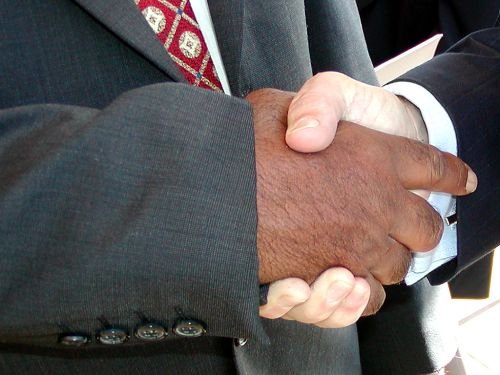
    The hand that signed the bill this morning belongs to President Musoveni. The bill has terrible consequences for gay people in Uganda and stretches its reach to people here in the city of Glasgow.

    This summer, the eyes of the world will be on the city of Glasgow as we welcome sports people from around the world for the Commonwealth Games. It is very clear to me that politicians (and church people t00 – for the churches muscle in on these sports fixtures just like many organisations and businesses do) must not be seen to shake hands with any Ugandan official. In particular, it must be made clear in this city that President Musoveni and other officials of the Ugandan government are not welcome here. That must apply to local council leaders as well as Scottish and UK government ministers. It would be particularly sickening to see SNP leaders welcoming the official representatives of a foreign government which is attempting to criminalize Ugandans living in Scotland just weeks before the Independence Vote.

    Ugandan athletes should be warmly welcomed in Glasgow this summer. They should be greeted with welcoming banners in all the colours of the rainbow.

    Ugandan government officials should be met with a refusal on behalf of all people of goodwill to shake hands.

    That’s a language that is well understood internationally and particularly well understood in Africa.

11 responses to “We should be wary of declaring martyrs”

  1. Eamonn Avatar

    Agree totally. I find myself in a comparable position vis-à-vis the mass canonisations of the ‘martyrs’ of the Spanish Civil War, which assume that all those worthy of commemoration were on the same side.

  2. Michael Russell Avatar

    Anyone killed for professing their faith is a martyr. ISIS is an equal opportunity martyring machine. The various faith communities targeted, including Islamic ones, should build common ground to dismember ISIS. I simply fail to see the point in quibbling about who is a real martyr and who is not.

    1. Kelvin Avatar

      Is it your view that someone is a martyr for Christianity because they cannot recite a verse from the Qur’an?

      It seems to me that whilst some men and women of violence are being claimed to be martyrs if they should be shot by law enforcement agencies whilst pursuing paths of terror that there’s a huge amount to be gained by determining who is a martyr and who isn’t.

      1. Bro David Avatar
        Bro David

        Not being able to explain a quranic verse was merely a way of discerning if someone was not Muslim. However, is it not just as great a presumption to think they weren’t martyrs, as to think that they were.

        The early church seemed to accept that all who were crucified or sent to the lions for their Christianity were martyrs. Perhaps not all did so as a statement of faith, but were nominal Christians caught up with the rest. But the church didn’t seem obliged to footnote who didn’t qualify.

        I’m not sure that I understand why your are hesitant. It seems a quibble. I don’t think anyone is leaning toward canonization here, just speaking of them as a whole.

  3. Jo Avatar
    Jo

    The SEC still keeps the feast of Charles, King and Martyr. I don’t think we get to be too narrow in defining who is or isn’t a martyr.

    1. Kelvin Avatar

      Actually, Jo – that’s not quite right. The SEC keeps the commemoration of “Charles I, King, 1649”

      There’s no mention of him being a martyr in the calendar (and the current calendar superseded and replaced the one in the prayer book). There are plenty of people who are named as martyrs such as Agnes the week before Charles or indeed “Charles Mackenzie of Central Africa, Bishop, Missionary, Martyr, 1862” the very day after Charles.

      It would appear that rather careful thought was given to whether to describe Charles as a martyr and though he is included in the calendar (not least for founding one of our dioceses) any notion of martyrdom is absent.

      1. Jo Avatar
        Jo

        Thanks for the correction, I hadn’t realised there was that detail of difference between the SEC and CofE.

  4. Father David Avatar
    Father David

    Of course, King Charles was a Martyr and is commemorated as such on January 31st each year. The trouble is that Anglicans have no real mechanism for declaring people to be saints or martyrs. Having referred to two recent horrific incidents on the African continent where Christians were slaughtered simply for being Christians, I wonder what the Provost of Glasgow thinks about the Ugandan Martyrs of the 19th century and would you personally regard them to be martyrs? As you know 23 Anglicans and 22 Roman Catholics were killed by the Kabaka for refusing to submit to King Mwanga’s corporal intimacies. The Roman Catholics were beatified in 1920 and canonised in 1964 but what of our Anglican Ugandan brothers – where they equally to be regarded as martyrs, or would you deny them that honorific title?

    1. Kelvin Avatar

      The Scottish Episcopal Calendar is again very clear: “Charles Lwanga and his companions, 1886, Janani Luwum, Bishop, 1977, Martyrs of Uganda”

      I have no idea why anyone would say that the SEC has no means of declaring someone to be a martyr. Not only do we have such a mechanism, we use it.

  5. Father David Avatar
    Father David

    It would be interesting to know how this mechanism works in the SEC in deciding who is eligible to join the noble army of martyrs? Bishop Edward King of Lincoln is widely regarded as a saint South of the Border. I think it was Archbishop Lang who was asked how it was decided that Bishop King had reached sainthood status and the answer was that he was given a Collect, Epistle and Gospel to commemorate his saint’s day – 8th March, the day of his Heavenly Birthday.

  6. Harry Campbell Avatar
    Harry Campbell

    “We strongly condemn such atrocities, whether they are Ethiopians are not,” the Ethiopian communications minister Redwan Hussein told AFP.
    http://www.theguardian.com/world/2015/apr/19/isis-video-purports-to-show-massacre-of-two-groups-of-ethiopian-christians

    What a shame the Archbishop couldn’t have said something similarly inclusive about the victims of the Kenyan massacre, and all such massacres, without caring about what their religion affiliation may or may not have been.

Leave a Reply

Your email address will not be published. Required fields are marked *

Previous Posts

  • Sermon – Lent 1

    The gospel reading that we have just heard is an important one. Like the reading from the book of Genesis that we heard earlier in the service, it takes us straight into a deep strange place. For these readings take us into the strange world of myth and mystery. And if you doubt that, can…

  • What am I listening to?

    Oh, thank you for asking again. It is a long time since you did. I’ve still not exhausted the wonderful Harmonia Mundi 50 Years Boxset that I bought at Christmas. 30 fabulous CDs for about £30. Glorious If I’m bopping, I’m probably bopping along to Elvis Ain’t Dead and sniggering at the phrase Scouting for…

  • Equality Training for Bishops?

    Leaving aside the Hapless Rowan story for a moment, let us just give thanks that John Reaney’s legal case has come to its conclusion. He has been awarded £47000 for the discrimination that he suffered. There has been little sign of remorse from the cleric in question, the Bishop of Hereford, who was given Stonewall’s…

  • Hapless Rowan #2

    The thing is, what the ABC needs right now, is a bunch of clever left-leaning liberal intellectuals in sympathy with the church sorting all this mess out and standing up for him and spinning the story in a different direction. It could be done. Those kind of people are people like me. Such people, he…