
• Listen up! Moocs are the future

    OK listen up. Moocs are the future.

    Now before we go any further, let’s get the usual responses out of the way. The usual responses are twofold:

    1. What’s a mooc?  (Most people)
    2. *rolls eyeballs* (lots of academics, including quite a few in my congregation)

    Firstly, a mooc is a term used for a new form of education that you engage in online. It stands for Massively Open Online Course. Such things have been around for the last couple of years and there’s a good wikipedia page on the concept.

    The basic idea is that you do a course online along with many thousands of other people all at once (massive) which you have easy/free (open) online (online!) access to. It is a way for someone to teach many people. Many, many people. I’ve just finished doing a mooc where a team of three people were attempting to teach 13000 students all around the world.

    But why the eyeball-rolling from clever people?

    Well, any teacher worth their salt is going to say, “Ah, but wait a minute? Hang on there… what do you mean…. that’s not a learning experience that is equivalent to what I can do in a classroom.”

    And you know what? It isn’t.

    However, it is here, it is now and it is going to develop in the future all the same.

    Now, are you thinking you’ve heard all this before – are you thinking this is just a glorified correspondence course? Sure you are. But this is a bit more than that. Typically in a mooc, you get video lectures or other content to download, maybe on a weekly basis. You work through that stuff and you get online quizzes and exercises that you do along the way. If the course is well designed, you get instant feedback on how you are doing and can go back and review any of the bits that you didn’t understand.

    But here’s the thing – it isn’t just you. It is social. There’s a whole bunch of people out there doing the same course as you. And you can get to interact with them on the forums. Indeed, some of the ways that the mooc is assessed may include interaction on the forums. (Cue eyeball rolling from academics who can’t work out that this is the equivalent of giving a mark for interaction in class discussions, which is a relatively common practise in some institutions).

    Then, when all is done, you may well have a final piece of work to submit and this will be marked. But hey, how do you mark 13000 pieces of work? Well, if it is not machine markable material (multiple-guess questions) then the mooc method is to get students to peer review. In the mooc I’ve just participated in, we were encouraged to produce a final video and to pass the course you had to, not only submit your own video, but assess three (or more) others.

    Then you get your certificate and there is much rejoicing.

    Now, here’s where the Eyeball Rollers have started to harumph loudly. “What use is a certificate when no-one qualified has seen the work? Isn’t this the dumb assessing the dumber?”

    Well, the truth is, such a certificate is worth precisely nothing in terms of the educative processes that we have been used to.

    But get this, moocs are not really about what the certificate is worth. The satisfaction comes from having learned something new. Getting the certificate is just icing on the beans. Yet getting that certificate is oddly fulfilling – it is part of the gamification of learning. You get a certificate, you want another. You unlock a level badge, you go  back to try to accomplish the next level.

    Anyway at the end of this post is my certificate from the mooc I recently completed. I don’t care what you think about its value – for me it represents a whole bunch of skills that I just learned. It is for a course that was really for school teachers on Blended Learning – that’s about how to mix learning that takes place in an online setting with more traditional face-to-face teaching. I took the course because I want to be able to offer some online courses at St Mary’s as well doing what we already do. It seemed sensible to do the course and also learn from completing the mooc itself.

    What does this mean for the church at large – well it means that education needs to get slicker. In the same way that new technology has meant that we need to up our game in religious circles in the way we communicate with people, so we need to do the same with how we teach. That scrappy stapled-together church magazine is a great means of communicating but it does so on two levels. On one level, it communicates to those who have always received it that things are carrying on just the same as ever and even lets them know whether they are on the coffee rota on Sunday. To the more casual reader, however, it probably communicates that you are not terribly professional, have low expectations which will carry forward into worship and that you are desperate for someone to join the coffee rota to try to replace the people who are dying off.

    It is the same with education. Sitting around a flipchart with half a dozen people is something that I continue to do. However, increasingly as I do it, I’m aware that the ways in which people learn are changing. Gamification (rewards – yes, sometimes silly little rewards) is here to stay. Blending of online and offline worlds is how people are doing everything from shopping to looking after their health so why shouldn’t that affect how we learn about Things That Matter in church circles? And yes, self directed learning is here to stay.

    There’s new technology on offer here. Who knows what we’re going to do with it?

    And here’s my certificate, which I’m terribly proud of, can you tell?
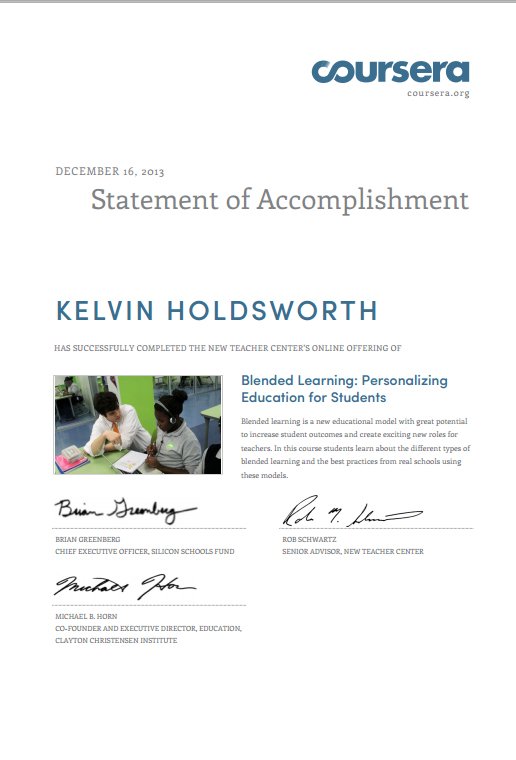
    Blended Learning

11 responses to “We should be wary of declaring martyrs”

  1. Eamonn Avatar

    Agree totally. I find myself in a comparable position vis-à-vis the mass canonisations of the ‘martyrs’ of the Spanish Civil War, which assume that all those worthy of commemoration were on the same side.

  2. Michael Russell Avatar

    Anyone killed for professing their faith is a martyr. ISIS is an equal opportunity martyring machine. The various faith communities targeted, including Islamic ones, should build common ground to dismember ISIS. I simply fail to see the point in quibbling about who is a real martyr and who is not.

    1. Kelvin Avatar

      Is it your view that someone is a martyr for Christianity because they cannot recite a verse from the Qur’an?

      It seems to me that whilst some men and women of violence are being claimed to be martyrs if they should be shot by law enforcement agencies whilst pursuing paths of terror that there’s a huge amount to be gained by determining who is a martyr and who isn’t.

      1. Bro David Avatar
        Bro David

        Not being able to explain a quranic verse was merely a way of discerning if someone was not Muslim. However, is it not just as great a presumption to think they weren’t martyrs, as to think that they were.

        The early church seemed to accept that all who were crucified or sent to the lions for their Christianity were martyrs. Perhaps not all did so as a statement of faith, but were nominal Christians caught up with the rest. But the church didn’t seem obliged to footnote who didn’t qualify.

        I’m not sure that I understand why your are hesitant. It seems a quibble. I don’t think anyone is leaning toward canonization here, just speaking of them as a whole.

  3. Jo Avatar
    Jo

    The SEC still keeps the feast of Charles, King and Martyr. I don’t think we get to be too narrow in defining who is or isn’t a martyr.

    1. Kelvin Avatar

      Actually, Jo – that’s not quite right. The SEC keeps the commemoration of “Charles I, King, 1649”

      There’s no mention of him being a martyr in the calendar (and the current calendar superseded and replaced the one in the prayer book). There are plenty of people who are named as martyrs such as Agnes the week before Charles or indeed “Charles Mackenzie of Central Africa, Bishop, Missionary, Martyr, 1862” the very day after Charles.

      It would appear that rather careful thought was given to whether to describe Charles as a martyr and though he is included in the calendar (not least for founding one of our dioceses) any notion of martyrdom is absent.

      1. Jo Avatar
        Jo

        Thanks for the correction, I hadn’t realised there was that detail of difference between the SEC and CofE.

  4. Father David Avatar
    Father David

    Of course, King Charles was a Martyr and is commemorated as such on January 31st each year. The trouble is that Anglicans have no real mechanism for declaring people to be saints or martyrs. Having referred to two recent horrific incidents on the African continent where Christians were slaughtered simply for being Christians, I wonder what the Provost of Glasgow thinks about the Ugandan Martyrs of the 19th century and would you personally regard them to be martyrs? As you know 23 Anglicans and 22 Roman Catholics were killed by the Kabaka for refusing to submit to King Mwanga’s corporal intimacies. The Roman Catholics were beatified in 1920 and canonised in 1964 but what of our Anglican Ugandan brothers – where they equally to be regarded as martyrs, or would you deny them that honorific title?

    1. Kelvin Avatar

      The Scottish Episcopal Calendar is again very clear: “Charles Lwanga and his companions, 1886, Janani Luwum, Bishop, 1977, Martyrs of Uganda”

      I have no idea why anyone would say that the SEC has no means of declaring someone to be a martyr. Not only do we have such a mechanism, we use it.

  5. Father David Avatar
    Father David

    It would be interesting to know how this mechanism works in the SEC in deciding who is eligible to join the noble army of martyrs? Bishop Edward King of Lincoln is widely regarded as a saint South of the Border. I think it was Archbishop Lang who was asked how it was decided that Bishop King had reached sainthood status and the answer was that he was given a Collect, Epistle and Gospel to commemorate his saint’s day – 8th March, the day of his Heavenly Birthday.

  6. Harry Campbell Avatar
    Harry Campbell

    “We strongly condemn such atrocities, whether they are Ethiopians are not,” the Ethiopian communications minister Redwan Hussein told AFP.
    http://www.theguardian.com/world/2015/apr/19/isis-video-purports-to-show-massacre-of-two-groups-of-ethiopian-christians

    What a shame the Archbishop couldn’t have said something similarly inclusive about the victims of the Kenyan massacre, and all such massacres, without caring about what their religion affiliation may or may not have been.

Leave a Reply

Your email address will not be published. Required fields are marked *

Previous Posts

  • Book Review – Iona Dawn

    Edited by Neil Paynter (Wild Good Publications – www.ionabooks.com £7.99) Getting this book for your next Holy Week might be a wise move. The dramatic events of the days leading up to Easter Sunday are expressed here through biblical readings and the reflections of several well-known Iona Community members. This is a more devotional book…

  • Book Review – The Eye of the Storm

    The Eye of the Storm: Spiritual Resources for the Pursuit of Justice by Kenneth Leech This is an honest spirituality. Kenneth Leech knows that an authentic engagement with God will mean that everything changes. Here is a writer to knows that to separate spirituality from justice is to do great damage to Christian consciousness. A…

  • Book Review – Changing Rural Life

    This new book addresses a number of different themes facing rural life, which we are assured is changing in particular and distinctive ways. Drawing together essays by many contributors, the editors attempt to stimulate reflection on the rural economy, the environment and community issues. Of particular interest is a chapter by the Most Rev Bruce…

  • Book Review – Making Church Buildings Work

    The task of managing creaking church buildings is one which is mostly undertaken by volunteers in almost every community the length and breadth of the country. It is surprising therefore that so little has been written to aid those who take on this mammoth task. Those of us who do undertake such work now have…