
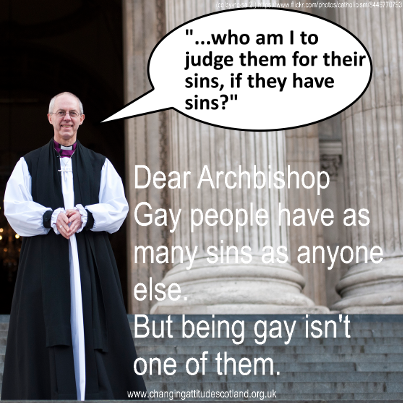
• The Archbishop, the gays and their sins

    Welby fbsize

    One of the things that we’ve learned about Archbishop Justin Welby in recent weeks is that he gets upset about what people write about him on social media.

    He wrote at some length about how what gets written online is upsetting and he’d just prefer to have personal contact with him rather than sounding off online.

    Love often says don’t tweet. Love often says don’t write. Love often says if you must rebuke, then do so in person and with touch – with an arm around the shoulder and tears in your eyes that can be seen by the person being rebuked.

    It is difficult not to have some sympathy for him and I say that as someone who has been really particularly critical of him in the past. It can’t have been much fun seeing my You Condemn It, Archbishop post being relentlessly copied, commented on and retweeted across the Anglican globe.

    And yet the trouble is, there’s no turning the social media clock back. Wanting a world where people don’t comment online about things they care about very deeply is wanting a fantasy world that has no chance of coming back into being.

    Is it possible for leaders and people in public life to do well when the whole internet seems bedeviled with naughty people who will retweet and repost every last mistake that people make?

    I think it is possible, but trying to stand above the fray and condemning people for writing about things you’ve said is hardly going to work nowadays.

    The Archbishop’s complaint about social media came just after someone published a blog post which appeared to suggest that one of the Archbishop’s closest advisors had given a briefing to a group of Anglicans which suggested that Lambeth was now not trying to avoid schism in the Anglican communion but trying to manage it – the expectation being that some parts of the Church of England (the most liberal and the most conservative) would be lost but that a coherent “middle” would survive. It was a deeply shocking position to claim to be true. So shocking that I didn’t believe it at first but have since heard others who were at the briefing confirm that this stuff was indeed said and repeat also that expectation is that there would be bargaining over which buildings to give away, within 10 years.

    That blog post disappeared fairly quickly but internet genies don’t jump back into bottles and the story was out there and really rather embarrassing to all concerned.

    No wonder the Archbishop posted something indicating his discomfort about social media.

    But the real question is whether the social media phenomenon is the problem or whether the archbishop’s problems lie with with the things that social media point towards.

    It must be terribly frustrating to have people pick up on your every utterance and make a big deal out of it.

    The trouble is, in public life, the words you say have a lot of power. Social media posts rebalance that power a little and we should be welcoming the fact that we are a community that cares enough to talk about things rather than trying to remake the Anglican world into one in which bishops speak and everyone else listens uncritically.

    I’ve no doubt that the Archbishop will be embarrassed by posts such as this one which highlight something he said this week. Asked about the usual topic – those pesky gays, a topic that he will be asked about in every interview he ever gives, he is reported to have said:

    I’m listening very, very closely to try to discern what the spirit of God is trying to tell us.

    I see my own selfishness and weakness and think who am I judge them for their sins, if they have sins.

    You can almost hear him dithering over the comma in that last sentence and wondering how this might sound on social media and adding a bit of theological nonsense.

    Of course gay people have sins. However if the first response you make when people ask you about gay people is to talk about sin, then you are going to sound pretty homophobic. And it doesn’t matter whether you like it or you don’t like it, people are going to call attention to it online.

    But is that to be too critical? What strategies could the Archbishop adopt that would help when he is asked about the Usual Topic?

    The most basic thing is to recognise that everything is a conversation these days.

    In fact the Archbishop did quite well in answering a question from a young Muslim who wanted to know whether he would try to convert him to Christianity.

    I am not going to put pressure on you, and I wouldn’t expect you to put pressure on me.

    He could have done far worse with that question than he did.

    Unfortunately, he answered the question on the Usual Topic by immediately talking about sin and then parroting the “sex outside marriage in the C of E is against the rules” line.

    It is a conversation, Archbishop.

    That means we want to talk about it, not be told what the rules are before the conversation gets going.
    It means we want to talk about it, not be told to lay off social media because it gives you the hump.
    It means you can have your say so too and people will listen respectfully and carefully to what you say, but only so long as you engage with people.

    It is a conversation, Archbishop. Everything is a conversation.

    When the first thing you say about gay people is about sin then you can’t expect the conversation to go well.

    It wasn’t helped that the second thing you said was along the lines of “some of my best friends are gay you know?”

    “Marriage is between one man and one woman for life and sexual activity should be confined to marriage, that’s in the Church of England’s laws” he said. “I’m equally aware I have a lot of gay friends and I know gay clergy and they are doing incredible work.”

    You say that stuff and you are going to get people observing that there’s a lot more archbishops who claim that gay people are their friends than gay people who claim archbishops are their friends.

    This could be going better. It could be going much better.

    And it is going to happen again. That question is going to be asked again and again and again.

    There are people out there who can help you find better answers.

    Guess where they are, Archbishop?

    Yes – all over social media.

10 responses to “Sermon for Christ the King 2014”

  1. Julie Mansfield Avatar
    Julie Mansfield

    Kelvin, I follow your blog and I often find your conversations on facebook a lot of fun. But often, too, I don’t really understand what you are saying – such as your last paragraph there; ‘Like love. Like compassion. Like truth. Like hope. Like justice. Like joy. Like peace. Like the Way. Like the very essence of life itself.’ It sounds wonderful but what does it actually mean? Are you saying that the word, ‘God’ is a synonym for other worthwhile words which already have meanings I do understand?

    1. Kelvin Avatar

      What a good question.

      No, I’m not saying that, or at least not quite. I would say that we can’t describe what God is like in language, but one of the closest ways we can come near to talking about God is to talk by analogy – to talk about what God is like.

      The bible is full of times when people use analogy and metaphor to describe the reality of God which we can never completely comprehend.

      In this sermon I’m saying that whilst God may be like a king, God is also like a lot of things that one doesn’t immediately associate with kingship and monarchy. That string of words that you picked out in the sermon are all ways that the bible uses to speak of God. I was using them to do the same.

      Does any metaphor contain or enclose or sum up what we can say or know of God. The answer is always no.

  2. Joy Jones Avatar
    Joy Jones

    I loved your sermon. And have subscribed to your blog.

    No, I have not met the Queen, but I have met the King! And continue to get to know Him more and more every day. His love, peace joy, truth, etc.

    Our priest in North Carolina, said on Sunday, that
    it was hard to tell the difference between sheep and goats.
    Since you live in Scotland, you see a lot of sheep and goats….why did Jesus picked those animals?

    1. Kelvin Avatar

      Thanks for your comments, Joy.

      Actually, I don’t see that many sheep and goats in Great Western Road in the middle of Glasgow. I do see sheep when I drive in the countryside but very rarely goats.

      I think that it is the case that in the Middle East, sheep and goats are pastured together and do sometimes need sorting out. Here in Scotland, sheep and goats (especially wild goats) look very different. However I think in the Middle East, that’s less true.

  3. Julie Mansfield Avatar
    Julie Mansfield

    Kelvin, I’ve only just found your reply! Thanks so much for bothering. I really mean it. I thought you must have just ignored it. Yes, I see what you are saying but… I would say that all those meaningful words in the Bible about what God is like only make sense in the context of understanding who God is. ( i.e. that He came into being as the personification of the worldview of the marginalised Hebrew people, later taken up by Jesus, just as all of the other communities of the ancient Near East had gods representing their worldviews. I study with this bloke here http://www.bibleincartoons.co.uk. ) What I am trying – !! – to say is that God obviously cannot be everyone’s ‘truth’, ‘joy’, ‘justice’ etc because in society there are contradictory ideas about what these things are.

    1. Kelvin Avatar

      Are there contradictory ideas about truth, joy and justice?

      I’m not so sure. Surely we can still speak of these things as though they had some commonly understood meanings.

      1. Julie Mansfield Avatar
        Julie Mansfield

        oh absolutely there are, Kelvin. Just one of many examples: these immigrants in the Mediterranean Sea. Their truth and joy and justice is to be allowed to come and live here. Many folk here get their truth, joy and justice in seeking to put in controls. Whose truth, joy and justice is right? As I see it, the god of the marginalised Hebrews would side with the immigrants but I’m not sure about the Church…

        1. Kelvin Avatar

          I was speaking about God, not ethics. That’s not to say that there isn’t a lot that is interesting to say about the two, but they are quite different I think.

          The fact that people disagree about how to show love. does not, to me at least, negate the assertion that God is love.

      2. Julie Mansfield Avatar
        Julie Mansfield

        Oh absolutely there are contradictory ideas, Kelvin. Just one of many examples; these immigrants in the Mediterranean Sea. Their truth and joy and justice is to be allowed a place to live and thrive. For many folk here, their truth and joy and justice depends on keeping out as many immigrants as possible because they affect housing, medical care, schools etc. As I see it, the Biblical god of the marginalised Hebrews is on the side of the immigrants…

        1. Julie Mansfield Avatar
          Julie Mansfield

          sorry I didn’t see your reply! My difficulty is that you use words as if they have a universal meaning. E.g. love is not a neutral word. there are many different types of love such as conservative paternalistic love or socialist love or non-marginalising love. They are all love. How can God be them all?

Leave a Reply

Your email address will not be published. Required fields are marked *

Previous Posts

  • Good article on Comic Sans

    There’s a good article on Comic Sans on the BBC website. Shhh! – don’t tell the Primus.

  • St Eucalyptus and St Anaglypta

    I’m fascinated by the responses to my post yesterday about the two hypothetical but spiritually blessed congregations of St Eucalyptus and St Anaglypta. Broadly speaking, I think that the responses fall into the following categories: Change the game and ordain someone else (the Ordained Local Ministry option) Change the spirituality of the people and tell…

  • Liturgy Online – again

    I want to return to a question that I began to raise a couple of weeks ago regarding liturgy online. Let me concoct a scenario this time and ask a question. Last year I went down to one of the glorious English Cathedrals to preach. Being robed and up at the sharp end of things,…

  • New Vice-Provost appointed for St Mary’s

    I’m delighted to be able to share the news that a new Vice-Provost has been appointed for St Mary’s. The Rev Canon Cedric Blakey will be taking up the appointment at the start of December and licensed by Bishop Gregor on 5 December 2010. The appointment of a full time priest to work along side…