
Something significant is going on in the Vatican this week. A series of conversations has started about how the Roman Catholic Church deals with issues that arise in family life. It is hugely significant because such conversations simply don’t happen very often. Another interesting thing is that it started off with a questionnaire that was sent out to Roman Catholics allowing them the chance to respond to a set of questions with the idea that their responses would inform the bishops who have gone to Rome to have the conversation.
There will always be people who say, “How can it be that a bunch of supposedly celibate men make decisions about family life?” and there’s no escaping from that question in this day and age. However, the idea of consulting the whole church through a questionnaire was revolutionary.
The questionnaire itself was something of a mixed bag. It felt as though various tectonic plates within the Roman Catholic church were grinding together throughout its production. On the one hand it was an attempt to allow lay catholics to comment on their own situation but on the other, the dominant theme was that church teaching doesn’t change, so how can we present it in a better way to the world. It has been clear in the last week that there are enormous forces at work within the Roman Catholic church which are not all moving in the same direction. Some very highly placed leaders in the church have been disagreeing publicly about the way forward, particularly over whether divorced people should be able to receive communion in church.
With these forces at work, what we don’t know is whether there will be an earthquake or not.
This all has huge significance for non-Roman Catholics too. The reason for this is that the RC Church is such an incredible size in the world and the way it describes personal morality is very often a benchmark and indeed something which people presume all the churches sign up to.
I see a lot of Roman Catholics in St Mary’s. Sometimes they are simply visiting out of interest, for example during Open Church times or Doors Open Day. This week, we had a large funeral and lots of Roman Catholics were present both when the coffin was brought into church and at the funeral itself. During these kinds of times lots of conversations open up about some of the areas which the synod in Rome may tackle.
The reason that the Synod on the Family affects all Christians, not merely Roman Catholics is that we are related – marriages, baptisms, deaths all bring me into contact with Roman Catholics on a regular basis. We are in a sense, all family when it comes to the issues under discussion.
A typical conversation goes like this:
RC Visitor – “…but this looks just like a chapel.”
Self – “Yes, and if you came on Sunday you would recognise the service immediately”.
RC Visitor – “Yes, I know, I went to a requiem recently and it was just the same. It was exactly the same – well apart from the music which was much better. It was the same though and I couldn’t believe it.”
Self – “Yes, I know.”
RC Visitor – “So what are the differences then if there’s no difference in the worship?”
Self – “Well there’s a few differences in how we teach people about social issues”
RC Visitor – “Well what do you tell people about how they are to behave”.
Self – “Well, I don’t think we do that. We give people the chance to make their own minds up about things.”
RC Visitor – “Well do you give communion to people who are divorced?”
Self – “Yes, of course we do.”
RC Visitor – “Well that’s what took my sister away from the church, when the priest told her he would like to give her communion but he wasn’t allowed”
Self – “Yes it is a hard discipline.”
RC Visitor – “Can divorced people get married here?”
Self – “Yes, so long as I get the permission of the Bishop. ”
RC Visitor – “Oh, right. Can I give your number to my sister?
Self – “Yes, here’s my card”.
RC Visitor “And do you say abortion is OK too?”
Self – “No, I don’t say abortion is OK but I do think that sometimes it can be the only option and I think women are best placed to make that decision for themselves”
RC Visitor – “And I suppose you can have gays as priests too?”
Self – “I am a gay priest”.
RC Visitor – “We have gay priests too but they can’t say. It isn’t nice for them”.
Self – “And we have priests who are women too.”
RC Visitor “Oh we don’t have them, just nuns. You don’t have nuns.”
Self – “We have nuns”.
And so it goes.
That isn’t particularly an exaggeration – it is common to discuss all those issues within the space of 10 minutes and I know from other clergy that when they get the chance to talk to Roman Catholic folk, these are some of the very first topics that come up in conversation and some of them at least are the topics coming up in Rome this week.
Our prayers should be with the Roman Catholic bishops in Rome as they attend this special Synod on Family Life. The rules of their church cause some ordinary people great misery and heartache, notwithstanding the very best of intentions.
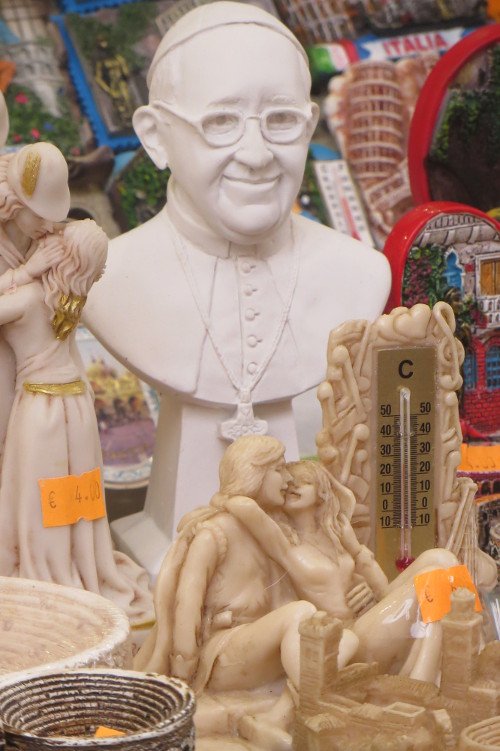
The picture, by the way, is one I took the other week in Verona. I rather like the Pope looking down in benediction on Romeo and Juliet. Not a bad picture to prompt our prayers this week.


Leave a Reply