
• Every Eucharist is a Virtual Eucharist

    Heaven

    Every Eucharist is a virtual Eucharist. Of course it is.

    We know this.

    We experience this.

    We forget this.

    Christianity – at least the bits of Christianity that are worth taking seriously – takes time and space so seriously that it knows that the particular cannot ever express the ultimate. Indeed, time and space are playthings in the hands of the religiously inspired.

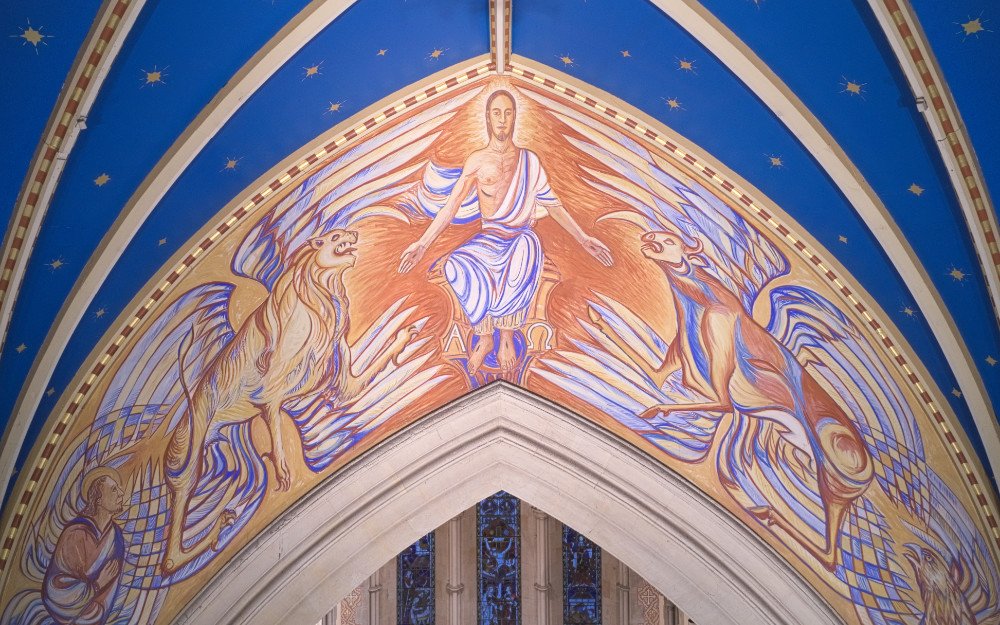
    Over the last few months it hasn’t been possible for my congregation to celebrate the Eucharist together in one space. But when we used to do that, we were never entirely in one space anyway. The very building itself is designed to transport people from the knowledge that they are a few yards from a busy thoroughfare in the Second City of Empire. Taking a few steps inside we find that we are in another place altogether. And in another empire, where the Emperor is servant of all and love is the essense of the law. The conceit that going into church takes you into a divine, heavenly realm is not an idea exclusive to the East. Coming into St Mary’s you are supposed to feel that you are stepping into heaven. It has been built to make you feel that. It has been decorated to make you feel that.  It does make people feel that.

    Whenever I take people into church I almost always hear them express a sense of wonder. We have the wow factor. It has been created by human skill to make you feel that the reality that you experience as you stand in the street is not the only reality that you can experience. It is a space that conveys that love, joy and peace might be possible and it does that without words. It is done with beauty and it takes people a few steps up the stairway to heaven.

    And it is the church playing with reality.

    That experience of going into a holy space and feeling part of something bigger is something common to religions that are divided on all kinds of doctrinal matters. It points to things that are best expressed through virtual reality and religious people are so used to virtual reality that they sometimes forget that it is all around them.

    When people come to the Eucharist in St Mary’s they are at once in Glasgow and simultaneously elsewhere. And elsewhere isn’t even singular either. At the Eucharist in Glasgow we are at one and the same time in an Upper Room in Jerusalem rather a long time ago and at the Wedding Feast of the Lamb at the ultimate consumation of all that is. The Last Supper and the Breakfast at the End of the Universe happen at the same table. At the same time.

    And as we gather at our table, we gather at every table and eat in communion with those who share in the same meal. Our fellowship with them isn’t prevented by circumstance. Our Eucharistic fellowship has never been prevented by circumstance or lack of physical proximity.

    We couldn’t keep the Triduum in Holy Week without virtual reality.

    Without virtual reality it would just be a way of making feet smell less.

    Without virtual reality it would just be a bonfire that would die.

    Christ is the celebrant at every Eucharist no matter which particular celebrant is standing there. Virtual reality becomes interwoven with the reality of the lives that we bring to the table and we are formed and changed and made new. It is how God’s love is expressed.

    This is virtual reality. Every Eucharist is a Virtual Eucharist. Cyberspace is one of the most powerful metaphors for prayer that human beings may ever develop.

    Our bodies are bound by physics.

    God’s love in this world isn’t.

    This is why religious buildings are important. It is also why they are not important.

    Every Eucharist is a Virtual Eucharist.

    Every Eucharist always was a Virtual Eucharist.

    Of course it was.

8 responses to “Synod Review – things you might have missed”

  1. kelvin Avatar

    COMMENTING POLICY

    Someone has tried to leave an anonymous comment making an allegation against someone in our church, that specific instances of bullying have been covered up.

    Whatever my sympathies are about the issue in general or what it being said in this case in particular, it is my view that dealing with this kind of thing through leaving an anonymous comment on a blog is neither an appropriate nor fruitful way forward. Indeed, my guess is that any anti-bullying policy worth its salt would argue that such a comment was itself an inappropriate behaviour in church circles.

    There is a grievance procedure in the church. If the person who left the comment would like to contact me by email or phone, I would be happy to point them towards the most appropriate way of dealing with the unfinished business which is causing them concern.

  2. chris Avatar

    Glad you had the energy to write this up so soon. I’d be interested in the further pursuit of the perceived irregularities with the Reserved Sacrament – but right now I have to get out to an entirely lay-led RS communion …

  3. Sarah Murray Avatar
    Sarah Murray

    It would be great to see the stats more widely available, they are quite difficult to get hold of- having written a paper on secularization and the SEC this year- stats were the first place to start to look at the trends and whether they matched the general trends etc. however I had to go around the houses to find them and then there were some considerable gaps. The census data unfortunately doesn’t include SEC as a separate category and therefore we have no picture from that data either. The patterns and the implications are hugely important picture for the future of the church.

  4. Suz Cate Avatar
    Suz Cate

    First, I offer thanks for the glimpse at a sister-church’s inner workings. Fascinating!

    I’m so sorry to hear that your preparation for ordained ministry included bullying. My personal experience here in TEC of the USA has been entirely supportive and not a bit confrontational (which isn’t to say it hasn’t been probing at times), but I’m aware of colleagues whose “process” has definitely included some bullying, and it is disgraceful.

    Your observation that “by such small mercies that great social change happens” is apt. I’ve seen that principle in action in our diocesan convention, in the pews of multiple parishes, and, more significantly for a native of the southern US, in the hundreds of daily situations in which persons of all different sorts have access to what were in former times the exclusive privileges of white upper class.

    The fact that there are still unspoken and unseen barriers to truly free access (here I’m thinking of my African American friends who feel the need to teach their sons to avoid encounters with the police, for instance) bears witness to the need to include as contributors and consultants the subjects of projects such as the Grosvenor Essay.

    Data matter. Even outliers are meaningless without the context of the data.

  5. Melissa Holloway Avatar
    Melissa Holloway

    I believe in small mercies – but the genesis of the small mercy mentioned here is a voice of leadership and power. In my southern USA diocese, as far as I can tell, the bishop’s voice goes in a different direction.

    Also, there is a ‘once upon a time’ that I think pertains not just to the Anglican Covenant, but also to the full inclusion of gay people in the church:

    “Once upon a time, I would have been on my feet encouraging, threatening, cajoling. I’d have been sowing fear, uncertainty and doubt. I would have been at work behind the scenes, bending people’s ears, twisting people’s arms – ”

    To risk being coy- as I was recently exhorted, we wait for the holy spirit here.

    I rejoice for this episode in the Scottish Episcopal Church, but it doesn’t make me feel so sanguine about my own life in the church. I hope for the day when a bishop I can claim says such a thing in a diocesan convention and then also for the day when everyone just wonders what the nibbles will be.

  6. revruth Avatar

    I wasn’t there nor did I manage to catch up on the talk about the deaconate online, but I wonder if anyone mentioned how this was going to be financed. Ordaining lots of deacons might be a very nice thing indeed, but I wonder if there is money for this. I reckon there are few churches who could afford both, so…?

  7. Christian Avatar
    Christian

    Fr Kelvin,

    It’s sad but not surprising to read your reporting on the SEC Synod debate about ministry. I am utterly perplexed to read that folks in this day and age think that someone coming straight from college knew nothing about the world. This is one of the reasons why I think that SEC will continue to struggle to attract younger members of our communities if they will not be accepeted (given the opportunity) and recognized for who they are and what they bring–Freshness, passion, zeal, strength, etc.

    However, I thank God for the grace and boldness given to our Primus to respond robustly to such ill-thought notions like: [There were calls for more non-stipendiaries working “not in the parish but in the world” and also for us to focus on those who have “life-experience” to be sought for ministry and not those coming “straight from college who know nothing about the world”.]

  8. Julie Avatar
    Julie

    Provost Kelvin

    It was refreshing to read the various reflections in the special edition of Inspires on-line post Synod 2012.
    Where there were any differences, when I compared the above with your Review, from my perspective, I felt your description was more measured & accurate.

Leave a Reply

Your email address will not be published. Required fields are marked *

Previous Posts

  • New Year Predictions 2015

    Here are my New Year Predictions for 2015   Those who voted YES in the Scottish Referendum will continue to behave as though they won. This may be unhelpful. Those who voted NO in the Scottish Referendum will continue to behave as thought he referendum never happened. This may be unhelpful. There will, I fear,…

  • Review of Last Year’s Predictions

    Well, clearly it behoves me to consider last year’s New Year Predictions and see how I did. Remember those people who used to say, “But what is a blog…?” Well this year you are going to be hearing them say, “But what is a mooc…?” Well, I think I got that partially right. Lots of…

  • Review of the year on the blog

    Well, everyone else is doing it so I might as well look back over the last year and pick out a few highlights from the blog. I began the year by declaring that The Archbishop of Canterbury is not a Pope and defended him from other people making demands that he rebuke the Nigerian Church.…

  • Ditching the sermon – a dialogue for Holy Innocents

    This morning I decided to ditch the sermon in favour of a dialogue with Bishop Gregor. It has been a difficult Christmas in Glasgow with a major tragedy in the centre of the city as people were doing their last minute Christmas shopping. Bishop Gregor was himself there in the square just after the incident…